


Pharmacotherapy and psychotherapy for body dysmorphic disorder
- PMID: 19160252
- PMCID: PMC7159283
- DOI: 10.1002/14651858.CD005332.pub2
Pharmacotherapy and psychotherapy for body dysmorphic disorder
Abstract
Background: Body dysmorphic disorder (BDD) is a prevalent and disabling preoccupation with a slight or imagined defect in appearance. Trials have investigated the use of serotonin reuptake inhibitors (SRIs) and cognitive behaviour therapy (CBT) for BDD.
Objectives: To assess the efficacy of pharmacotherapy, psychotherapy or a combination of both treatment modalities for body dysmorphic disorder.
Search strategy: We searched the Cochrane Depression, Anxiety and Neurosis Trial Register (December 2007), the Cochrane Central Register of Controlled Trials (The Cochrane Library Issue 4, 2007), MEDLINE (January 1966 to December 2007), and PsycINFO (1967 to December 2007). Ongoing and unpublished trials were located through searching the metaRegister of Controlled Trials, the CRISP and WHO ICTRP search portals (databases searched in December 2007), and through contacting key researchers and pharmaceutical companies. Additional studies were located through study reference lists.
Selection criteria: Randomised controlled trials (RCTs) of patients meeting DSM or ICD diagnostic criteria for BDD, in which the trials compare pharmacotherapy, psychotherapy or multi-modal treatment groups with active or non-active control groups. Short or long-term trials were eligible.
Data collection and analysis: Two review authors independently assessed RCTs for inclusion in the review, collated trial data, and assessed trial quality. Investigators were contacted to obtain missing data. Summary effect sizes for dichotomous and continuous outcomes were calculated using a random effects model and heterogeneity was assessed.
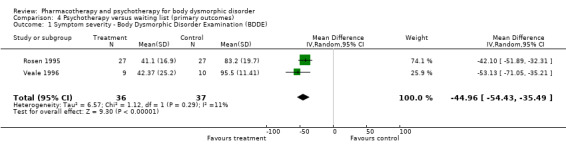
Main results: Two pharmacotherapy and three psychotherapy trials were eligible for inclusion in the review, with data from four short-term RCTs (169 participants) available for analysis. Response data from a single placebo-controlled trial of fluoxetine suggested overall superiority of medication relative to placebo (relative risk (RR) 3.07, 95% CI 1.4 to 6.72, n = 67). Symptom severity was also significantly reduced in the RCTs of fluoxetine and clomipramine (relative to desipramine), as well as in the two CBT trials (WMD -44.96, 95% CI -54.43 to -35.49, n = 73). A low relapse rate (4/22) was demonstrated in one trial of CBT.
Authors' conclusions: Results from the small number of available RCTs suggest that SRIs and CBT may be useful in treating patients with BDD. The findings of these studies need to be replicated. In addition, future controlled studies in other samples, such as adolescents, and using other selective SRIs, as well as a range of psychological therapy approaches and modalities (alone and in combination), are essential in supplementing the sparse data currently available.
Conflict of interest statement
Jonathan Ipser has no known conflicts of interest outside of his employment by the MRC Unit on Anxiety Disorders.
Candice Sander has no known conflicts of interest. Dan Stein has received research grants and/or consultancy honoraria from Astrazeneca, Eli‐Lilly, GlaxoSmithKline, Lundbeck, Orion, Pfizer, Pharmacia, Roche, Servier, Solvay, Sumitomo, and Wyeth. He has participated in a number of ongoing trials, and has presented data from some of these trials on behalf of the sponsoring companies.
Figures


Update of
References
References to studies included in this review
Hollander 1999 {published data only}
-
- Hollander E, Allen A, Kwon J, Aronowitz B, Schmeidler J, Wong C, Simeon D. Clomipramine vs des ipramine crossover trial in body dysmorphic disorder. Archives of General Psychiatry 1999;56:1033‐1039. - PubMed
McKay 1997 {published data only}
-
- McKay D. Two‐year follow‐up of behavioral treatment and maintenance for body dysmorphic disorder. Behavior Modification 1999;23(4):620‐9. - PubMed
-
- McKay D, Todaro J, Neziroglu F, Campisi T, Moritz EK, Yaryura‐Tobias JA. Body dysmorphic disorder: A preliminary evaluation of treatment and maintenance using exposure with response prevention. Behaviour Research and Therapy 1997;35(1):67‐70. - PubMed
Phillips 2002 {published data only}
-
- Phillips KA, Albertini RS, Rasmussen SA. A randomized placebo‐controlled trial of fluoxetine in body dysmorphic disorder. Archives of General Psychiatry 2002;59:381‐388. - PubMed
Rosen 1995 {published data only}
-
- Rosen JC, Reiter J, Orosan P. Cognitive‐behavioral body image therapy for body dysmorphic disorder. Journal of Consulting and Clinical Psychology 1995;63(2):263‐269. - PubMed
Veale 1996 {published data only}
-
- Veale D, Gournay K, Dryden W, Boocock A, Shah F, Willson R, Walburn J. Body dysmorphic disorder: A cognitive behavioural model and pilot randomised controlled trial. Behavioural Research and Therapy 1996;34:717‐729. - PubMed
References to studies excluded from this review
Allen 2008a {published data only}
-
- Allen A, Hadley SJ, Kaplan A, Simeon D, Friedberg J, Priday L, Baker BR, Greenberg JL, Hollander E. An open‐label trial of venlafaxine in body dysmorphic disorder . CNS Spectr ums 2008 ; 13 ( 2 ):138‐44. - PubMed
Campisi 1995 {published data only}
-
- Campisi TA. Exposure and response prevention in the treatment of body dysmorphic disorder. Dissertations Abstracts International: Section B: The Sciences and Engineering 1995;56:7036.
Geremia 2001 {published data only}
-
- Geremia GM, Neziroglu F. Cognitive therapy in the treatment of body dysmorphic disorder. Clinical Psychology and Psychotherapy 2001;8:243‐251.
Gomez‐Perez 1994 {published data only}
-
- Gomez‐Perez JC, Marks IM, Gutierrez‐Fisac JL. Dysmorphobia: Clinical features and outcome with behaviour therapy. European Psychiatry 1994;9:229‐235.
Khemlani‐Patel 2001 {published data only}
-
- Khemlani‐Patel S. Cognitive and behaviour therapy for body dysmorphic disorder: A comparative investigation. Dissertation Abstracts International: Section B: The Sciences and Engineering 2001;62:1087.
Neziroglu 1993 {published data only}
-
- Neziroglu FA, Yaryura‐Tobias JA. Body dysmorphic disorder: phenomenology and case descriptions. Behavioural Psychotherapy 1993;21:27‐36.
Neziroglu 1996 {published data only}
-
- Neziroglu F, McKay D, Todaro J, Yaryura‐Tobias JA. Effects of cognitive behavior therapy on persons with body dysmorphic disorder and comorbid axis II diagnoses. Behavior Therapy 1996;27:67‐77.
Perugi 1996 {published data only}
-
- Perugi G, Giannotti D, Vaio S, Frare F, Saettoni M, Cassano GB. Fluvoxamine in the treatment of body dysmorphic disorder. International Clinical Psychopharmacology 1996;11(4):274‐54. - PubMed
Phillips 1996 {published data only}
-
- Phillips KA. An open study of buspirone augmentation of serotonin‐reuptake inhibitors in body dysmorphic disorder. Psychopharmacology Bulletin 1996;32(1):175‐80. - PubMed
Phillips 1998 {published data only}
-
- Phillips KA, Dwight MM, McElroy SL. Efficacy and safety of fluvoxamine in body dysmorphic disorder. Journal of Clinical Psychiatry 1998;59(4):165‐71. - PubMed
Phillips 2003 {published data only}
-
- Phillips KA, Najjar F. An open‐label study of citalopram in body dysmorphic disorder. Journal of Clinical Psychiatry 2003;64(6):715‐20. - PubMed
Phillips 2005b {published data only}
Phillips 2005c {published data only}
Phillips 2006e {published data only}
Wilhelm 1999 {published data only}
-
- Wilhelm S, Otto MW, Lohr B, Deckersbach T. Cognitive behavior group therapy for body dysmorphic disorder: a case series. Behaviour Research and Therapy 1999;37:71‐75. - PubMed
References to ongoing studies
1K23MH076934‐01A1 {unpublished data only}
-
- Didie ER. Interpersonal Psychotherapy for Body Dysmorphic Disorder. CRISP ( http://crisp.cit.nih.gov/ ) 2008 [accessed on 30 October, 2008]. [Grant Number: 1K23MH076934‐01A1]
NCT00029471 {published data only}
-
- NIMH. Pharmacotherapy of Body Dysmorphic Disorder in Adolescents. controlled‐trials.com 2008 [accessed on 30 October, 2008]. [ClinicalTrials.gov identifier: NCT00029471]
NCT00106223 {published data only}
-
- Wilhelm S. Treatment study investigating new cognitive behavioral therapy treatment manual for body dysmorphic disorder. controlled‐trials.com 2008 [accessed on 30 October, 2008]. [ClinicalTrials.gov identifier :NCT00106223]
NCT00149799 {published data only}
-
- Wilhelm S, Phillips KA. Effectiveness of Escitalopram in the Treatment of Body Dysmorphic Disorder. controlled‐trials.com 2008 [accessed on 30 October, 2008]. [ClinicalTrials.gov identifier: NCT00149799]
NCT00211809 {published data only}
-
- Allen A. CBT as an Adjunct to SRIs in the Treatment of BDD. controlled‐trials.com 2008 [accessed on 30 October, 2008]. [ClinicalTrials.gov identifier: NCT00211809]
NCT00245635 {published data only}
-
- Hollander E. Fluoxetine in Pediatric Body Dysmorphic Disorder. controlled‐trials.com 2008 [accessed on 30 October, 2008]. [ClinicalTrials.gov identifier: NCT00245635]
Additional references
APA 1987
-
- American Psychiatric Association. Diagnostic and Statistical Manual of Mental Disorders. American Psychiatric Association, 1987.
APA 1994
-
- American Psychiatric Association. Diagnostic and statistical manual of mental disorders. 4th Edition. Washington DC: American Psychiatric Association, 1994.
Baxter 1992
-
- Baxter Jr lr, Schwartz JM, Berman KS, Szuba MP, Guze BH, Mazziotta JC, et al. Caudate glucose metabolic rate changes with both drug and behavior therapy for obsessive‐compulsive disorder. Archives of General Psychiatry 1992;49:681‐689. - PubMed
Beck 1987
-
- Beck AT, Steer R. Beck Depression Inventory: Manual. San Antonio, Texas: Psychological Corporation, 1987.
Bohne 2002a
-
- Bohne A, Wilhelm S, Keuthen NJ, Florin I, Baer L, Jenike MA. Prevalence of body dysmorphic disorder in a German college student sample . Psychiatry Res earch 2002 ; 109 ( 1 ):101‐4. - PubMed
Bohne 2002b
-
- Bohne A, Keuthen NJ, Wilhelm S, Deckersbach T, Jenike MA. Prevalence of symptoms of body dysmorphic disorder and its correlates: a cross‐cultural comparison . Psychosomatics 2002 ; 43 ( 6 ):486‐90. - PubMed
Deckersbach 2000
-
- Deckersbach T, Savage CR, Phillips KA, Wilhelm S, Buhlmann U, Rauch SL, Baer L, Jenike MA. Characteristics of memory dysfunction in body dysmorphic disorder. Journal of the International Neuropsychological Society 2000;6(6):673‐81. - PubMed
Deeks 2001
-
- Deeks JJ, Altman DG, Bradburn MJ. Statistical methods for examining heterogeneity and combining results from several studies in meta‐analysis.. In: Egger M, Davey SG, Altman DG editor(s). Systematic Reviews in Health Care: Meta‐Analysis in Context. 2nd Edition. BMJ Publication Group, 2001.
Deeks 2008
-
- Deeks J, Higgins JPT, Altman D. editors. Analysing and presenting results. In: Higgins JPT, Green S editor(s). Cochrane Reviewers’ Handbook 5.0.0 [updated February] Section 9;. Chichester, UK: John Wiley & Sons, Ltd., 2008.
Eisen 1998
-
- Eisen JL, Phillips KA, Baer L, Beer DA, Atala KD, Rasmussen SA. The Brown Assessment of Beliefs Scale: Reliability and Validity. American Journal of Psychiatry 1998;155(1):102‐108. - PubMed
Eisen 2004
Faravelli 1997
-
- Faravelli C, Salvatori S, Galassi F, Aiazza L, Drei C, Cabras P. Epidemiology of somatoform disorders: A community survey in Florence. Social Psychiatry and Psychiatric Epidemiology 1997;32(1):24‐29. - PubMed
Feusner 2007
-
- Feusner JD, Townsend J, Bystritsky A, Bookheimer S. Visual information processing of faces in body dysmorphic disorder. Archives of General Psychiatry 2007;64(12):1417‐25. - PubMed
Foa 1995
-
- Foa EB, Kozak MJ, Goodman WK, Hollander E, Jenike MA, Rasmussen SA. DSM‐IV field trial: obsessive‐compulsive disorder. American Journal of Psychiatry 1995;152(1):90‐6. - PubMed
Frare 2004
-
- Frare F, Perugi G, Ruffolo G, Toni C. Obsessive‐compulsive disorder and body dysmorphic disorder: a comparison of clinical features. European Psychiatry 2004;19:292‐298. - PubMed
Gabbay 2003
-
- Gabbay V, Asnis GM, Bello JA, Alonso CM, Serras SJ, O’Dowd MA. New onset of body dysmorphic disorder following frontotemporal lesion. Neurology 2003;61:123‐5. - PubMed
Goodman 1989
-
- Goodman WK, Price LH, Rasmussen SA, Mazure C, Fleischmann RL, Hill CL, Heninger GR, Charney DS. The Yale‐Brown Obsessive Compulsive Scale. I. Development, use, and reliability . Arch ives of Gen eral Psychiatry. 1989 ; 46 ( 11 ):1006‐11. - PubMed
Gury 1999
-
- Gury C, Cousin F. Pharmacokinetics of SSRI antidepressants: half‐life and clinical applicability. Encephale 1999;25(5):470‐476. - PubMed
Guy 1976
-
- Guy W. ECDEU assessment manual for psychopharmacology. Washington, DC: U.S. National Institute of Health, 1976.
Hamilton 1959
-
- Hamilton M. The assessment of anxiety states by rating. British Journal of Medical Psychology 1959;32:50‐5. - PubMed
Hanes 1998
-
- Hanes KR. Neuropsychological performance in body dysmorphic disorder. Journal of the International Neuropsycholog ical Society 1998;4(2):167‐71. - PubMed
Higgins 2003
Higgins 2008
-
- Higgins JPT, Altman DG. Assessing risk of bias in included studies. In: Higgins JPT, Green S editor(s). Cochrane Reviewers’ Handbook 5.0.0 [updated February] Section 8;. Chichester, UK: John Wiley & Sons, Ltd., 2008.
Higgins 2008b
-
- Higgins JPT, Deeks J, Altman D, Editors. Special topics in statistics. Higgins JPT, Green S, Editors. Cochrane Handbook for Systematic Reviews of Interventions 5.0.0 [updated February] Section 16. Chichester, UK: John Wiley & Sons Ltd, 2008.
Hollander 1989
-
- Hollander E, Liebowitz MR, Winchel R, Klumker A, Klein DF. Treatment of body‐dysmorphic disorder with serotonin reuptake blockers. American Journal of Psychiatry 1989;146(6):768‐770. - PubMed
Hollander 1993
-
- Hollander E, Phillips KA. Body image and experience disorders: Body dysmorphic and depersonalization disorders. In: Hollander E editor(s). Obssessive Compulsive‐Related Disorders. Washington DC: American Psychiatric Press, 1993:17‐48.
Hunter 2000
-
- Hunter JE, Schmidt FL. Fixed effects vs. random effects meta‐analysis models: Implications for cumulative research knowledge. International Journal of Selection and Assessment 2000;8(4):275‐292.
Ipser 2006
-
- JC Ipser, P Carey, Y Dhansay, N Fakier, S Seedat, DJ Stein. Pharmacotherapy augmentation strategies in treatment‐resistant anxiety disorders . Cochrane Database of Systematic Reviews 2006 , Issue 4 . - PubMed
Leon 1999
-
- Leon AC, Solomon DA, Mueller TI, Turvey CL, Endicott J, Keller MB. The Range of Impaired Functioning Tool (LIFE‐RIFT): a brief measure of functional impairment. Psychological Medicine 1999;29:869‐878. - PubMed
Marks 1988
-
- Marks I, Mishan J. Dysmorphophobic avoidance with disturbed bodily perception: A pilot study of exposure therapy. British Journal of Psychiatry 1988;152:674‐678. - PubMed
McKay 1999
-
- McKay D. Two‐year follow‐up of behavioral treatment and maintenance for body dysmorphic disorder. Behavior Modification 1999;23(4):620‐629. - PubMed
Moher 2001
-
- Moher D, Schulz KF, Altman DG. The CONSORT statement: revised recommendations for improving the quality of reports of parallel group randomized trials . Lancet 2001 ; 357 ( 9263 ):1191‐4. - PubMed
Moncrieff 2001
-
- Moncrieff J, Churchill R, Drummond DC, McGuire H. Development of a quality assessment instrument for trials of treatments for depression and neurosis. International Journal of Methods in Psychiatric Research 2001;10(3):126‐33.
Montgomery 1979
-
- Montgomery SA, Asberg M. A new depression scale designed to be sensitive to change. British Journal of Psychiatry 1979;134:382‐9. - PubMed
NICE 2005
-
- National Institute for Clinical Excellence. The management of post traumatic stress disorder in primary and secondary care . London : NICE , 2005 .
Phillips 1991
-
- Phillips KA. Body dysmorphic disorder: The distress of imagined ugliness. American Journal of Psychiatry 1991;148(9):1138‐1149. - PubMed
Phillips 1993
-
- Phillips KA, McElroy SL, Keck PE, Pope HG, Hudson JI. Body dysmorphic disorder: 30 cases of imagined ugliness. American Journal of Psychiatry 1993;150(2):302‐308. - PubMed
Phillips 1994
-
- Phillips KA, McElroy SL, Keck PE, Hudson JI, Pope HG. A comparison of delusional and nondelusional body dysmorphic disorder in 100 cases. Psychopharmacology Bulletin 1994;30(2):179‐186. - PubMed
Phillips 1997a
-
- Phillips KA, Diaz SF. Gender differences in body dysmorphic disorder. Journal of Nervous and Mental Disease 1997;185(9):570‐577. - PubMed
Phillips 1997b
-
- Phillips KA, Hollander E, Rasmussen SA, Aronowitz BR, DeCaria C, Goodman WK. A severity rating scale for body dysmorphic disorder: Development, reliability and validity of a modified version of the Yale‐Brown Obsessive Compulsive Scale. Psychopharmacology Bulletin 1997;33(1):17‐22. - PubMed
Phillips 2000
-
- Phillips KA, Dufresne RG, Wilkel CS, Vittorio CC. Rate of body dysmorphic disorder in dermatology patients. Journal of the American Academy of Dermatology 2000;42:436‐441. - PubMed
Phillips 2001a
-
- Phillips KA, Albertini RS, Siniscalchi JM, Khan A, Robinson M. Effectiveness of pharmacotherapy for body dysmorphic disorder: A chart‐review study. Journal of Clinical Psychiatry 2001;62:721‐727. - PubMed
Phillips 2001b
-
- Phillips KA, Grant J, Siniscalchi J, Albertini RS. Surgical and nonpsychiatric medical treatment of patients with body dysmorphic disorder. Psychosomatics 2001;42(6):504‐510. - PubMed
Phillips 2004
Phillips 2006
Phillips 2006b
Phillips 2006c
Phillips 2006d
Rauch 2003
-
- Rauch SL, Phillips KA, Segal E, Makris N, Shin LM, Whalen PJ, Jenike MA, Caviness VS Jr, Kennedy DN. A preliminary morphometric magnetic resonance imaging study of regional brain volumes in body dysmorphic disorder. Psychiatry Research 2003;122(1):13‐9. - PubMed
Robinson 2002
-
- Robinson KA, Dickersin K. Development of a highly sensitive search strategy for the retrieval of reports of controlled trials using PubMed. International Journal of Epidemiology 2002;31:150‐153. - PubMed
Rosen 1996
-
- Rosen JC, Reiter J. Development of the Body Dysmorphic Disorder Examination. Behaviour Research and Therapy 1996;34(9):755‐766. - PubMed
Rosen 1998
-
- Rosen JC, Ramirez E. A comparison of eating disorders and body dysmorphic disorders on body image and psychological adjustment. Journal of Psychosomatic Research 1998;44(3/4):441‐449. - PubMed
Saxena 2001
-
- Saxena S, Winograd A, Dunkin JJ. A retrospective review of clinical characteristics and treatment response in body dysmorphic disorder versus obsessive‐compulsive disorder . Journal of Clinical Psychiatry 2001 ; 62 :67‐72. - PubMed
Schneier 1994
-
- Schneier FR, Heckelman LR, Garfinkel R, Campeas R, Fallon BA, Gitow A, Street L, Bene D, Liebowitz MR. Functional impairment in social phobia . J ournal of Clin ical Psychiatry 1994 ; 55 ( 8 ):322‐31. - PubMed
Sheehan 1996
-
- Sheehan DV, Harnett‐Sheehan K, Raj BA. The measurement of disability. International Clinical Psychopharmacology 1996;11 Suppl 3:89‐95. - PubMed
Spitzer 1996
-
- Spitzer R, Williams J, Gibbons M. Instructional manual for the structured clinical interview for DSM‐IV.. New York: New York State Psychiatric Institute., 1996.
Tignol 2007
-
- Tignol J, Biraben‐Gotzamanis L, Martin‐Guehl C, Grabot D, Aouizerate B. Body dysmorphic disorder and cosmetic surgery: Evolution of 24 subjects with a minimal defect in appearance 5 years after their request for cosmetic surgery. Euro pean Psychiatry 2007; 22 ( 8 ):520‐4. - PubMed
Veale 1996b
-
- Veale D, Boocock A, Gournay K, Dryden W, Shah F, Willson R, Walburn J. Body dysmorphic disorder: A survey of fifty cases. British Journal of Psychiatry 1996;169:196‐201. - PubMed
Veale 2000
-
- Veale, D. Outcome of cosmetic surgery and 'DIY' surgery in patients with body dysmorphic disorder. Psychiatric Bulletin 2000;24:218‐221.
Verbeke 2000
-
- Verbeke M, Molenberghs G. Linear Mixed Models for Longitudinal Data. New York: Springer, 2000.
Ware 1993
-
- Ware JE Jr. SF‐36 Health Survey Manual and Interpretation Guide. Boston: Health Institute New England Medical Center, 1993.
WHO 1975
-
- World Health Organisation. The ICD‐9 Classification of Mental and Behavioural Disorders: Clinical Descriptions and Diagnostic Guidelines. Geneva, Switzerland: World Health Organisation, 1975.
WHO 1992
-
- World Health Organisation. ICD‐10 International statistical classification of diseases and related health problems : based on the International Statistical Classification of Diseases and Related Health Problems, ICD. Geneva: World Health Organisation, 1992.
Williams 2006
-
- Williams J, Hadjistavropoulos T, Sharpe D. A meta‐analysis of psychological and pharmacological treatments for Body Dysmorphic Disorder. Beha viour Research and Therapy 2006;44:99‐111. - PubMed
Publication types
MeSH terms
Substances
LinkOut - more resources
Full Text Sources
