


Combination formoterol and inhaled steroid versus beta2-agonist as relief medication for chronic asthma in adults and children
- PMID: 19160317
- PMCID: PMC4023854
- DOI: 10.1002/14651858.CD007085.pub2
Combination formoterol and inhaled steroid versus beta2-agonist as relief medication for chronic asthma in adults and children
Abstract
Background: Formoterol has a fast onset of action and can therefore be used to relieve symptoms of asthma. A combination inhaler can deliver formoterol with different doses of inhaled corticosteroid; when used as a reliever both drugs will be delivered more frequently when asthma symptoms increase. This has the potential to treat both bronchoconstriction and inflammation in the early stages of exacerbations.
Objectives: To assess the efficacy and safety of combined inhalers containing both formoterol and an inhaled corticosteroid when used for reliever therapy in adults and children with chronic asthma.
Search strategy: We last searched the Cochrane Airways Group trials register in April 2008.
Selection criteria: Randomised trials in adults and children with chronic asthma, where a combination inhaler containing formoterol and inhaled corticosteroid is compared with fast-acting beta2-agonist alone for the relief of asthma symptoms. This should be the only planned difference between the trial arms.
Data collection and analysis: Two review authors independently extracted the characteristics and results of each study. Authors or manufacturers were asked to supply unpublished data in relation to primary outcomes.
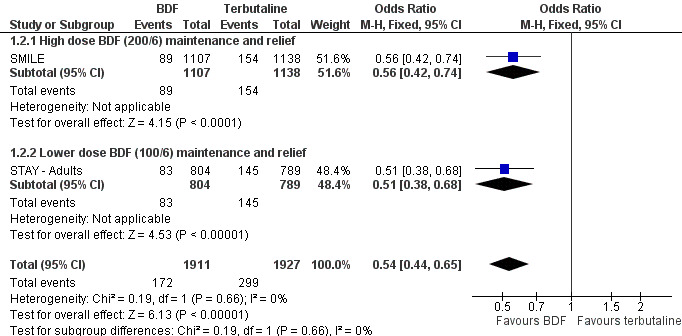
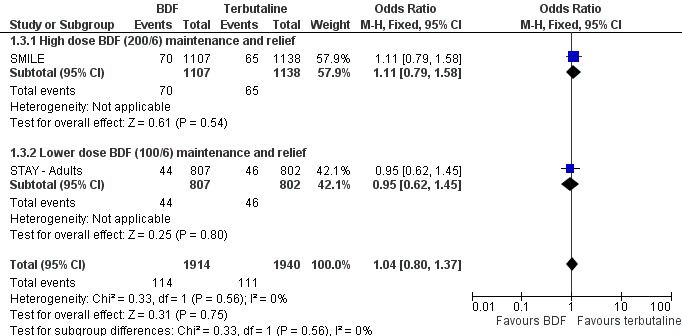
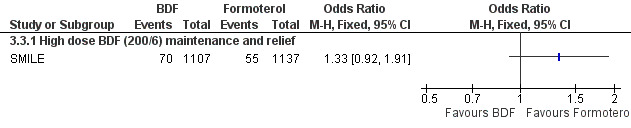
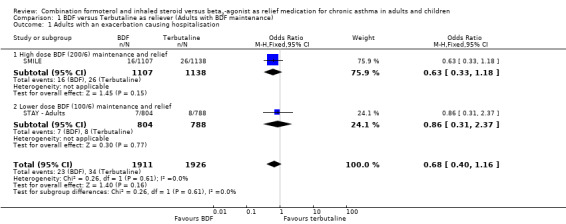
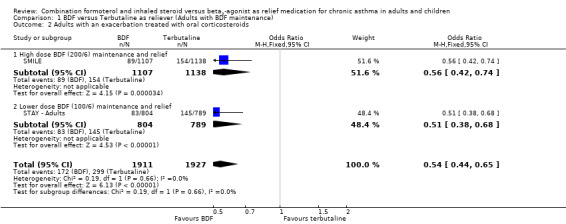
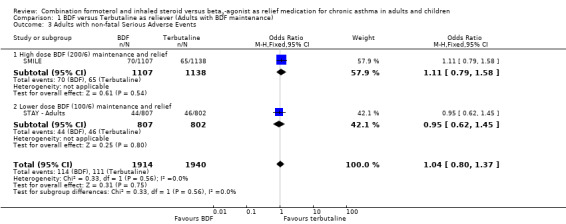
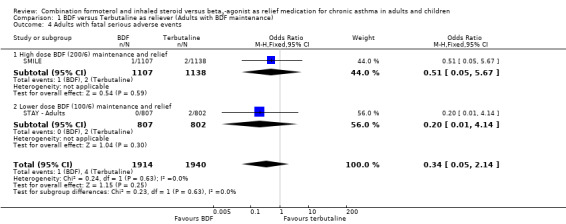
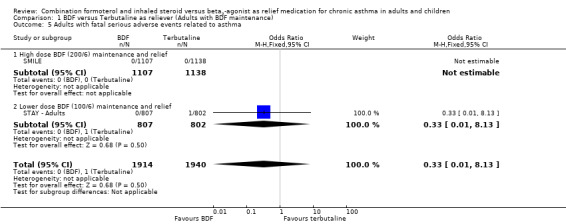
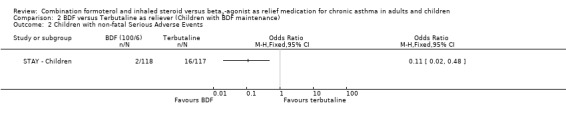
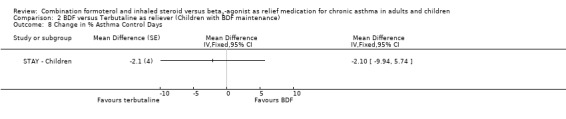
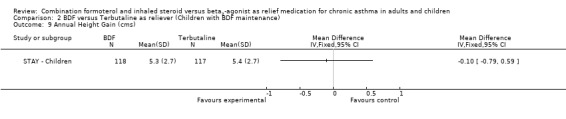
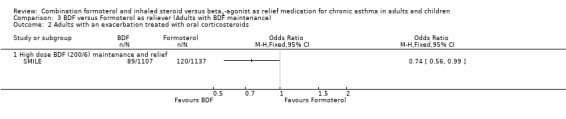
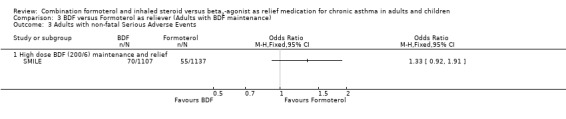
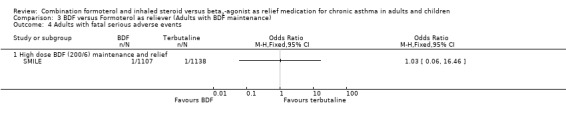
Main results: Three trials involving 5905 participants were included. In patients with mild asthma who do not need maintenance treatment, no clinically important advantages of budesonide/formoterol as reliever were found in comparison to formoterol as reliever.Two studies enrolled patients with more severe asthma who were not controlled on high doses of inhaled corticosteroids (around 700 mcg/day in adults), and had suffered a clinically important asthma exacerbation in the past year. Hospitalisations related to asthma in the two studies comparing budesonide/formoterol for maintenance and relief with the same dose of budesonide/formoterol for maintenance with terbutaline for relief yielded an odds ratio of 0.68 (95% CI 0.40 to 1.16), which was not a statistically significant reduction. One adult study found a reduction in exacerbations requiring oral corticosteroids compared to terbutaline, odds ratio 0.56 (95% CI 0.42 to 0.74) and the study in children found less serious adverse events with budesonide/formoterol used for maintenance and relief. There was no significant difference in annual growth in children using budesonide/formoterol reliever in comparison to terbutaline.
Authors' conclusions: In mild asthma it is not yet known whether patients who use a budesonide/formoterol inhaler for relief of asthma symptoms derive any clinically important benefits. In more severe asthma, one study that enrolled patients who were not controlled on quite high doses of inhaled corticosteroids, and had suffered an exacerbation in the previous year, demonstrated a reduction in the risk of exacerbations that require oral corticosteroids with budesonide/formoterol for maintenance and relief in comparison with budesonide/formoterol for maintenance and terbutaline or formoterol for relief. The incidence of serious adverse events in children was also less using budesonide/formoterol for maintenance and relief in one study, which similarly enrolled children who were not controlled on medium to high doses of inhaled corticosteroids, and compared to terbutaline relief with an explorative maintenance dose of budesonide/formoterol that is not approved for treatment.
Conflict of interest statement
None known.
Figures












Update of
References
References to studies included in this review
SMILE {published and unpublished data}
-
- Rabe F, Atienza T, Magyar P, Larsoon P, Jorup C, Lalloo G. A new combination therapeutic approach challenging the current dogma of using inhaled corticosteroids as maintenance only to control asthma. European Respiratory Journal 2006;28(Suppl 50):666s.
-
- Rabe KF, Atienza T, Magyar P, Larsson P, Jorup C, Lalloo UG. Effect of budesonide in combination with formoterol for reliever therapy in asthma exacerbations: a randomised controlled, double‐blind study. Lancet 2006;938(9537):744‐53. - PubMed
SOMA {published and unpublished data}
-
- Haahtela T, Tamminen K, Malmberg LP, Zetterstrom O, Karjalainen J, Yla‐Outinen H, et al. Formoterol as needed with or without budesonide in patients with intermittent asthma and raised NO levels in exhaled air: A SOMA study. European Respiratory Journal 2006;28(4):748‐55. - PubMed
-
- Haahtela T, Tamminen K, Malmberg P, Karjalainen J, Yia‐Outinen H, Zetterstrom O, et al. As‐needed treatment with a b2‐agonist/ corticosteroid combination in mild intermittent asthma (SOMA). European Respiratory Journal 2005;26(Suppl 45):Abstract No. 1722.
STAY ‐ Adults {published and unpublished data}
-
- Bateman ED, Palmqvist M, Juniper EF, Zhu Y, Ekstrom T. Single inhaler therapy with budesonide/formoterol has superior efficacy to fixed‐dose budesonide/formoterol or a higher dose of budesonide alone. American Thoracic Society 100th International Conference, May 21‐26, 2004, Orlando. 2004.
-
- Bruce SA, Scherer YK. Maintenance and symptom relief with budesonide plus formoterol reduced severe asthma exacerbations. Evidence‐Based Nursing 2005;8(3):78. - PubMed
-
- Jönsson BG, Berggren FE, Svensson K, O'Byrne PM. Budesonide and formoterol in mild persistent asthma compared with doubling the dose of budesonide ‐ a cost‐effectiveness analysis. European Respiratory Journal. 2001; Vol. 18, issue Suppl 33:517s.
-
- Jönsson BG, Berggren FE, Svensson K, O'Byrne PM. Economic results of adding formoterol to budesonide in mild persistent asthma. European Respiratory Journal 2001; Vol. 18, issue Suppl 33:331s.
-
- O'Byrne PM. Acute asthma intervention: Insights from the STAY study. Journal of Allergy and Clinical Immunology 2007;119(6):1332‐6. - PubMed
STAY ‐ All ages {published and unpublished data}
-
- O'Byrne PM, Bisgaard H, Godard PP, Pistolesi M, Palmqvist M, Zhu Y, et al. Budesonide/formoterol combination therapy as both maintenance and reliever medication in asthma. American Journal of Respiratory & Critical Care Medicine 2005;171(2):129‐36. - PubMed
STAY ‐ Children {published and unpublished data}
-
- Bisgaard H, Hultquist C. Budesonide/formoterol for maintenance and as needed ‐ a new approach to asthma management in children [Abstract]. European Respiratory Journal 2005;26(Suppl 49):Abstract No. 1060.
-
- Bisgaard H, Roux P, Bjamer D, Dymek A, Vermeulen JH, Hultquist C. Budesonide/formoterol maintenance plus reliever therapy ‐ a new strategy in pediatric asthma. Chest 2006;130(6):1733‐43. - PubMed
-
- O'Byrne PM. Acute asthma intervention: Insights from the STAY study. Journal of Allergy & Clinical Immunology 2007;119(6):1332‐6. - PubMed
-
- O'Byrne PM, Bisgaard H, Godard PP, Pistolesi M, Palmqvist M, Zhu Y, et al. Budesonide/formoterol combination therapy as both maintenance and reliever medication in asthma. American Journal of Respiratory & Critical Care Medicine 2005;171(2):129‐36. - PubMed
-
- SD‐039‐673. Efficacy and safety of budesonide/formoterol (Symbicort) Turbuhaler® as Single Therapy in patients with mild‐moderate asthma. Comparison with Symbicort Turbuhaler and Pulmicort® Turbuhaler as maintenance therapy, both complemented with Bricanyl® Turbuhaler (STAY). http://www.astrazenecaclinicaltrials.com 2006.
References to studies excluded from this review
Balanzat 2004 {published data only}
-
- Balanzat A, Centanni S, Palmqvist M, Rabe K. Budesonide/formoterol single inhaler therapy reduces over reliance on rapid acting reliever medication [Abstract]. European Respiratory Journal 2004;24(Suppl 48):344s.
Bousquet 2007 {unpublished data only}
-
- Astrazeneca (D5890C00002). Efficacy and safety of Symbicort®Turbuhaler®160/4.5 mcg/inhalation, two inhalations twice daily plus as‐needed compared with Seretide™ Diskus™ 50/500 mcg/inhalation, one inhalation twice daily plus terbutaline Turbuhaler 0.4 mg/inhalation as‐needed ‐ a 6‐month, randomised, double‐blind, parallel‐group, active controlled, multinational phase IIIB study in adult and adolescent patients with persistent asthma. AstraZeneca Clinical Trials Register 2006, issue www.astrazenecaclinicaltrials.com (accessed 21/02/2008).
-
- Bousquet J, Boulet L‐P, Peters MJ, Magnussen H, Quiralte J, Martinez‐Aguilar NE, et al. Budesonide/formoterol for maintenance and relief in uncontrolled asthma vs. high‐dose salmeterol/fluticasone. Respiratory Medicine 2007;101(12):2437‐46. - PubMed
COMPASS {published and unpublished data}
-
- AstraZeneca. SYM/050/DEC2007. Data on File.
-
- Bleecker ER, Postma DS, Lawrance R, Meyers DA, Ambrose H, Goldman M. Effect of polymorphisms in the beta2‐adrenergic receptor gene (ADRB2) on response to long‐acting beta2‐agonist (LABA) therapy. Journal Allergy and Clinical Immunology 2007;119(2):523.
-
- Buhl R, Vogelmeier C. Budesonide/formoterol maintenance and reliever therapy: a new treatment approach for adult patients with asthma. Current Medical Research and Opinion 2007;23(8):1867‐78. - PubMed
-
- Kuna P, Peters MJ, Buhl R. Budesonide/formoterol as maintenance and reliever therapy reduces asthma exacerbations a higher maintenance dose of budesonide/versus formoterol or salmeterol/fluticasone. European Respiratory Journal 2006;28(Suppl 50):205s.
COSMOS {published data only}
-
- Buhl R, Vogelmeier C. Budesonide/formoterol maintenance and reliever therapy: a new treatment approach for adult patients with asthma. Current Medical Research and Opinion 2007;23(8):1867‐78. - PubMed
-
- D'Urzo A, Vogeimeier C, Jaspal M, Merino JM, Boulet S. Symbicort (budesonide/formoterol) for both maintenance and relief reduces the exacerbation burden compared with titration of seretide (salmeterol/fluticasone) in patients with asthma, a real life stud. American Thoracic Society International Conference; May 20‐25; San Diego, California. 2005:Poster G24.
-
- Johansson G, Andreasson EB, Larsson PE, Vogelmeier CF. Cost effectiveness of budesonide/formoterol for maintenance and reliever therapy versus salmeterol/fluticasone plus salbutamol in the treatment of asthma. Pharmacoeconomics 2006;24(7):695‐708. - PubMed
-
- Vogelmeier C, D'Urzo A. Maintenance plus as‐needed budesonide/formoterol vs salmeterol/fluticasone in a real‐life setting. European Respiratory Journal 2005;26(Suppl 49):Abstract No. 2770.
-
- Vogelmeier C, D'Urzo A, Jaspal M, Merino JM, Johansson G, Boulet S. Symbicort for both maintenance and relief reduces exacerbations compared with a titration of Seretide (Advair) in patients with asthma: a real life study. American Thoracic Society 2005 International Conference; May 20‐25; San Diego, California. 2005:Poster F67.
D5890C00003 {published data only}
-
- AstraZeneca (D5890C00003). A comparison of the control of asthma inflammation provided by Symbicort turbuhaler 160/4.5 mcg/inhalation bid plus as‐needed versus symbicort turbuhaler 320/9 mcg/inhalation bid plus Pulmicort turbuhaler 400 mcg/dose bid plus terbutaline turbuhaler 0.4 mg/inhalation as‐needed. www.clinicaltrials.gov 2006:http://www.clinicaltrials.gov/ct/show/NCT00244608 (Accessed 22 February 2008).
Ind 2002 {published data only}
-
- Ind PW, Villasante C, Shiner RJ, Pietinalho A, Boszormenyi NG, Soliman S, et al. Safety of formoterol by Turbuhaler as reliever medication compared with terbutaline in moderate asthma. European Respiratory Journal 2002;20(4):859‐66. - PubMed
Jenkins 2007 {published data only}
-
- Jenkins CR, Marks GB, Gibson PG, Wark PAB, Thien FC, Belousova EG, et al. A randomised controlled trial of two algorithms for maintaining asthma control on long‐acting bronchodilators (LABA) and inhaled corticosteroids (ICS). Thoracic Society of Australia and New Zealand Annual Scientific Meeting, 25‐28 March 2007, Auckland. 2007:Abstract TP044.
Jonkers 2006 {published data only}
Loukides 2005 {published data only}
-
- Loukides S, Papageorgiou M, Karokis A, Zervas E, Christodoulopoulou A, Papageorgiou N, et al. Single inhaler therapy (SiT) with budesonide/formoterol (BUD/FUM) is effective in asthma control. European Respiratory Journal. 2005:http://www.ersnet.org/ers/lr/browse/default.aspx (accessed 22 February 2008).
Lundborg 2006 {published data only}
-
- Astrazeneca (LD‐039‐0003). An open, randomized, parallel‐group, multicentre, phase IIIB study to evaluate the efficacy of Symbicort® Turbuhaler® single inhaler therapy (SiT), given as a low maintenance dose once or twice daily plus as needed, compared to a higher maintenance dose of Symbicort Turbuhaler given twice daily plus Oxis® Turbuhaler® as needed during 24 weeks in asthmatic patients (LD‐039‐0003). AstraZeneca Clinical Trials Register 2006, issue http://www.astrazenecaclinicaltrials.com/ncmprint.aspx?type=article&... (accessed 21st February 2008).
-
- Lundborg M, Wille S, Bjermer L, Tilling B, Lundgren M, Telg G, et al. Maintenance plus reliever budesonide/formoterol compared with a higher maintenance dose of budesonide/formoterol plus formoterol as reliever in asthma: An efficacy and cost‐effectiveness study. Current Medical Research & Opinion 2006;22(5):809‐21. - PubMed
MONO {published data only}
-
- AstraZeneca (D5890L00008). MONO: Symbicort single inhaler therapy and conventional best standard treatment for the treatment of persistent asthma in adolescents and adults. clinicaltrials.gov 2006:http://www.clinicaltrials.gov/ct/show/NCT00242411 (Accessed 12 April 2006).
-
- Soes‐Petersen U, Dahl R, Kava T, Lei Y, Dam N. Budesonide/formoterol maintenance and reliever therapy compared with conventional best sound treatment [Abstract]. European Respiratory Society Annual Congress, Berlin, Germany, October 4‐8 2008:[P3508].
NCT00235911 {unpublished data only}
-
- AstraZeneca (BN‐00S‐0011). Symbicort single inhaler therapy for asthma in a general practice setting. www.clinicaltrials.gov 2005:http://www.clinicaltrials.gov/ct/show/NCT00235911 (Accessed 22 February 2008).
NCT00252863 {unpublished data only}
-
- Worth H. DESOLO ‐ SiT Peri‐Launch: a comparison of symbicort single inhaler therapy and conventional best practice for the treatment of persistent asthma in adults. clinicaltrials.gov 2005:http://www.clinicaltrials.gov/ct/show/NCT00252863 (Accessed 22nd February 2008).
Richter 2007 {published data only}
-
- Richter K, Hartmann U, Metzenauer P, Magnussen H. Randomised trial comparing as‐needed versus regular treatment with formoterol in patients with persistent asthma. Respiratory Medicine 2007;101(3):467‐75. - PubMed
Riemersma 2008 {published data only}
-
- Riemersma RA, Postma DS, Molen T. Budesonide/formoterol maintenance and reliever therapy for asthma in general practice [Abstract]. American Thoracic Society International Conference, May 16‐21, 2008, Toronto 2008:A612[#A29].
SALTO {published data only}
-
- AstraZeneca (D5890L00009). SALTO ‐ symbicort single inhaler therapy use in adolescent adults and adults with persistent asthma. www.clinicaltrials.gov 2006:http://www.clinicaltrials.gov/ct/show/NCT00290264 (Accessed 22 February 2008).
-
- Louis R, Joos G, Michiels A, Vandenhoven G, Schepper I, Duquenne V. Budesonide/formoterol maintenance and reliever therapy compared to conventional best practice in the treatment of persistent asthma [Abstract]. European Respiratory Journal 2007; Vol. 30, issue Suppl 51:616s [P3617].
Scicchitano 2004 {published data only}
-
- Scicchitano R, Aalbers R, Ukena D, Manjra A, Fouquert L, Centann S, et al. Efficacy and safety of budesonide/formoterol single inhaler therapy versus a higher dose of budesonide in moderate to severe asthma. Current Medical Research & Opinion 2004;20(9):1403‐18. - PubMed
SOLO {published data only}
-
- Sears MR, Boulet L‐P, Laviolette M, FitzGerald J Mark, Bai TR, et al. Budesonide/formoterol maintenance and reliever therapy: impact on airway inflammation in asthma. European Respiratory Journal 2008:Epub: doi: 10.1183/09031936.00104007. - PubMed
-
- Sears R, Boulet L‐P, Laviolette M, FitzGerald JM, Bai R, SmiljanicGeorijev N, et al. Budesonide/formoterol maintenance and reliever therapy for asthma compared to conventional best practice a randomised real life study. European Respiratory Journal 2006;28(Suppl 50):613s.
Sovani 2008 {published data only}
Stallberg 2008 {published and unpublished data}
-
- AstraZeneca. Symbicort and Health Economics in a Real Life Evaluation – SHARE – A randomised, open‐label, parallel‐group, multicentre study to assess the. http://www.astrazenecaclinicaltrials.com/ (accessed 21 April 2008).
-
- Stallberg B, Ekstrom T, Neij F, Olsson P, Skoogh BE, Wennergren G, et al. A real‐life cost‐effectiveness evaluation of budesonide/formoterol maintenance and reliever therapy in asthma. Respiratory Medicine 2008;102(10):1360‐70. - PubMed
-
- Stallberg B, Lofdahl CG, Skoogh BE, Wennergren G, Olsson P, Neij F, et al. Budesonide/formoterol maintenance and reliever therapy effective treatment at a lower cost [Abstract]. European Respiratory Society Annual Congress, Berlin, Germany, October 4‐8. 2008:[4424].
STEAM {published data only}
-
- Astrazenca (SD‐039‐0667). Efficacy and Safety of Symbicort® Turbuhaler® as Single Therapy in Patients with Mild to Moderate Asthma ‐ STEAM (SD‐039‐0667). Astrazeneca Clinical Trials Register 2005:http://www.astrazenecaclinicaltrials.com (accessed 20th February 2008).
-
- Rabe KF, Pizzichini E, Stallberg B, Romero S, Balanzat AM, Atienza T, et al. Budisonide/formoterol in a single inhaler for maintenance and relief in mild‐to‐moderate asthma: A randomized, double‐blind trial. Chest 2006;129:245‐56. - PubMed
STYLE {published data only}
-
- AstraZeneca (D5890L00014). STYLE ‐ symbicort single inhaler therapy vs. conventional therapy in treatment of persistent asthma. www.clinicaltrials.gov 2005:http://www.clinicaltrials.gov/ct/show/NCT00252824 (Accessed 22 February 2008).
Tattersfield 2001 {published data only}
-
- Berggren F, Ekström T. A cost‐effectiveness study comparing the as‐needed use of formoterol (Oxis) and terbutaline (Bricanyl) in patients with moderate to severe asthma. Respiratory Medicine 2001;98(9):753‐8. - PubMed
-
- Tattersfield AE, Löfdahl CG, Postma DS, Eivindson A, Schreurs AGM, Rasidakis A, et al. Comparison of formoterol and terbutaline for as‐needed treatment of asthma: a randomised trial. Lancet 2001;357(9252):257‐61. - PubMed
Additional references
Adams 2008
Bisgaard 2003
-
- Bisgaard H. Effect of long‐acting Beta2 agonists on exacerbation rates of asthma in children. Pediatric Pulmonology 2003; Vol. 36, issue 5:391‐8. [1099‐0496] - PubMed
BTS 2003
-
- British Thoracic Society. British Guideline on Asthma Management. Thorax 2003;58(Suppl 1):1‐83.
Cates 2008
Cates 2008a
FitzGerald 2004
Greenstone 2005
-
- Greenstone IR, Ni Chroinin MN, Masse V, Danish A, Magdalinos H, Zhang X, et al. Combination of inhaled long‐acting beta2‐agonists and inhaled steroids versus higher dose of inhaled steroids in children and adults with persistent asthma. Cochrane Database of Systematic Reviews 2005, Issue 4. [DOI: 10.1002/14651858.CD005533] - PubMed
Handbook 2006
-
- Higgins JPT, Green S, editors. Assessment of study quality. Cochrane Handbook for Systematic Reviews of Interventions 4.2.6 [updated September 2006]; Section 6. http://www.cochrane.org/resources/handbook/hbook.htm (accessed 14 February 2008). Chichester: John Wiley & Sons Ltd, 2006.
Harrison 2004
-
- Harrison T, Oborne J, Newton S, Tattersfield A. Doubling the dose of inhaled corticosteroid to prevent asthma exacerbations: randomised controlled trial. Lancet 2004; Vol. 363, issue 9405:271‐5. - PubMed
Higgins 2003
Ni Chroinin 2005
-
- Ni Chroinin M, Greenstone IR, Danish A, Magdolinos H, Masse V, Zhang X, et al. Long‐acting beta2‐agonists versus placebo in addition to inhaled corticosteroids in children and adults with chronic asthma. Cochrane Database of Systematic Reviews 2005, Issue 4. [DOI: 10.1002/14651858.CD005535] - PubMed
Palmqvist 2001
-
- Palmqvist M, Arvidsson P, Beckman O, Peterson S, Lotvall J. Onset of bronchodilation of budesonide/formoterol vs. salmeterol/fluticasone in single inhalers. Pulmonary Pharmacology & Therapeutics 2001;14(1):29‐34. - PubMed
Salpeter 2006
-
- Salpeter SR, Buckley NS, Ormiston TM, Salpeter EE. Meta‐analysis: effect of long‐acting beta‐agonists on severe asthma exacerbations and asthma‐related deaths. Annals of Internal Medicine 2006;144(14):904‐12. - PubMed
Tattersfield 1999
-
- Tattersfield AE, Postma DS, Barnes PJ, Svensson K, Bauer CA, O'Byrne PM, et al. Exacerbations of asthma: a descriptive study of 425 severe exacerbations. The FACET International Study Group. American Journal of Respiratory & Critical Care Medicine 1999;160(2):594‐9. - PubMed
Walters 2007
www.nntonline.net [Computer program]
-
- Cates C. Visual Rx. Cates C, 2001.
Publication types
MeSH terms
Substances
Grants and funding
LinkOut - more resources
Full Text Sources
Medical
Miscellaneous
