


Acupuncture for tension-type headache
- PMID: 19160338
- PMCID: PMC3099266
- DOI: 10.1002/14651858.CD007587
Acupuncture for tension-type headache
Update in
-
Acupuncture for the prevention of tension-type headache.Cochrane Database Syst Rev. 2016 Apr 19;4(4):CD007587. doi: 10.1002/14651858.CD007587.pub2. Cochrane Database Syst Rev. 2016. PMID: 27092807 Free PMC article.
Abstract
Background: Acupuncture is often used for tension-type headache prophylaxis but its effectiveness is still controversial. This review (along with a companion review on 'Acupuncture for migraine prophylaxis') represents an updated version of a Cochrane review originally published in Issue 1, 2001, of The Cochrane Library.
Objectives: To investigate whether acupuncture is a) more effective than no prophylactic treatment/routine care only; b) more effective than 'sham' (placebo) acupuncture; and c) as effective as other interventions in reducing headache frequency in patients with episodic or chronic tension-type headache.
Search strategy: The Cochrane Pain, Palliative & Supportive Care Trials Register, CENTRAL, MEDLINE, EMBASE and the Cochrane Complementary Medicine Field Trials Register were searched to January 2008.
Selection criteria: We included randomized trials with a post-randomization observation period of at least 8 weeks that compared the clinical effects of an acupuncture intervention with a control (treatment of acute headaches only or routine care), a sham acupuncture intervention or another intervention in patients with episodic or chronic tension-type headache.
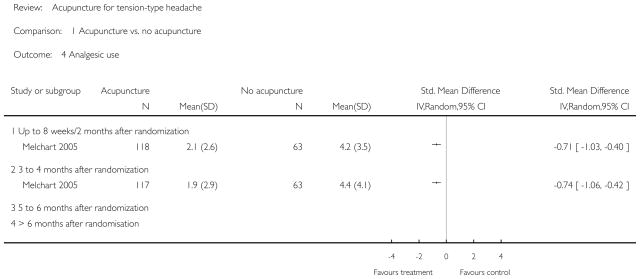
Data collection and analysis: Two reviewers checked eligibility; extracted information on patients, interventions, methods and results; and assessed risk of bias and quality of the acupuncture intervention. Outcomes extracted included response (at least 50% reduction of headache frequency; outcome of primary interest), headache days, pain intensity and analgesic use.
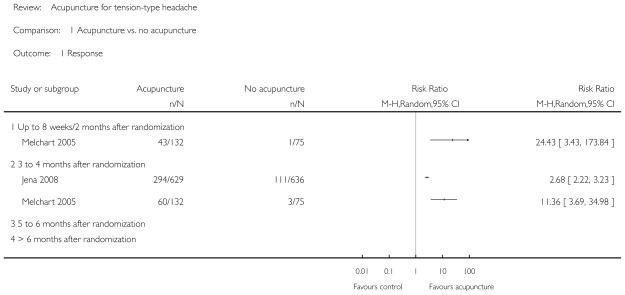
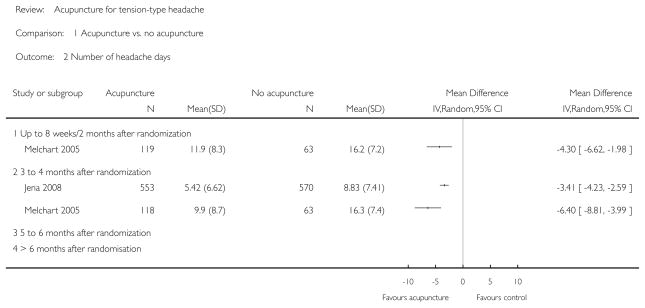
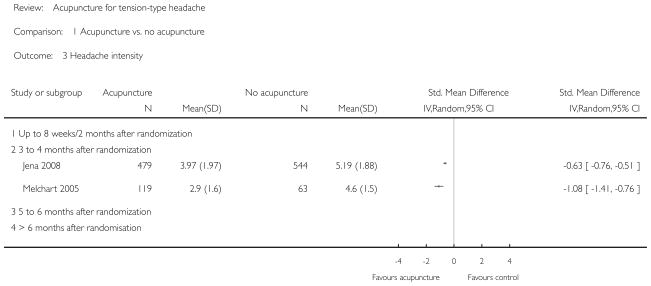
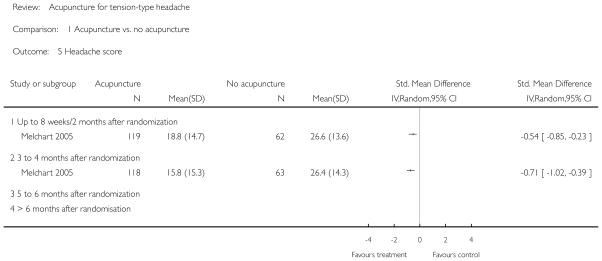
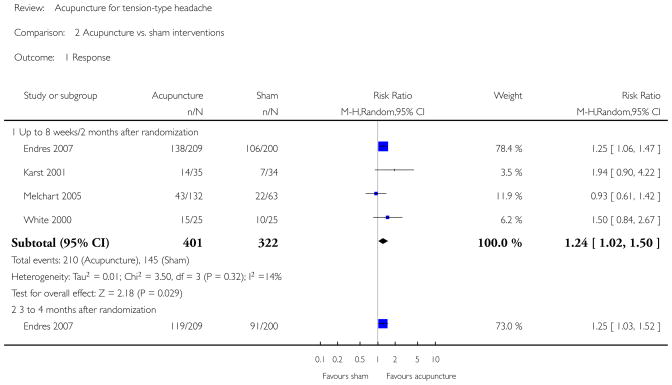
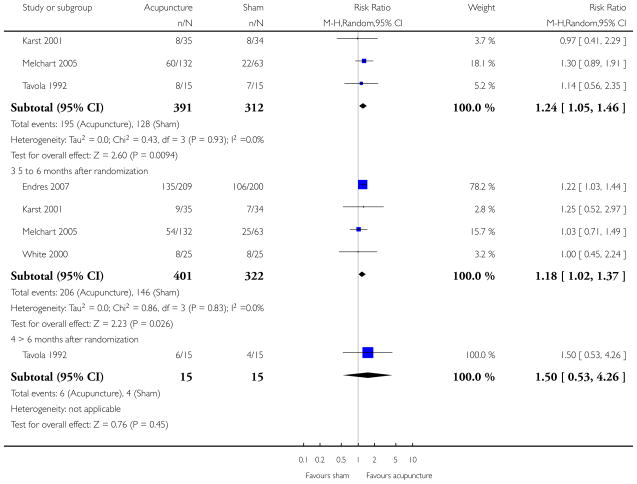
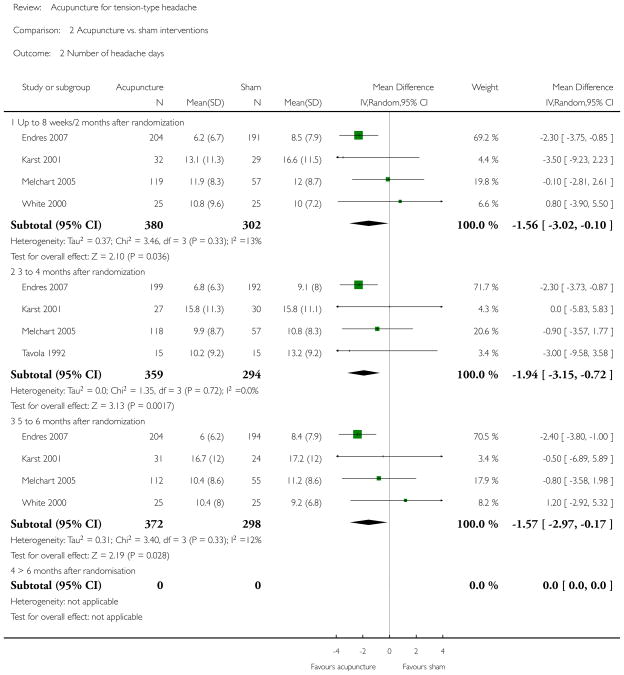
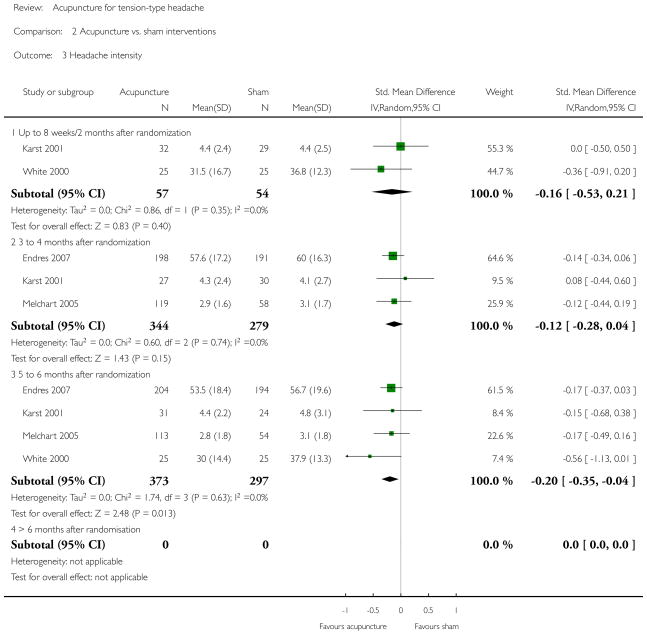
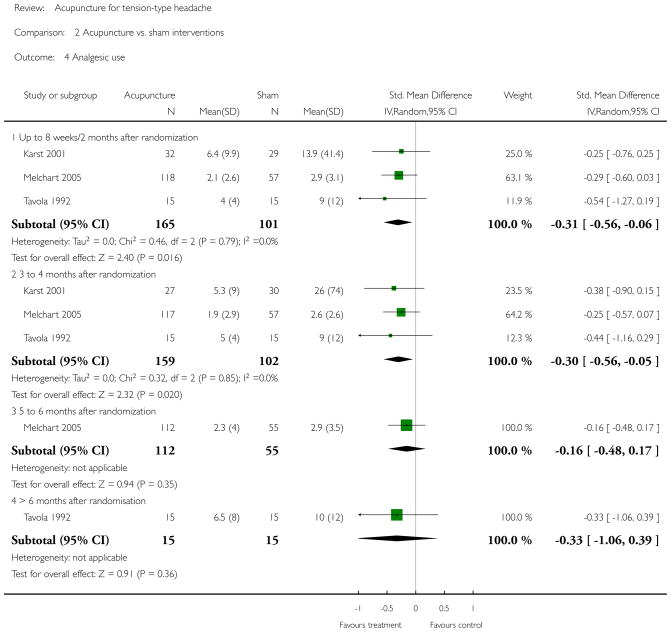
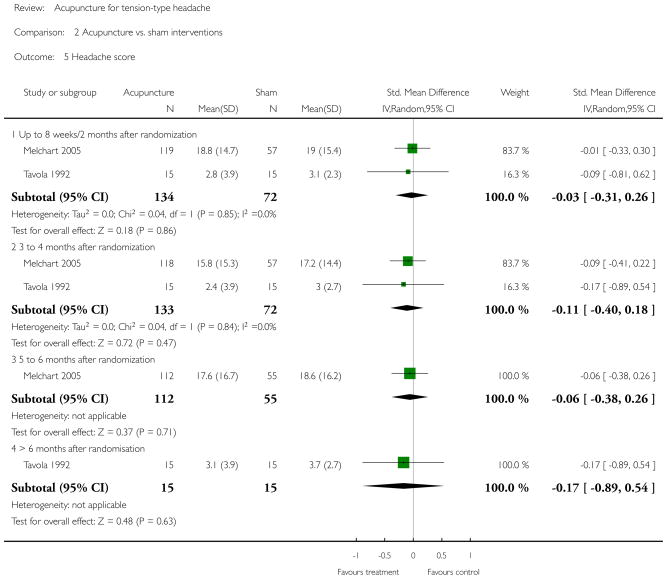
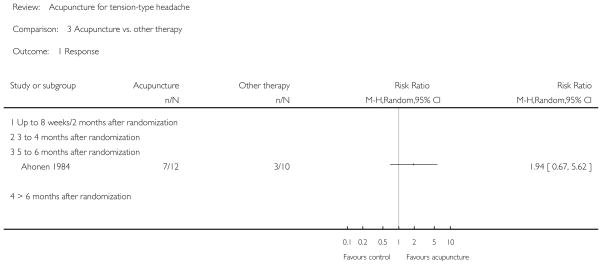
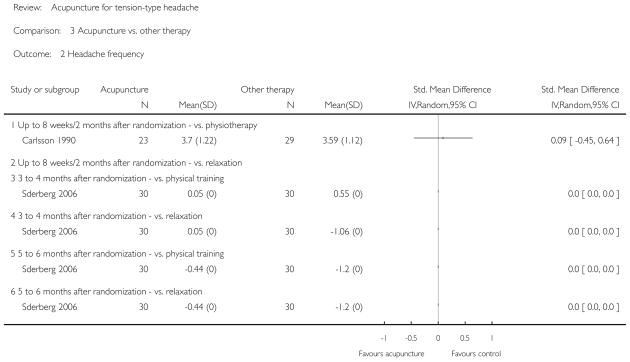
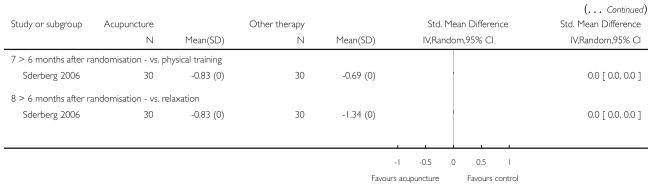
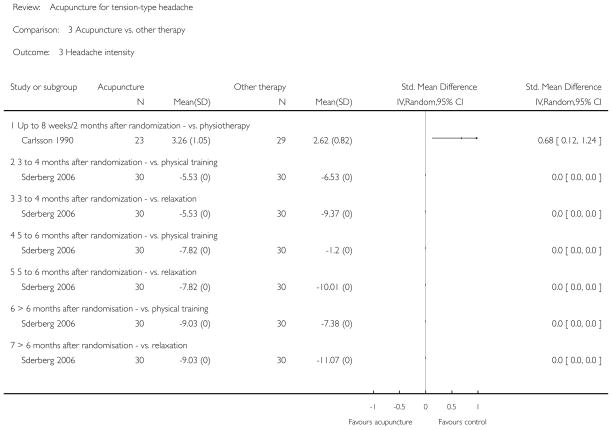
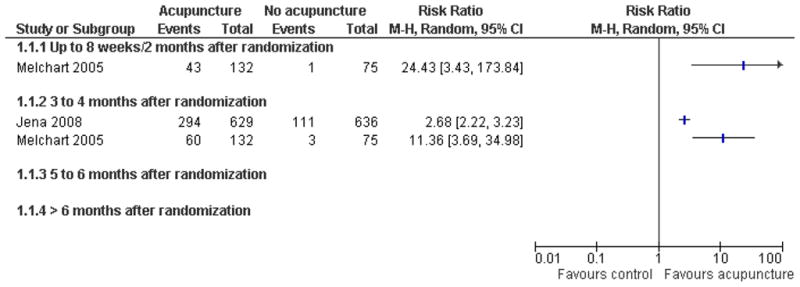
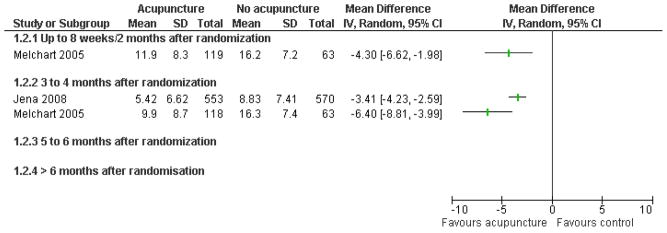
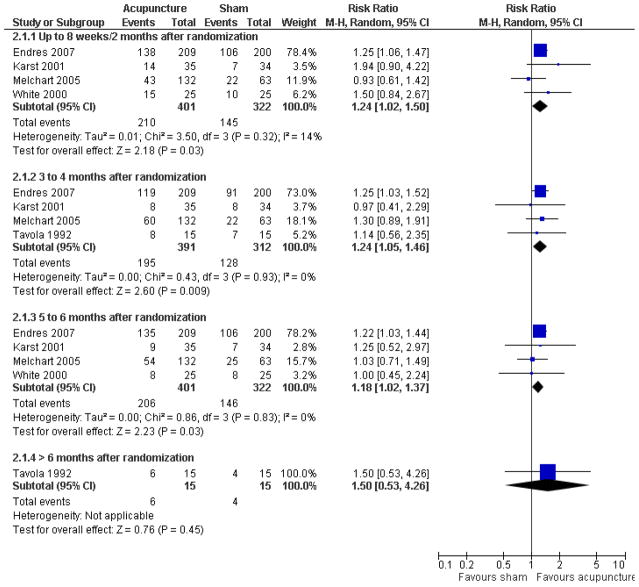
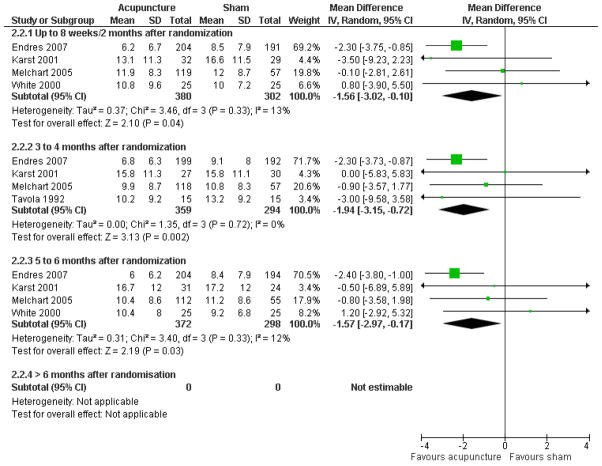
Main results: Eleven trials with 2317 participants (median 62, range 10 to 1265) met the inclusion criteria. Two large trials compared acupuncture to treatment of acute headaches or routine care only. Both found statistically significant and clinically relevant short-term (up to 3 months) benefits of acupuncture over control for response, number of headache days and pain intensity. Long-term effects (beyond 3 months) were not investigated. Six trials compared acupuncture with a sham acupuncture intervention, and five of the six provided data for meta-analyses. Small but statistically significant benefits of acupuncture over sham were found for response as well as for several other outcomes. Three of the four trials comparing acupuncture with physiotherapy, massage or relaxation had important methodological or reporting shortcomings. Their findings are difficult to interpret, but collectively suggest slightly better results for some outcomes in the control groups.
Authors' conclusions: In the previous version of this review, evidence in support of acupuncture for tension-type headache was considered insufficient. Now, with six additional trials, the authors conclude that acupuncture could be a valuable non-pharmacological tool in patients with frequent episodic or chronic tension-type headaches.
Figures
Comment in
-
Commentary on the Cochrane review of acupuncture for tension-type headache.Explore (NY). 2009 Nov-Dec;5(6):356-8. doi: 10.1016/j.explore.2009.09.007. Explore (NY). 2009. PMID: 19913766 No abstract available.
References
References to studies included in this review
-
- Ahonen E, Hakumäki M, Mahlamäki S, Partanen J, Riekkinen P, Sivenius J. Acupuncture and physiotherapy in the treatment of myogenic headache patients: pain relief and EMG activity. In: Bonica JJ, Lindblom U, Iggo A, editors. Advances in pain research and therapy. Vol. 5. New York: Raven Press; 1983. pp. 571–6.
- Ahonen E, Hakumäki M, Mahlamäki S, Partanen J, Riekkinen P, Sivenius J. Effectiveness of acupuncture and physiotherapy on myogenic headache: a comparative study. Acupuncture and Electro-Therapeutics Research. 1984;9(3):141–50. [MEDLINE: 6151786] - PubMed
-
- Carlsson J, Augustinsson LE, Blomstrand C, Sullivan M. Health status in patients with tension headache treated with acupuncture or physiotherapy. Headache. 1990;30(9):593–9. [MEDLINE: 2262314] - PubMed
- Carlsson J, Fahlcrantz A, Augustinsson LE. Muscle tenderness in tension headache treated with acupuncture or physiotherapy. Cephalalgia. 1990;10(3):131–41. [MEDLINE: 2245458] - PubMed
- Carlsson J, Rosenhall U. Oculomotor disturbances in patients with tension headache treated with acupuncture or physiotherapy. Cephalalgia. 1990;10(3):123–9. [MEDLINE: 2245457] - PubMed
- Carlsson J, Wedel A, Carlsson GE, Blomstrand C. Tension headache and signs and symptoms of craniomandibular disorders treated with acupuncture or physiotherapy. Pain Clinic. 1990;3:229–38.
-
- Endres HG, Böwing G, Diener HC, Lange S, Maier C, Molsberger A, et al. Acupuncture for tension-type headache: a multicentre, sham-controlled, patient- and observer-blinded, randomised trial. Journal of Headache and Pain. 2007;8(5):306–14. [MEDLINE: 17955168] - PMC - PubMed
- Molsberger AF, Boewing G, Diener HC, Endres HG, Kraehmer N, Kronfeld K, et al. Designing an acupucture study: the nationwide, randomized, controlled German Acupuncture Trials on migraine and tension-type headache. Journal of Alternative and Complementary Medicine. 2006;12(3):237–45. [MEDLINE: 16646722] - PubMed
-
- Jena S, Becker-Witt C, Brinkhaus B, Selim D, Willich S. Effectiveness of acupuncture treatment for headache - the Acupuncture in Routine Care Study (ARC-Headache) Focus on Alternative and Complementary Therapies. 2004;9 (Suppl):17.
- Jena S, Witt CM, Brinkhaus B, Wegscheider K, Willich SN. Acupuncture in patients with headache. Cephalalgia. 2008;28(9):969–79. - PubMed
- Witt CM, Reinhold T, Jena S, Brinkhaus B, Willich SN. Costeffectiveness of acupuncture treatment in patients with headache. Cephalalgia. 2008;28(4):334–45. [MEDLINE: 18315686] - PubMed
-
- Fink M, Gutenbrunner C, Rollnik J, Karst M. Credibility of a newly designed placebo needle for clinical trials in acupuncture research. Forschende Komplementärmedizin und Klassische Naturheilkunde. 2001;8(6):368–72. [MEDLINE: 11799305] - PubMed
- Karst M, Reinhard M, Thum P, Wiese B, Rollnik J, Fink M. Needle acupuncture in tension-type headache: a randomized, placebo-controlled study. Cephalalgia. 2001;21(6):637–42. [MEDLINE: 11531895] - PubMed
- Karst M, Rollnik JD, Fink M, Reinhard M, Piepenbrock S. Pressure pain threshold and needle acupuncture in chronic tensiontype headache - a double-blind placebo-controlled study. Pain. 2000;88(2):199–203. - PubMed
References to studies excluded from this review
-
- Airaksinen O, Pontinen PJ. Effects of the electrical stimulation of myofascial trigger points with tension headache. Acupuncture and Electro-Therapeutics Research. 1992;17(4):285–90. [MEDLINE: 1362038] - PubMed
-
- Allais G, de Lorenzo C, Quirico PE, Lupi G, Airola G, Mana O, et al. Non-pharmacological approaches to chronic headaches: transcutaneous electrical nerve stimulation, laser therapy and acupuncture in transformed migraine treatment. Neurological Sciences. 2003;24 (Suppl 2):S138–42. - PubMed
-
- Annal N, Soundappan SV, Subbu Palaniappan KMC, Chandrasekar S. Introduction of transcutaneous, low-voltage, non-pulsatile direct current (DC) therapy for migraine and chronic headaches. A comparison with transcutaneous electrical nerve stimulation (TENS) Headache Quarterly. 1992;3(4):434–37.
-
- Borglum-Jensen L, Melsen B, Borglum-Jensen S. Effect of acupuncture on headache measured by reduction in number of attacks and use of drugs. Scandinavian Journal of Dental Research. 1979;87(5):373–80. [MEDLINE: 395626] - PubMed
-
- Coeytaux RR, Kaufman JS, Kaptchuk TJ, Chen W, Miller WC, Callahan LF, et al. A randomized controlled trial of acupuncture for chronic daily headache. Headache. 2005;45(9):1113–23. [MEDLINE: 16178942] - PubMed
Additional references
-
- Bodeker G, Ong CK, Grundy C, Burford G, Shein K. WHO global atlas of traditional, complementary and alternative medicine. Kobe, Japan: WHO Center for Health Development; 2005.
-
- Burke A, Upchurch DM, Dye C, Chyu L. Acupuncture use in the United States: findings from the National Health Interview Study. Journal of Alternative and Complementary Medicine. 2006;12(7):639–48. [MEDLINE: 16970534] - PubMed
-
- Bäcker M, Gareus IK, Knoblauch NTM, Michalsen A, Dobos G. Acupuncture in the treatment of pain - hypothesis to adaptive effects [Akupunktur in der Schmerztherapie – Hypothese zu adaptiven Prozessen] Forschende Komplementärmedizin und Klassische Naturheilkunde. 2004;11(6):335–45. [MEDLINE: 15604624] - PubMed
-
- Carlsson C. Acupuncture mechanisms for clinically relevant long-term effects - reconsideration and a hypothesis. Acupuncture in Medicine. 2002;20(2–3):82–99. [MEDLINE: 12216606] - PubMed
-
- Dale J. Acupuncture practice in the UK. Part I: report of a survey. Complementary Therapies in Medicine. 1997;5:215–20.
References to other published versions of this review
-
- Melchart D, Linde K, Fischer P, White A, Allais G, Vickers A, et al. Acupuncture for recurrent headaches: a systematic review of randomized controlled trials [erratum appears in Cephalalgia 2000; 20(8):762-3] Cephalalgia. 1999;19(9):779–86. [MEDLINE: 10595286] - PubMed
Publication types
MeSH terms
Grants and funding
LinkOut - more resources
Full Text Sources
Medical
Miscellaneous
