. 2008 Sep;11(9):1074-82.
doi: 10.1038/nn.2174.

Circadian oscillation of hippocampal MAPK activity and cAmp: implications for memory persistence

Affiliations

Circadian oscillation of hippocampal MAPK activity and cAmp: implications for memory persistence

Kristin L Eckel-Mahan et al. Nat Neurosci. 2008 Sep.

Abstract

The mitogen-activated protein kinase (MAPK) and cyclic adenosine monophosphate (cAMP) signal transduction pathways have critical roles in the consolidation of hippocampus-dependent memory. We found that extracellular regulated kinase 1/2 MAPK phosphorylation and cAMP underwent a circadian oscillation in the hippocampus that was paralleled by changes in Ras activity and the phosphorylation of MAPK kinase and cAMP response element-binding protein (CREB). The nadir of this activation cycle corresponded with severe deficits in hippocampus-dependent fear conditioning under both light-dark and free-running conditions. Circadian oscillations in cAMP and MAPK activity were absent in memory-deficient transgenic mice that lacked Ca2+ -stimulated adenylyl cyclases. Furthermore, physiological and pharmacological interference with oscillations in MAPK phosphorylation after the cellular memory consolidation period impaired the persistence of hippocampus-dependent memory. These data suggest that the persistence of long-term memories may depend on reactivation of the cAMP/MAPK/CREB transcriptional pathway in the hippocampus during the circadian cycle.


Figures
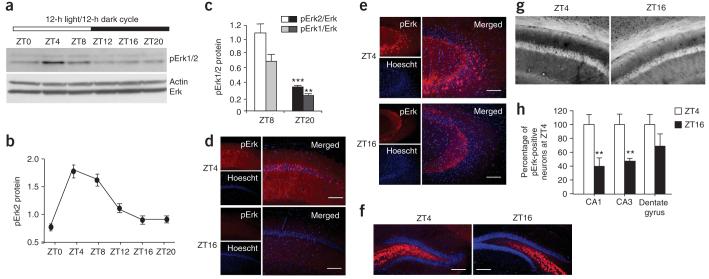
Figure 1
Figure 1
MAPK activity in the hippocampus shows circadian oscillations. Mice maintained on a 12-h light/12-h dark cycle for at least 10 d before experimentation were killed every 4 h. During the dark cycle, mice were killed under red light. (a) Pooled hippocampal extracts were evaluated by western blot analysis for pErk1/2 expression. (b) pErk2, normalized to actin, expression in the hippocampus during the 24-h cycle is shown. Error bars represent s.e.m. (n = 3 mice per time point). (c) pErk1 and pErk2, normalized to total Erk protein, at ZT8 and ZT20. *** P < 0.001, ** P < 0.01, t test. Error bars represent s.e.m. (n = 5 mice per time point). (d-h) MAPK activity underwent circadian oscillations in hippocampal areas CA1 and CA3. pErk expression is shown in area CA1 neurons (20×, d), CA3 neurons (20×, e) and granule cells of the dentate gyrus (10×, f). Scale bars represent 125 µm in d,e and 250 µm in f. 3,3′-diaminobenzidine staining showed an increase in pErk-positive cells in area CA1 at ZT4 compared with ZT16 (g). Quantification of pErk-positive cell bodies expressed as percent of pErk-positive cells at ZT4 in CA1, CA3 and the dentate gyrus (h). Error bars represent s.e.m. (n = 6-8 mice per time point).
Figure 2
Figure 2
Oscillations in the MAPK pathway occur upstream of MAPK and show oscillations that are free running. (a) pMEK1/2 protein expression in hippocampal tissue during the circadian cycle. (b) Quantification of pMEK1/2 at ZT8 and ZT20, normalized to MEK1 protein expression. * P = 0.016, Mann Whitney. Error bars represent s.e.m. (n = 5 mice per time point). (c) Actograms of voluntary mouse movement during D/D (free-running) conditions show a circadian oscillation of approximately 23.3 h. (d) pErk1/2 expression in the hippocampus oscillates even when mice are in free-running conditions. (e) pErk2 expression, normalized to total Erk protein, in the hippocampus during D/D conditions. * P < 0.05, Mann Whitney. Error bars represent s.e.m. (n = 4-5 mice per time point).
Figure 3
Figure 3
Contextual fear memory formation is dependent on zeitgeber time. (a) Mice were trained for contextual fear conditioning at either ZT4 or ZT16 and tested 24, 36 or 48 h later. Six mouse groups were used: those trained at ZT4 and tested 24 h later at ZT4 (4:4 (24)), those trained at ZT16 and tested 24 h later at ZT16 (16:16 (24)), those trained at ZT4 and tested 36 h later at ZT16 (4:16 (36)), those trained at ZT16 and tested 36 h later at ZT4 (16:4 (36)), and those groups trained at ZT4 or ZT16 and tested 48 h later (4:4 (48); 16:16 (48)). (b) Mice were tested for freezing behavior. *** P < 0.001, ** P < 0.01, ANOVA, Bonferroni's multiple comparison test for post hoc analysis. Error bars represent s.e.m. (n = 10-18 mice per group). (c) Freezing percentage of mice trained at ZT4 or ZT0 and tested 24 h after training. * P < 0.015, Mann Whitney. Error bars represent s.e.m. (n = 6 mice per time point).
Figure 4
Figure 4
Contextual fear memory is impaired when mice are trained during the subjective night. Mice were maintained in constant darkness for 6 d before being trained under red light for contextual fear conditioning. Mice were trained at CT4 or CT16 and tested 24 h later at CT4 or CT16, respectively. (a) The movement time (MT) during testing is plotted for each mouse (open circles indicate training movement time and filled circles represent testing movement time). (b,c) Mice trained at CT4 moved less (b) and had a higher freezing percentage (c) during testing compared with the mice trained at CT16. * P < 0.05, Mann Whitney. Error bars represent s.e.m. (n = 10 mice per group). (d) Freezing percentage of mice trained during the light period and tested 1 h later for short-term memory (ZT8). *** P ≤ 0.0001, Mann Whitney. Error bars represent s.e.m. (n = 10). (e) Freezing percentage of mice trained during the dark cycle and tested 1 h later (ZT20). ** P < 0.01, Mann Whitney. Error bars represent s.e.m. (n = 5).
Figure 5
Figure 5
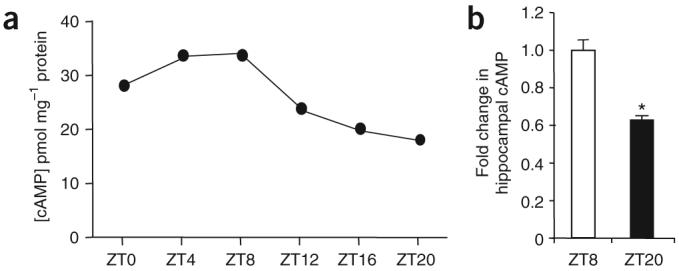
cAMP in the hippocampus is higher during the day than at night. (a) Hippocampal cAMP from tissues excised at ZT0, 4, 8, 12, 16 and 20. Each data point is the average of quadruplicate determinations derived from three pooled hippocampi obtained from separate mice. Error bars represent s.e.m. (b) The relative decrease in cAMP at ZT20 compared with ZT8 from independent experiments. * P < 0.05, t test. Error bars represent s.e.m. (n = 3-4 mice per time point per experiment).
Figure 6
Figure 6
DKO mice do not have diurnal oscillations in pErk activity or cAMP in the hippocampus and are deficient in long-term contextual memory. (a) pErk1/2, actin and total Erk proteins in pooled wild-type (WT) and DKO hippocampal tissue taken at ZT8 or ZT20. (b) Quantification of pErk relative to Erk expression in DKO mice. P = 0.6600, t test. Error bars represent s.e.m. (n = 10 for each genotype, 5 per time point). (c) Quantification of the fold change in cAMP accumulation in DKO hippocampus at ZT8 and ZT20. P = 0.13, t test. Error bars represent s.e.m. (error derived from four experiments, three hippocampal lobes pooled per time point per experiment). N.S., not significant. (d) Freezing percentage of DKO mice trained at ZT4 or ZT16 and tested 24 h later compared with wild-type mice trained and tested at ZT4. ** P < 0.01, ANOVA, Bonferroni's multiple comparison test for post hoc analysis. Error bars represent s.e.m. (n = 6-8 mice per group).
Figure 7
Figure 7
Ca2+-stimulated adenylyl cyclase activity and Ras activity in the hippocampus peak during the day. (a) Ca2+-stimulated adenylyl cyclase activity in the hippocampus of wild-type mice was determined at ZT8 and ZT20. (b) Ca2+-stimulated adenylyl cyclase activity at ZT20 expressed as a percentage of the activity at ZT8. Data are pooled from independent experiments. * P < 0.05; t test. Error bars represent s.d. in a and s.e.m. in b. (c) Western analysis of Ras activity showing pan (H, N and K) GTP-bound Ras protein in the hippocampus at ZT0, ZT4, ZT8, ZT12, ZT16 and ZT20 and actin protein in supernatant fractions from the corresponding pull-downs. (d,e) Quantification of GTP-Ras expression (d), normalized to actin protein, and the average decrease in Ras activity at ZT20 compared with ZT8 (e) from independent experiments. ** P < 0.01, t test. Error bars represent s.e.m.
Figure 8
Figure 8
Infusion of MEK inhibitors into the hippocampus during the circadian peak, but not during the trough of MAPK activation impairs LTM. (a) Mice trained for contextual fear were infused with vehicle (Veh) or UO126 (UO) at ZT0 and ZT4, starting 2 d after training and lasting for an entire week thereafter. (b,c) UO126 administration during the day reduced pErk in the hippocampal areas infused compared with vehicle-infused controls. * P = 0.0159, Mann Whitney. Error bars represent s.e.m. (n = 5). (d) UO mice (n = 16) had reduced freezing during testing compared with the Veh group (n = 13). * P < 0.05, t test. Error bars represent s.e.m. (e) The percentage of weak and nonlearners between Veh and UO groups was compared by Fisher's exact test (P < 0.01). (f) Mice trained for contextual fear conditioning were infused with vehicle or UO126 at ZT12 and ZT16 starting 36 h after training and lasting for an entire week thereafter. (g) UO mice (n = 8) had normal freezing during testing compared to the Veh group (n = 9). P = 0.669, t test. Error bars represent s.e.m.

Comment in

  • Rhythms of memory.
    Roth TL, Sweatt JD. Roth TL, et al. Nat Neurosci. 2008 Sep;11(9):993-4. doi: 10.1038/nn0908-993. Nat Neurosci. 2008. PMID: 18725902 Review.

References

    1. Impey S, Obrietan K, Storm DR. Making new connections: role of ERK/MAP kinase signaling in neuronal plasticity. Neuron. 1999;23:11–14. - PubMed
    1. Sweatt JD. Mitogen-activated protein kinases in synaptic plasticity and memory. Curr. Opin. Neurobiol. 2004;14:311–317. - PubMed
    1. Wang H, Storm DR. Calmodulin-regulated adenylyl cyclases: cross-talk and plasticity in the central nervous system. Mol. Pharmacol. 2003;63:463–468. - PubMed
    1. Atkins CM, Selcher JC, Petraitis JJ, Trzaskos JM, Sweatt JD. The MAPK cascade is required for mammalian associative learning. Nat. Neurosci. 1998;1:602–609. - PubMed
    1. Schafe GE, et al. Activation of ERK/MAP kinase in the amygdala is required for memory consolidation of Pavlovian fear conditioning. J. Neurosci. 2000;20:8177–8187. - PMC - PubMed

Publication types

MeSH terms