


Role of voltage-gated calcium channels in ascending pain pathways
- PMID: 19162069
- PMCID: PMC2692704
- DOI: 10.1016/j.brainresrev.2008.12.021
Role of voltage-gated calcium channels in ascending pain pathways
Abstract
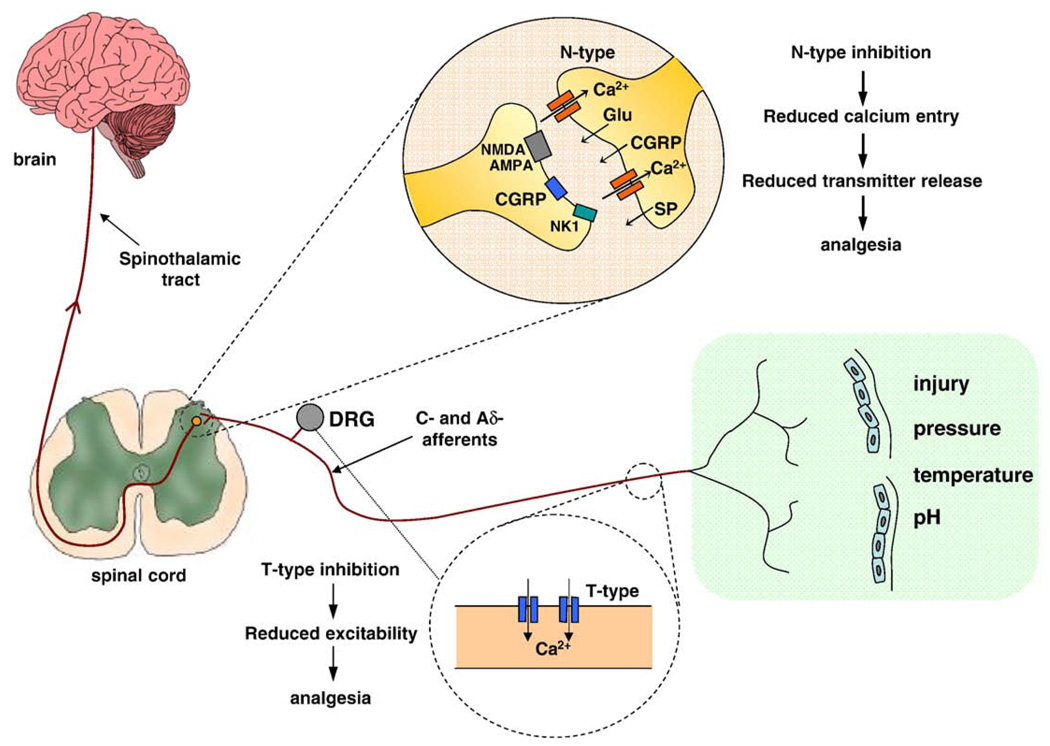
Voltage gated calcium channels (VGCCs) are well established mediators of pain signals in primary afferent neurons. N-type calcium channels are localized to synaptic nerve terminals in laminae 1 and 2 of the dorsal horn where their opening results in the release of neurotransmitters such as glutamate and substance P. The contribution of N-type channels to the processing of pain signals is regulated by alternate splicing of the N-type channel gene, with unique N-type channel splice variants being expressed in small nociceptive neurons. In contrast, T-type VGCCs of the Ca(v)3.2 subtype are likely localized to nerve endings where they regulate cellular excitability. Consequently, inhibition of N-type and Ca(v)3.2 T-type VGCCs has the propensity to mediate analgesia. T-type channel activity is regulated by redox modulation, and can be inhibited by a novel class of small organic blockers. N-type VGCC activity can be potently inhibited by highly selective peptide toxins that are delivered intrathecally, and the search for small organic blockers with clinical efficacy is ongoing. Here, we provide a brief overview of recent advances in this area, as presented at the Spring Pain Research conference (Grand Cayman, 2008).
Figures
References
-
- Altier C, Zamponi GW. Targeting Ca2+ channels to treat pain: T-type versus N-type. Trends Pharmacol. Sci. 2004;25:465–470. - PubMed
-
- Barton ME, Eberle EJ, Shannon HE. The antihyperalgesic effects of the T-type calcium channel blockers ethosuximide, trimethadione and mibefradil. Eur. J. Pharmacol. 2005;521:79–85. - PubMed
-
- Bell TJ, Thaler C, Castiglioni AJ, Helton TD, Lipscombe D. Cell-specific alternative splicing increases calcium channel current density in the pain pathway. Neuron. 2004;41:127–138. - PubMed
Publication types
MeSH terms
Substances
Grants and funding
LinkOut - more resources
Full Text Sources
Other Literature Sources
Medical
Molecular Biology Databases
