


doi: 10.1126/science.1166426.
Genetic interactions between transcription factors cause natural variation in yeast
Affiliations
- PMID: 19164747
- PMCID: PMC4984536
- DOI: 10.1126/science.1166426
Item in Clipboard
Genetic interactions between transcription factors cause natural variation in yeast
Science.
.
Abstract
Our understanding of the genetic basis of phenotypic diversity is limited by the paucity of examples in which multiple, interacting loci have been identified. We show that natural variation in the efficiency of sporulation, the program in yeast that initiates the sexual phase of the life cycle, between oak tree and vineyard strains is due to allelic variation between four nucleotide changes in three transcription factors: IME1, RME1, and RSF1. Furthermore, we identified that selection has shaped quantitative variation in yeast sporulation between strains. These results illustrate how genetic interactions between transcription factors are a major source of phenotypic diversity within species.
Figures
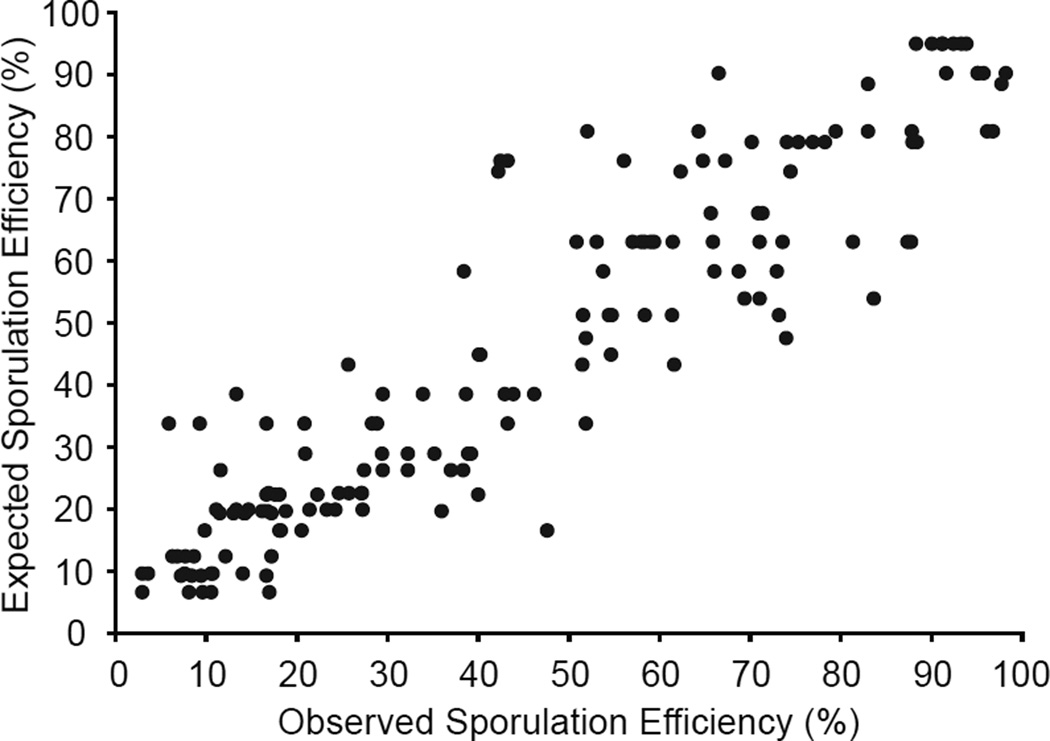
Expected values of sporulation efficiency plotted as a function of observed values for 155 segregants. Expected values are derived from a linear model based from 200 independent segregants (Table S2).
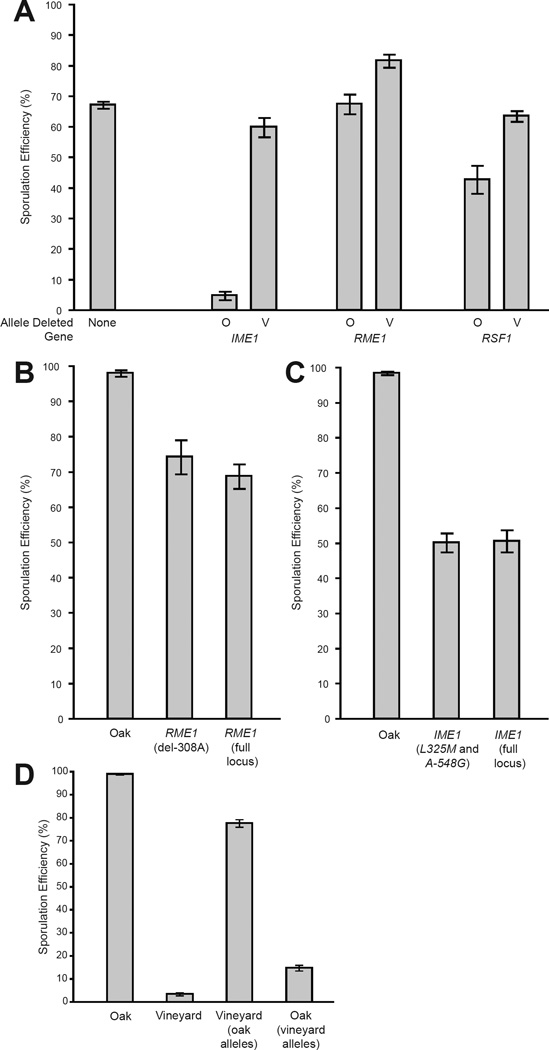
A. Reciprocal hemizygosity analysis of RME1, IME1, and RSF1 in an oak/vineyard hybrid background. O = oak parent allele, V = vineyard parent allele. B. Sporulation efficiency in oak, in oak with the vineyard parent allele (RME1(del-308A), and in oak with the entire vineyard parent locus including all the coding and non-coding polymorphisms. Variation among multiple replicate clones of the experiment (F test, P < 0.001) explains the discrepancy between the RME1(del-308A) and full allele in the oak background and this is not an effect of the two replacement types (F test, P = 0.13). C. Replacement of both the oak IME1 causative nucleotides with the vineyard parent alleles (L325M and A-548G) in the oak parent is equivalent to replacing the entire IME1 vineyard parent locus, coding and non-coding, in the oak parent (full locus). D. Replacements of all four alleles in the vineyard parent strain (oak alleles) compared to placing the vineyard alleles in the oak parent. Error bars denote one standard deviation.
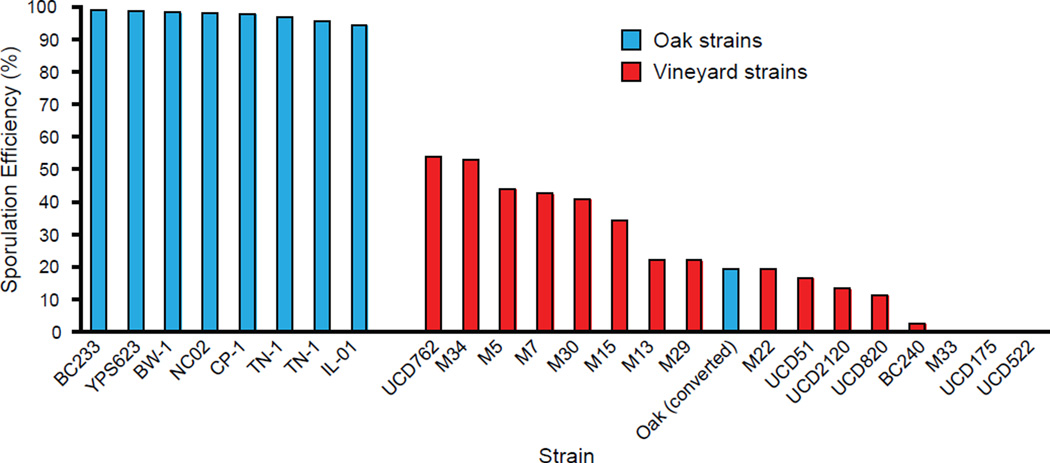
Variation among oak strains relative to the oak parental strain (BC233) and vineyard strains relative to the vineyard parental strain (BC240) show fixed and variable sporulation efficiencies, respectively. Oak(converted) is the parental oak strain transformed with the 4 causative nucleotides from the vineyard strain.
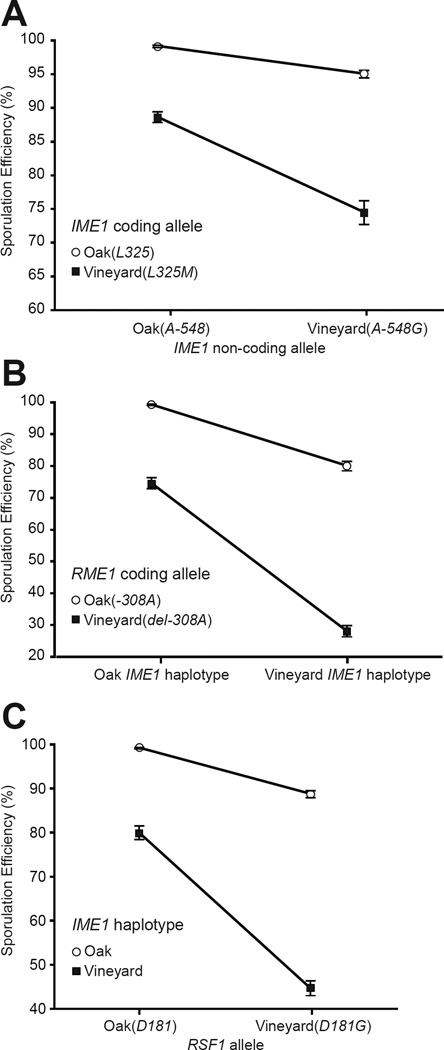
Single nucleotide interactions governing sporulation efficiency as shown by replacing single nucleotides in the oak parent with vineyard parent alleles. A. The effect of placing the vineyard allele IME1(A-548G) in the oak background is greater when the vineyard coding allele IME1(L325M) is also present. B. The effect of the two causative nucleotides in IME1 (IME1 haplotype) is greater when the vineyard RME1(del-308A) allele is also present. C. The effect of the RSF1(D181G) allele is greater when the vineyard alleles occur at IME1 (IME1 haplotype). A full list of interactions is available in Table S3. Error bars denote one standard deviation.
References
Publication types
MeSH terms
Substances
Associated data
- Actions
- Actions
- Actions
- Actions
- Actions
- Actions
- Actions
- Actions
- Actions
- Actions
- Actions
- Actions
- Actions
- Actions
- Actions
- Actions
- Actions
- Actions
- Actions
- Actions
- Actions
- Actions
- Actions
- Actions
- Actions
- Actions
- Actions
- Actions
- Actions
- Actions
- Actions
- Actions
- Actions
- Actions
- Actions
- Actions
- Actions
- Actions
- Actions
- Actions
- Actions
- Actions
- Actions
- Actions
- Actions
- Actions
- Actions
- Actions
- Actions
- Actions
Grants and funding
LinkOut - more resources
Full Text Sources
Other Literature Sources
Molecular Biology Databases
