Review
. 2009 Apr;390(4):287-93.
doi: 10.1515/BC.2009.035.

Central nervous system: cholesterol turnover, brain development and neurodegeneration

Affiliations
Review

Central nervous system: cholesterol turnover, brain development and neurodegeneration

John M Dietschy. Biol Chem. 2009 Apr.

Abstract

The average amount of cholesterol in the whole animal equals approximately 2100 mg/kg body weight, and 15% and 23% of this sterol in the mouse and human, respectively, is found in the central nervous system. There is no detectable uptake across the blood-brain barrier of cholesterol carried in lipoproteins in the plasma, even in the newborn. However, high rates of de novo cholesterol synthesis in the glia and neurons provide the sterol necessary for early brain development. Once a stable brain size is achieved in the adult, cholesterol synthesis continues, albeit at a much lower rate, and this synthesis is just balanced by the excretion of an equal amount of sterol, either as 24(S)-hydroxycholesterol or, presumably, as cholesterol itself.


Figures
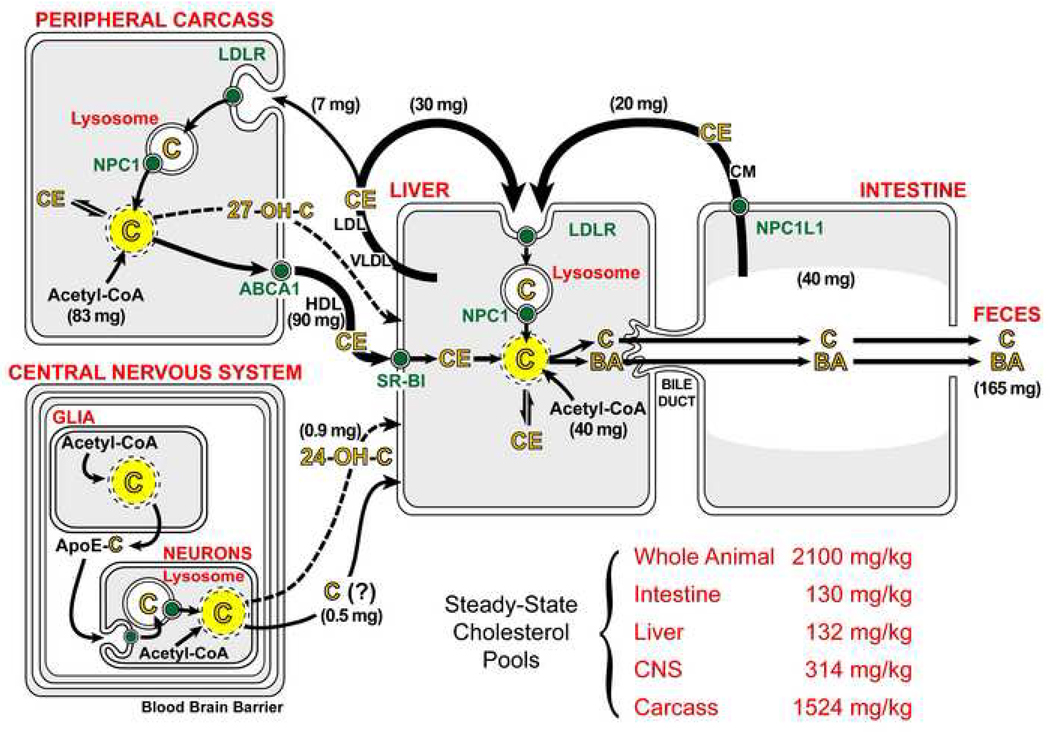
Figure 1
Figure 1
Flow of cholesterol through the major tissue compartments of the 7–8 week old mouse. The whole body is divided into four tissue compartments made up of the intestine, liver, central nervous system and remaining tissues of the peripheral carcass. The solid black arrows show the movement of cholesterol through the plasma carried in CM, VLDL/LDL and HDL. The numbers in parentheses adjacent to these arrows represent the milligrams of cholesterol moving through each of these pathways each day per kg of body weight (mg/day/kg). The dashed lines represent the flow of small amounts of various hydroxylated cholesterol molecules from the peripheral organs and CNS to the liver. The small green circles represent the specific cholesterol transporters NPC1L1, LDLR, SR-BI, NPC1 and ABCA1. Two separate intracellular pools of cholesterol are represented within each tissue compartment: one is isolated in the late endosomal/lysosomal compartment (white) while the other represents the metabolically active pool of unesterified cholesterol in the membranes of the cytosolic compartment (yellow). Movement of sterol from the lysosomal to the metabolically active pool requires functional NPC1. While not shown, a second protein, NPC2, acts in concert with NPC1 to promote C movement out of the lysosome. The numbers adjacent to acetyl-CoA represent the milligrams of cholesterol newly synthesized each day per kg of body weight (mg/day/kg). The size of the steady-state cholesterol pool in each of these tissue compartments is also listed. The abbreviations shown represent unesterified cholesterol (C), cholesteryl ester (CE), bile acid (BA) and hydroxylated cholesterol (OH-C). These flux rates are also available for larger animals and, in general, such rates decline in value as animal size increases (Dietschy et al., 1993).

References

    1. Acton S, Rigotti A, Landschulz KT, Xu S, Hobbs HH, Krieger M. Identification of scavenger receptor SR-BI as a high density lipoprotein receptor. Science. 1996;271:518–520. - PubMed
    1. Altmann SW, Davis HR, Jr, Zhu L-j, Yao X, Hoos LM, Tetzloff G, Iyer SPN, Maguire M, Golovko A, Zeng M, Wang L, Murgolo N, Graziano MP. Niemann-Pick C1 like 1 protein is critical for intestinal cholesterol absorption. Science. 2004;303:1201–1204. - PubMed
    1. Björkhem I, Diczfalusy U, Lütjohann D. Removal of cholesterol from extrahepatic sources by oxidative mechanisms. Curr. Opin. Lipidol. 1999;10:161–165. - PubMed
    1. Björkhem I, Lütjohann D, Diczfalusy U, Ståhle L, Ahlborg G, Wahren J. Cholesterol homeostasis in human brain: turnover of 24S-hydroxycholesterol and evidence for a cerebral origin of most of this oxysterol in the circulation. J. Lipid Res. 1998;39:1594–1600. - PubMed
    1. Brown JM, Rudel LL, Yu L. NPC1L1 (Niemann-Pick C1-like 1) mediates sterol-specific unidirectional transport of non-esterified cholesterol in McArdle-RH7777 hepatoma cells. Biochem. J. 2007;406:273–283. - PMC - PubMed

Publication types