Review
. 2009 Jul;1790(7):615-28.
doi: 10.1016/j.bbagen.2008.12.001. Epub 2008 Dec 29.

Amyloid precursor protein and alpha synuclein translation, implications for iron and inflammation in neurodegenerative diseases

Affiliations
Review

Amyloid precursor protein and alpha synuclein translation, implications for iron and inflammation in neurodegenerative diseases

Catherine M Cahill et al. Biochim Biophys Acta. 2009 Jul.

Abstract

Recent studies that alleles in the hemochromatosis gene may accelerate the onset of Alzheimer's disease by five years have validated interest in the model in which metals (particularly iron) accelerate disease course. Biochemical and biophysical measurements demonstrated the presence of elevated levels of neurotoxic copper zinc and iron in the brains of AD patients. Intracellular levels of APP holoprotein were shown to be modulated by iron by a mechanism that is similar to the translation control of the ferritin L- and H mRNAs by iron-responsive element (IRE) RNA stem loops in their 5' untranslated regions (5'UTRs). More recently a putative IRE-like sequence was hypothesized present in the Parkinsons's alpha synuclein (ASYN) transcript (see [A.L. Friedlich, R.E. Tanzi, J.T. Rogers, The 5'-untranslated region of Parkinson's disease alpha-synuclein messenger RNA contains a predicted iron responsive element, Mol. Psychiatry 12 (2007) 222-223. [6]]). Together with the demonstration of metal dependent translation of APP mRNA, the involvement of metals in the plaque of AD patients and of increased iron in striatal neurons in the substantia nigra (SN) of Parkinson's disease patients have stimulated the development of metal attenuating agents and iron chelators as a major new therapeutic strategy for the treatment of these neurodegenerative diseases. In the case of AD, metal based therapeutics may ultimately prove more cost effective than the use of an amyloid vaccine as the preferred anti-amyloid therapeutic strategy to ameliorate the cognitive decline of AD patients.


Figures

None
Equation 1
Metal-catalyzed neuronal oxidative damage via hydroxyl radicals.
Figure 1
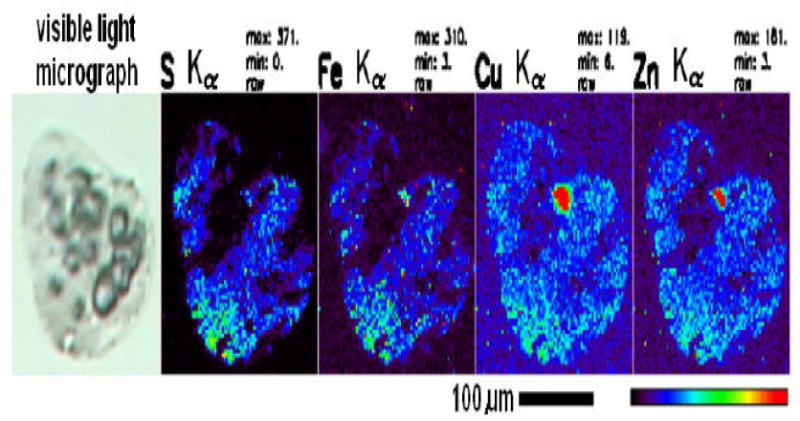
Figure 1. Elemental profiles (S, Fe, Cu, and Zn) in a typical Alzheimer's Aβ amyloid plaque
The cryo-sectioned (10 μm thichness) AD brain tissues were stained with 0.1% Thioflavin-T for amyloid plaques. The amyloid plaque-bearing human brain tissues were procured by LCM (Arcturus Pixcell IIE platform) and mounted on Si3N4 membrane grids (2.0 mm × 2.0 mm). Guided by the optical amyloid plaque images, the samples were excited with incident synchrotron X-ray of 10 keV for elemental Kα characteristic emission lines. Elemental profiles (S, Fe, Cu, and Zn) were obtained using Synchrotron scanning X-ray Fluorescence Microscopy (μ-XRF) at the Advanced Photon Source (APS) of the Argonne National Laboratory (ANL).
Figure 2
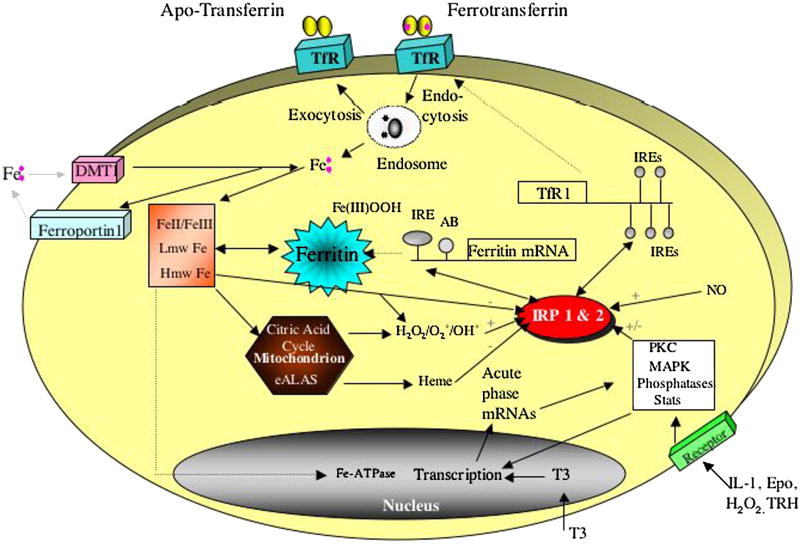
Figure 2. Intracellular Iron Homeostasis
Iron transit across the cell surface membrane is mediated by (i) ferrotransferrin internalization by the transferrin receptor (TfR), (ii) DMT-1, (iii) ferroportin mediated iron efflux from the duodenum into the blood. Ferritin mRNA translation is regulated by the modulated interaction between the IRPs and the IREs in the 5′UTR of ferritin mRNA. MAP kinase signaling events influence ferritin translation and transferrin receptor activity and expression.
Figure 3
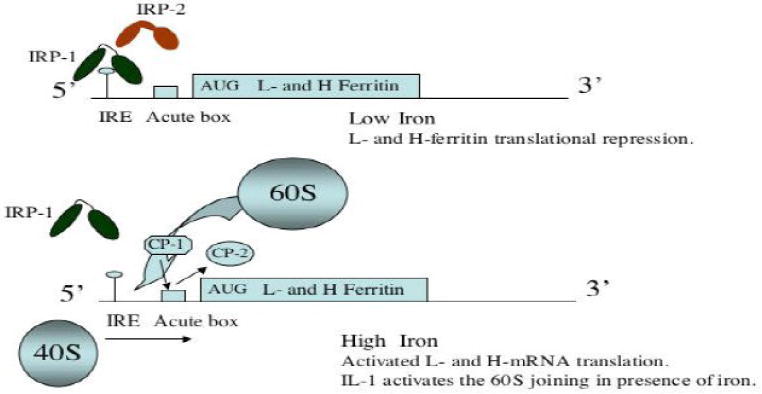
Figure 3. Model for Ferritin mRNA Translational Control
Iron releases IRP1/IRP2 from suppressing ferritin mRNA translation at the Iron responsive Element stem loops (IREs) specific to the Land H- mRNA 5′ cap sites. In the diagram, IRP1 and IRP2 are depicted as two domains separated by a hinge region (line). Our preliminary data suggests that the RNA binding protein (Poly C-binding proteins, CP-1 and CP-2) interact with the ferritin mRNA acute box (AB) domain (box) downstream from the IRE (114).
Figure 4
Figure 4
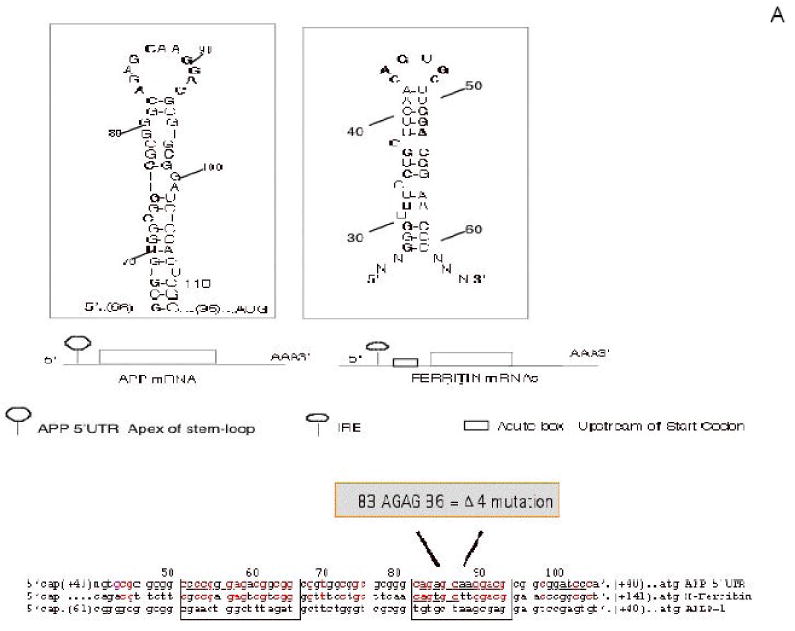
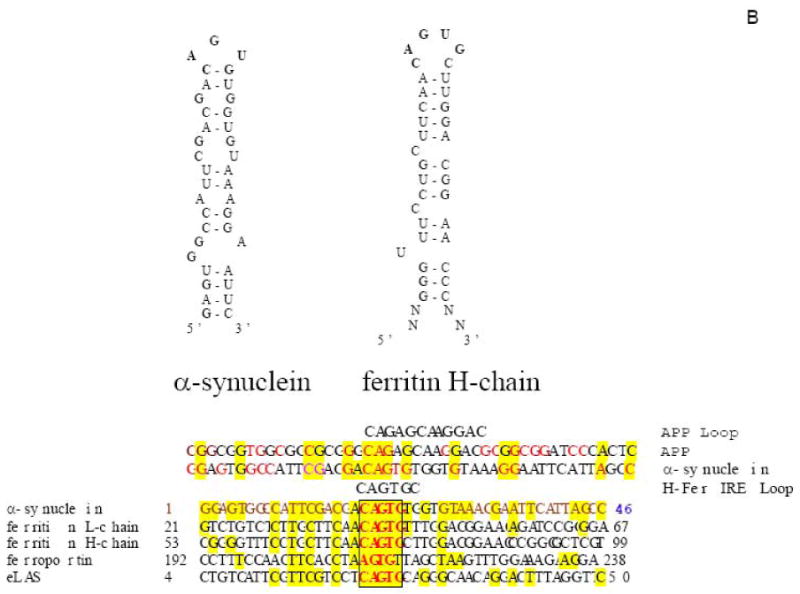
Both APP and alpha synuclein (ASYN) 5′UTRs were predicted to fold into the stable RNA stem loops similar to the 5′UTR-specific IRE in H-ferritin transcript (“APP 5′UTR” DG = -54 kCal/mol) (Zuker et al., 2003 (139)). Panel A The APP mRNA IRE (Type II) was identified after alignment with the ferritin Iron-responsive Element (shown in two clusters of > 70% sequence similarity)(8). The APP IRE is a currently active drug target for translational repression of APP in AD therapeutics (197). Panel B: The ASYN 5′UTR encodes a CAGUGU motif at the exon-1/exon-2 splice junction. This ASYN 5′UTR stem loop (DG =53 kcal/mol) aligns with classical IRE (5′CAGUGN3′ loop motif) that controls L-& H-ferritin translation & transferrin receptor (TfR) mRNA stability. Boxed alignment of the ASYN 5′CAGUGU3′ motif against the IREs of ferritin H- and L- chains (iron storage), ferroportin (iron transport), erythroid eALAS (heme synthesis) mRNAs in addition to an alignment with IRE sequences in APP mRNA.
Figure 4
Figure 4
Both APP and alpha synuclein (ASYN) 5′UTRs were predicted to fold into the stable RNA stem loops similar to the 5′UTR-specific IRE in H-ferritin transcript (“APP 5′UTR” DG = -54 kCal/mol) (Zuker et al., 2003 (139)). Panel A The APP mRNA IRE (Type II) was identified after alignment with the ferritin Iron-responsive Element (shown in two clusters of > 70% sequence similarity)(8). The APP IRE is a currently active drug target for translational repression of APP in AD therapeutics (197). Panel B: The ASYN 5′UTR encodes a CAGUGU motif at the exon-1/exon-2 splice junction. This ASYN 5′UTR stem loop (DG =53 kcal/mol) aligns with classical IRE (5′CAGUGN3′ loop motif) that controls L-& H-ferritin translation & transferrin receptor (TfR) mRNA stability. Boxed alignment of the ASYN 5′CAGUGU3′ motif against the IREs of ferritin H- and L- chains (iron storage), ferroportin (iron transport), erythroid eALAS (heme synthesis) mRNAs in addition to an alignment with IRE sequences in APP mRNA.

References

    1. Kosik K, Ahn J, Stein R, Yeh L. Discovery of compounds that will prevent tau pathology. J Mol Neurosci. 2002;19:261–266. - PubMed
    1. Lu M, Kosik K. Competition for microtubule-binding with dual expression of Tau missense and splice isoforms. Mol Biol Cell. 2001;12:171–184. - PMC - PubMed
    1. Selkoe DJ. Amyloid beta-protein and the genetics of Alzheimer's disease. J Biol Chem. 1996;271:18295–18298. - PubMed
    1. Hardy J. Framing β-amyloid. Nature Genetics. 1992;1:233–234. - PubMed
    1. Osenkowski P, Ye W, Wang R, Wolfe MS, Selkoe DJ. Direct and potent regulation of gamma-secretase by its lipid microenvironment. J Biol Chem. 2008;283:22529–22540. - PMC - PubMed

Publication types

MeSH terms