


Identification of novel glycosyltransferases required for assembly of the Pasteurella multocida A:1 lipopolysaccharide and their involvement in virulence
- PMID: 19168738
- PMCID: PMC2663145
- DOI: 10.1128/IAI.01144-08
Identification of novel glycosyltransferases required for assembly of the Pasteurella multocida A:1 lipopolysaccharide and their involvement in virulence
Abstract
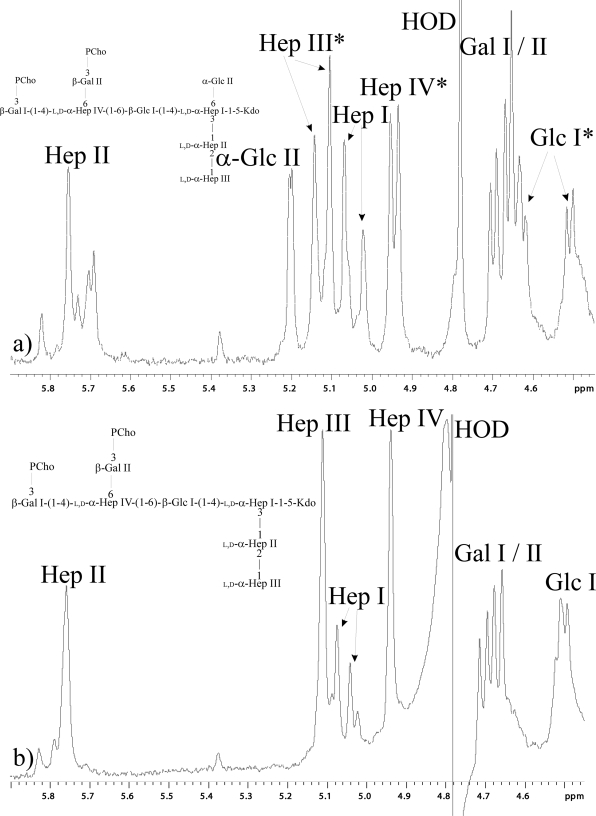
We previously determined the structure of the Pasteurella multocida Heddleston type 1 lipopolysaccharide (LPS) molecule and characterized some of the transferases essential for LPS biosynthesis. We also showed that P. multocida strains expressing truncated LPS display reduced virulence. Here, we have identified all of the remaining glycosyltransferases required for synthesis of the oligosaccharide extension of the P. multocida Heddleston type 1 LPS, including a novel alpha-1,6 glucosyltransferase, a beta-1,4 glucosyltransferase, a putative bifunctional galactosyltransferase, and two heptosyltransferases. In addition, we identified a novel oligosaccharide extension expressed only in a heptosyltransferase (hptE) mutant background. All of the analyzed mutants expressing LPS with a truncated main oligosaccharide extension displayed reduced virulence, but those expressing LPS with an intact heptose side chain were able to persist for long periods in muscle tissue. The hptC mutant, which expressed LPS with the shortest oligosaccharide extension and no heptose side chain, was unable to persist on the muscle or cause any disease. Furthermore, all of the mutants displayed increased sensitivity to the chicken antimicrobial peptide fowlicidin 1, with mutants expressing highly truncated LPS being the most sensitive.
Figures


References
-
- Ausubel, F. M., R. Brent, R. E. Kingston, D. D. Moore, J. G. Seidman, J. A. Smith, and K. Struhl. 1987. Current protocols in molecular biology. Wiley Interscience, New York, NY.
-
- Boyce, J. D., R. Y. C. Lo, I. Wilkie, and B. Adler. 2004. Pasteurella and Mannheimia, p. 385-396. In C. Gyles, C. Thoen, J. Prescott, and G. Songer (ed.), Pathogenesis of bacterial infections of animals. Blackwell Publishing, Ames, IA.
-
- Brisson, J.-R., E. Crawford, D. Uhrin, N. H. Khieu, M. B. Perry, W. B. Severn, and J. C. Richards. 2002. The core oligosaccharide component from Mannheimia (Pasteurella) haemolytica serotype A1 lipopolysaccharide contains l-glycero-d-manno-and d-glycero-d-manno-heptoses: analysis of the structure and conformation by high-resolution NMR spectroscopy. Can. J. Chem. 80949.
Publication types
MeSH terms
Substances
LinkOut - more resources
Full Text Sources
