. 2009 Mar;8(3):339-52.
doi: 10.1128/EC.00270-08. Epub 2009 Jan 23.

AgtA, the dicarboxylic amino acid transporter of Aspergillus nidulans, is concertedly down-regulated by exquisite sensitivity to nitrogen metabolite repression and ammonium-elicited endocytosis

Affiliations

AgtA, the dicarboxylic amino acid transporter of Aspergillus nidulans, is concertedly down-regulated by exquisite sensitivity to nitrogen metabolite repression and ammonium-elicited endocytosis

Angeliki Apostolaki et al. Eukaryot Cell. 2009 Mar.

Abstract

We identified agtA, a gene that encodes the specific dicarboxylic amino acid transporter of Aspergillus nidulans. The deletion of the gene resulted in loss of utilization of aspartate as a nitrogen source and of aspartate uptake, while not completely abolishing glutamate utilization. Kinetic constants showed that AgtA is a high-affinity dicarboxylic amino acid transporter and are in agreement with those determined for a cognate transporter activity identified previously. The gene is extremely sensitive to nitrogen metabolite repression, depends on AreA for its expression, and is seemingly independent from specific induction. We showed that the localization of AgtA in the plasma membrane necessitates the ShrA protein and that an active process elicited by ammonium results in internalization and targeting of AgtA to the vacuole, followed by degradation. Thus, nitrogen metabolite repression and ammonium-promoted vacuolar degradation act in concert to downregulate dicarboxylic amino acid transport activity.


Figures
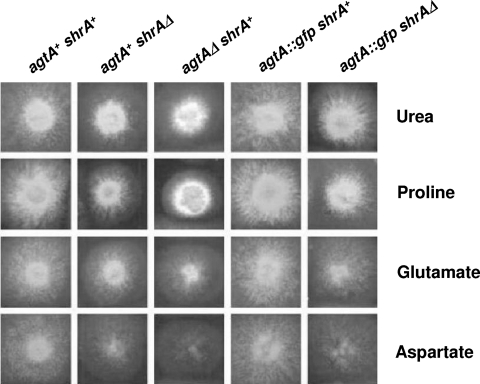
FIG. 1.
FIG. 1.
A. nidulans strains with different agtA and shrA genetic backgrounds grown on different nitrogen sources (urea, proline, glutamate, and aspartate). The relevant genotypes are indicated above the columns. For the complete genotypes, see Materials and Methods and Table 1. The agtAΔ strain shows almost no growth on aspartate and considerably impaired growth on glutamate. The strains carrying the agtA::sgfp fusion show wild-type growth on aspartate and glutamate. In all shrAΔ strains, the ability to grow on proline, glutamate, and aspartate is impaired in comparison with that of the corresponding shrA+ strains (17).
FIG. 2.
FIG. 2.
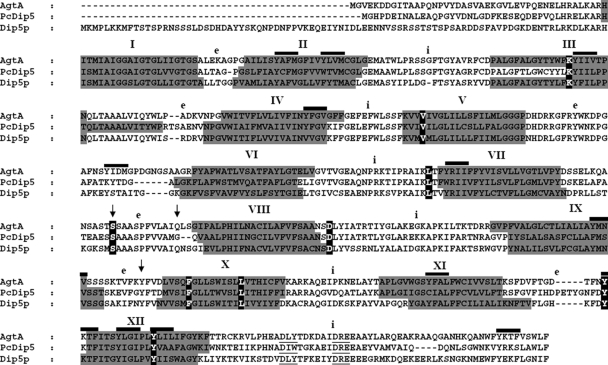
ClustalW2 alignment of the three specific dicarboxylic amino acid transporters of the YAT family: AgtA (A. nidulans), Pcdip5 (P. chrysogenum), and Dip5p (S. cerevisiae). Marked in gray are the putative transmembrane segments of each transporter according to Toppred (http://bioweb.pasteur.fr/seqanal/interfaces/toppred.html). The amino acid residues specific only to the dicarboxylic amino acid transporters are shaded in black. Ser318, Gln329, and Tyr413 are indicated by arrows (see Discussion). The YXXΦ motifs (Y motifs [see Discussion]) of AgtA are overlaid by a thick line. i, intracytoplasmic loops; e, extracytoplasmic loops.
FIG. 3.
FIG. 3.
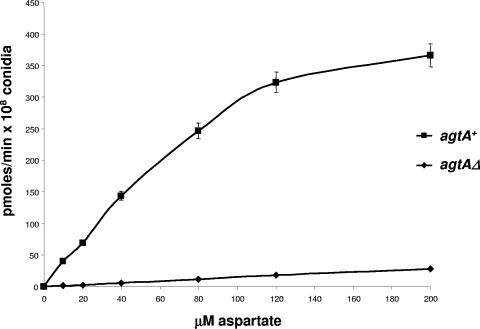
Kinetics of aspartate transport in wild-type (agtA+) and agtAΔ mutant strains. Each point is the average of three independent measurements. Aspartate uptake rates are expressed in picomoles per minute per 108 viable conidiospores. Analysis of these results by a Lineweaver-Burk plot (not shown) established the existence of a high-affinity aspartate transporter with a Km of 70 μM only in the wild-type strain.
FIG. 4.
FIG. 4.
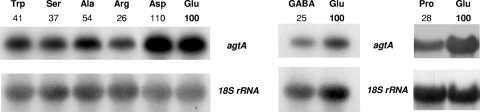
Northern blot analysis of agtA expression in mycelia of a wild-type (pabaA1) strain in the presence of different amino acids (Asp, aspartate; Glu, glutamate; Trp, tryptophan; Ser, serine; Ala, alanine; Arg, arginine; Pro, proline; GABA, γ-aminobutyric acid) as sole nitrogen sources. The three panels represent independent experiments. The growth conditions and probes used are described in Materials and Methods. Quantification of the transcript (above the Northern blot) was corrected for the loading with the 18S rRNA signal and expressed in 100% of the value obtained for glutamate in order to compare the results of different experiments.
FIG. 5.
FIG. 5.
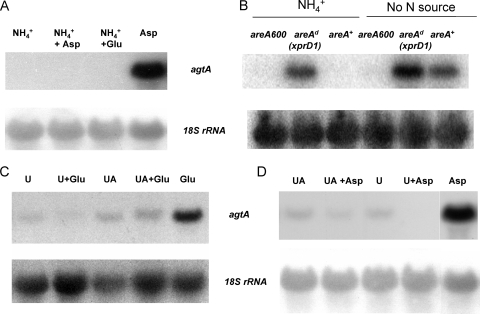
Sensitivity of agtA expression to nitrogen metabolite repression. (A) Northern blot analysis of agtA expression by wild-type strain (pabaA1) mycelia after 7 h of growth in the presence of ammonium as a sole nitrogen source, followed by 2 h of additional incubation in the sole presence of ammonium (first lane) or in the simultaneous presence of ammonium and aspartate (second lane) or ammonium and glutamate (third lane) and, as a control, aspartate alone (fourth lane). (B) Northern blot analysis of agtA expression in mycelia of strains carrying different areA alleles grown for 7 h on ammonium and subsequently shifted to medium either containing ammonium or without any nitrogen source for an additional 2 h. areA600 is a null areA mutant, areAd (xprD1) is a derepressed areA mutant, and areA+ is a wild-type (pabaA1) strain. Strains, growth conditions, and probes are described in Materials and Methods. (C) Northern blot analyses of agtA expression in mycelia of a wild-type strain (pabaA1) grown in urea (U) or uric acid (UA) in the presence of glutamate (Glu) or, as a control, in glutamate only. (D) Northern blot analyses of agtA expression in mycelia of a wild-type strain (pabaA1) grown in urea (U) or uric acid (UA) in the presence of aspartate (Asp) or, as a control, in aspartate only.
FIG. 6.
FIG. 6.
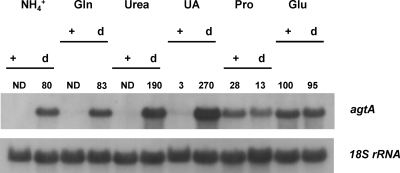
Effect of an areA derepressed mutation (xprD1) on the expression of agtA. The levels of expression of agtA in an areA+ strain (+ lanes) are compared to those found in a strain carrying an extremely derepressed areA mutation (xprD1; d lanes) on different nitrogen sources. The strains, growth conditions, and probes used are described in Materials and Methods. The nitrogen source used is indicated above each pair of lanes. Abbreviations: Gln, glutamine; UA, uric acid; Pro, proline; Glu, glutamate. Quantification of the transcript (above the Northern blot) was corrected for the loading with the 18S rRNA signal and expressed as a percentage of the value obtained for glutamate, which was set at 100%. ND, nondetectable signal.
FIG. 7.
FIG. 7.
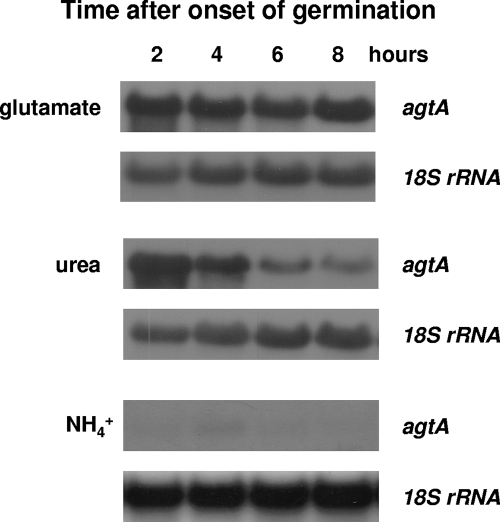
agtA expression during development in the presence of different nitrogen sources. Shown are steady-state agtA mRNA levels in germinating conidia (2 and 4 h) and young (6 and 8 h) mycelia of a wild-type strain (pabaA1) at 37°C in the presence of glutamate, urea, or ammonium as the sole nitrogen source. The growth conditions and probes used are described in Materials and Methods.
FIG. 8.
FIG. 8.
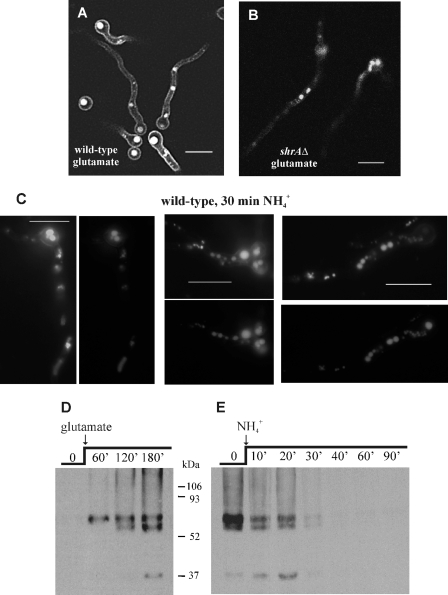
ShrA and ammonium-dependent subcellular localization and degradation of AgtA. At the top are representative pictures from LSCM of shrA+ agtA::gfp (A) and shrAΔ agtA::gfp (B) strains expressing a functional chimeric AgtA-GFP fusion, grown at 25°C for 16 h on MM in the presence of 10 mM glutamate as the sole nitrogen source. Bars, 10 μm. (C) Representative pictures from LSCM of an shrA+ agtA::gfp strain grown as described above, followed by the addition of 10 mM ammonium tartrate for the last 30 min (left) compared with CMAC staining (right) as described in reference . Bars, 10 μm. (D) Western blot analysis of AgtA-HA expression under different growth conditions showing the kinetics of AgtA-HA appearance in mycelia grown on ammonium for 15 h (time zero) after a shift to glutamate for 1, 2, and 3 h, respectively. Time in minutes is indicated at the top. (E) Kinetics of AgtA-HA ammonium-elicited degradation. Mycelia pregrown on ammonium for 15 h as above were transferred to glutamate for 2 h (derepressed conditions, time zero), transferred again to NH4+, and analyzed after 10 to 90 min of incubation. Time of incubation in minutes is indicated at the top. For further details on growth conditions, see Materials and Methods.
FIG. 9.
FIG. 9.
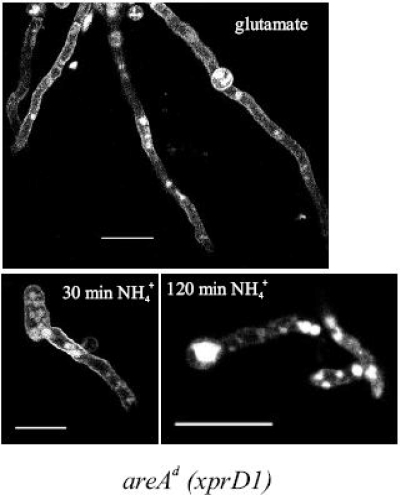
AgtA internalization occurs in an areA-derepressed strain. Shown is the subcellular localization of AgtA protein in young hyphae of an ammonium-derepressed strain (xprD1) of A. nidulans in the presence of ammonium. Representative pictures from LSCM show conidiospores of a wild-type strain (pabaA1) expressing functional AgtA-GFP molecules, grown at 25°C for 16 h on MM in the presence of 10 mM glutamate as the sole nitrogen source with the addition of 10 mM ammonium tartrate (NH4+) for the last 30 or 120 min of growth, respectively. Bars, 10 μm.
FIG. 10.
FIG. 10.
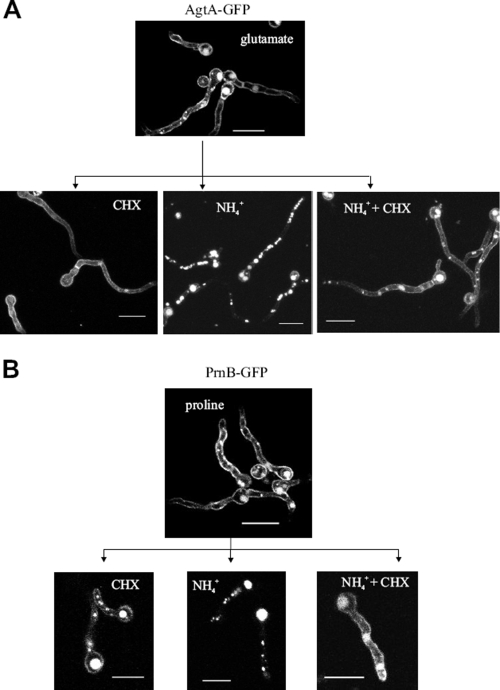
Protein synthesis is necessary for ammonium-dependent AgtA and PrnB internalization. Shown is the subcellular localization of AgtA and PrnB proteins in young hyphae of A. nidulans strains under conditions that inhibit protein synthesis. Representative pictures from LSCM show conidiospores of a wild-type strain (pabaA1) that expresses functional AgtA-GFP (A) or PrnB-GFP (B) molecules grown at 25°C for 16 h on MM in the presence of 10 mM glutamate as the sole nitrogen source, followed by the addition of 10 mM ammonium tartrate (NH+4[r]), 0.1 mg/ml cycloheximide (CHX), or both (NH+4[r] + CHX) for the last 30 min of growth (A), or in the presence of 10 mM proline as the sole nitrogen source, followed by the addition of 10 mM ammonium tartrate (NH+4[r]), 0.1 mg/ml cycloheximide (CHX), or both (NH+4[r] + CHX) for the last 30 min of growth (B). Bars, 10 μm.

References

    1. Amillis, S., G. Cecchetto, V. Sophianopoulou, M. Koukaki, C. Scazzocchio, and G. Diallinas. 2004. Transcription of purine transporter genes is activated during the isotropic growth phase of Aspergillus nidulans conidia. Mol. Microbiol. 52205-216. - PubMed
    1. Andre, B. 1995. An overview of membrane transport proteins in Saccharomyces cerevisiae. Yeast 111575-1611. - PubMed
    1. Apostolaki, A. 2003. Topogenèse des transporteurs d'acides aminés chez le champignon filamenteux Aspergillus nidulans. Ph.D. thesis. Université Paris-Sud, Paris, France.
    1. Arst, H. N., Jr., and D. J. Cove. 1973. Nitrogen metabolite repression in Aspergillus nidulans. Mol. Gen. Genet. 126111-141. - PubMed
    1. Arst, H. N., Jr., S. A. Jones, and C. R. Bailey. 1981. A method for the selection of deletion mutations in the l-proline catabolism gene cluster of Aspergillus nidulans. Genet. Res. 38171-195. - PubMed

Publication types

MeSH terms

Associated data

LinkOut - more resources