. 2009 Apr;33(4):684-92.
doi: 10.1111/j.1530-0277.2008.00885.x. Epub 2009 Jan 20.

Chronic ethanol feeding alters hepatocyte memory which is not altered by acute feeding

Affiliations

Chronic ethanol feeding alters hepatocyte memory which is not altered by acute feeding

F Bardag-Gorce et al. Alcohol Clin Exp Res. 2009 Apr.

Abstract

Background: Gene expression changes in the liver after acute binge drinking may differ from the changes seen in chronic ethanol feeding in the rat. The changes in gene expression after chronic ethanol feeding may sensitize the liver to alcohol-induced liver damage, which is not seen after acute binge drinking.

Methods: To test this hypothesis, gene microarray analysis was performed on the livers of rats (n = 3) fed an acute binge dose of ethanol (6 g/kg body wt) and killed at 3 and 12 hours after ethanol by gavage. The gene microarrays were compared with those made on the liver of rats from a previous study, in which the rats were fed ethanol by intragastric tube for 1 month (36% of calories derived from ethanol).

Results: Microarray analysis data varied between the acute and chronic models in several important respects. Growth factors increased mainly in the chronic alcohol fed rat. Changes in enzymes involved in oxidative stress were noted only with chronic ethanol feeding. Gene expression of fat metabolism was increased only with chronic ethanol feeding. Most importantly, epigenetic related enzymes and acetylation and methylation of histones changed only after chronic ethanol feeding.

Conclusions: The results support the concept that chronic ethanol ingestion induces altered gene expression as a result of changes in epigenetic mechanisms, where acetylation and methylation of histones were altered.


Figures
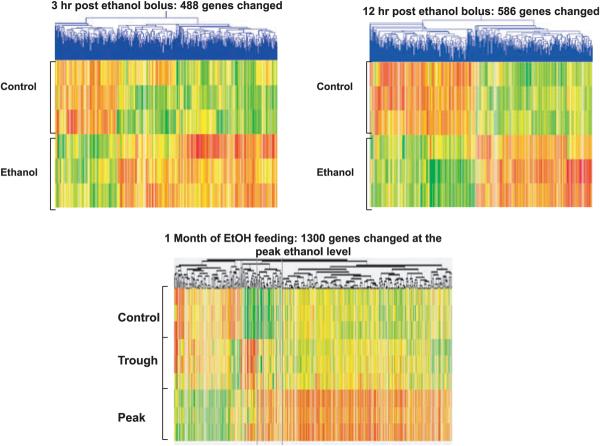
Fig. 1
Fig. 1
Gene microarrays at 3 hours and 12 hours after an ethanol bolus were compared with 3 and 12 hours controls given isocaloric diet (red lines represent up-regulated genes and green lines represent down-regulated genes). The 1 month of chronic ethanol ingestion heat map is reprinted from Bardag-Gorce and colleagues (2007), with permission from Elsevier (mean ± SEM, n = 3).
Fig. 2
Fig. 2
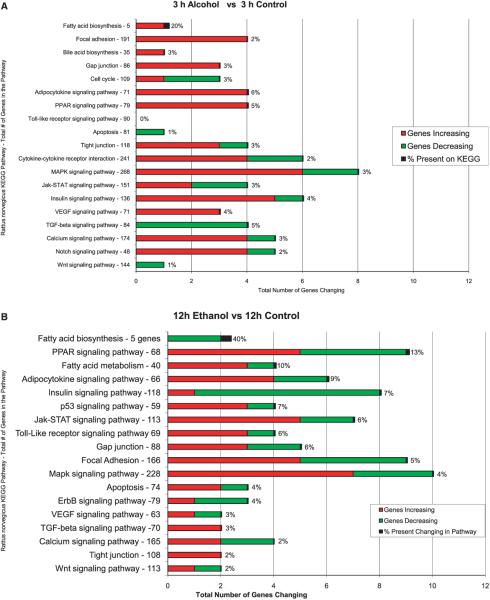
The functional pathways due to changes in gene expression at 3 hours (A) and 12 hours (B) after ethanol bolus feeding are compared with the controls. Red is up-regulated and green is down-regulated (mean ± SEM, n = 3).
Fig. 3
Fig. 3
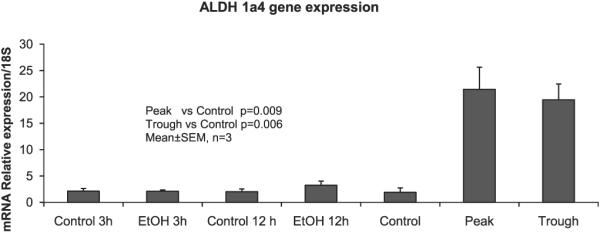
Aldh1a4 gene expression of the acute ethanol feeding experiment was compared with the chronic ethanol feeding experiment by PCR. Note: Only chronic ethanol feeding showed a significant increase (approximately 10-fold increase), both at the peak (P) and the trough (T) (mean ± SEM, n = 3).
Fig. 4
Fig. 4
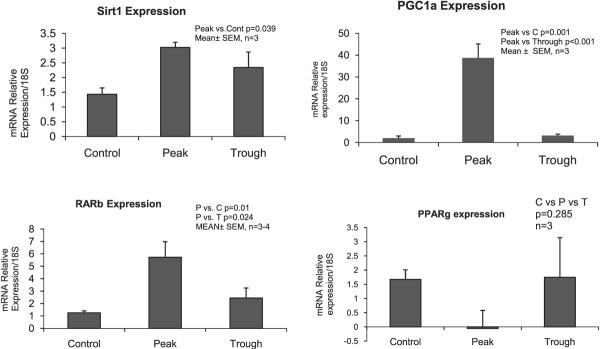
Gene expression of Sirt1, PGC-1a, and RARb was up-regulated at peaks of the alcohol level in chronic ethanol fed rats, whereas PPARγ was down-regulated at the peaks. Sirt1 expression was not changed at 3 hours and 12 hours (mean ± SEM, n = 3 to 4).
Fig. 5
Fig. 5
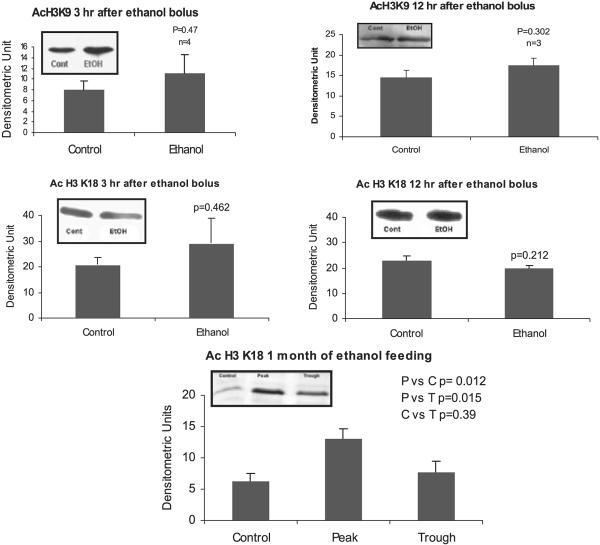
Western blot analysis of histone 3 lysine 9 acetylation in liver nuclear extracts after 3 and 12 hours of ethanol bolus. Note there were no significant changes in the liver of ethanol fed rats compared with the controls. The acetylation of histone 3 lysine 18 (H3K18) also showed no change in the acute ethanol fed model. There was a significant increase of H3K18 acetylation at the peaks in the chronic ethanol fed model (mean ± SEM, n = 3 to 4).
Fig. 6
Fig. 6
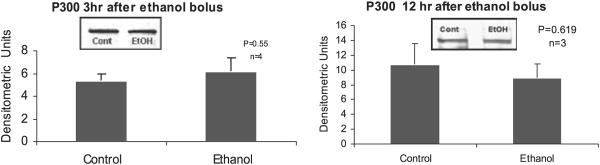
Western blot analysis of histone acetyltransferase p300 in the liver nuclear extracts after 3 and 12 hours after ethanol bolus. Note there was no significant change in the livers of ethanol fed rats compared with the controls (mean ± SEM, n = 3 to 4).
Fig. 7
Fig. 7
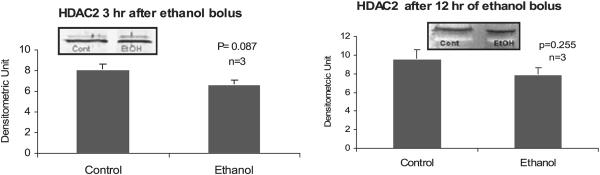
Western blot analysis of histone deacetylase HDAC2 responsible for deacetylating histone 3 lysine 9 in the liver nuclear extracts after 3 and 12 hours after ethanol bolus. Note: There was no significant change in the liver of the ethanol fed rats compared with the controls (mean ± SEM, n = 3 to 4).
Fig. 8
Fig. 8
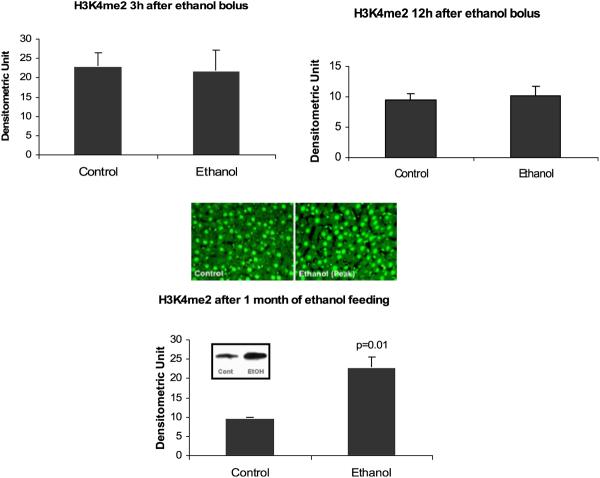
Histone 3 lysine 4 dimethylation analysis. There was a significant increase in H3K4me2 after 1 month of ethanol feeding (mean ± SEM, n = 3 to 4).
Fig. 9
Fig. 9
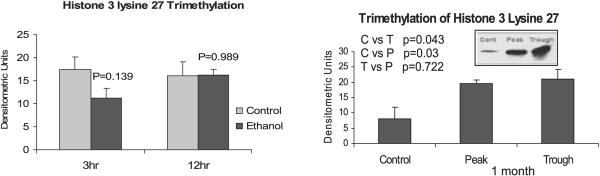
Histone 3 lysine 27 trimethylation analysis. There was a significant increase in H3K27me3 after 1 month of ethanol feeding (mean ± SEM, n = 3 to 4).
Fig. 10
Fig. 10
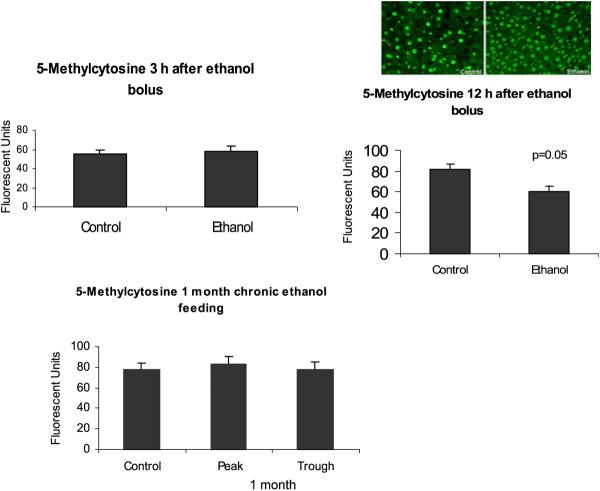
Global DNA hypomethylation occurred 12 hours after an ethanol bolus. It did not occur at 3 hours after an ethanol bolus or after 1 month of chronic ethanol feeding (mean ± SEM, n = 3 to 4).

References

    1. Bardag-Gorce F, French BA, Dedes J, Li J, French SW. Gene expression patterns of the liver in response to alcohol. In vitro and in vitro models compared. Exp Mol Pathol. 2005;80:241–251. - PubMed
    1. Bardag-Gorce F, French BA, Joyce M, Baires M, Montgomery RO, Li J, French S. Histone acetyltransferase p300 modulates gene expression in an epigenetic manner at high blood alcohol levels. Exp Mol Pathol. 2007;82:197–202. - PMC - PubMed
    1. Bardag-Gorce F, French BA, Li J, Riley NE, Yuan QX, Valinluck V, Fu P, Ingelman-Sundberg M, Yoon S, French SW. The importance of cycling of blood alcohol levels in the pathogenesis of experimental alcoholic liver disease in rats. Gastroenterology. 2002;123:325–335. - PubMed
    1. Bardag-Gorce F, French BA, Nan L, Song H, Nguyen SK, Yong H, Dedes J, French SW. CYP2E1 induced by ethanol causes oxidative stress, proteasome inhibition and cytokeratin aggresomes (Mallory body-like) formation. Exp Mol Pathol. 2006;81:191–201. - PubMed
    1. Bradford MM. A rapid and sensitive method for the quantitation of microgram quantities protein utilizing the principle of protein-dye binding. Anal Biochem. 1976;72:248–254. - PubMed

MeSH terms