Case Reports
. 2009 Apr 14;136(1-2):160-5.
doi: 10.1016/j.vetmic.2008.10.035. Epub 2008 Nov 28.

Characterization of an outbreak of astroviral diarrhea in a group of cheetahs (Acinonyx jubatus)

Affiliations
Case Reports

Characterization of an outbreak of astroviral diarrhea in a group of cheetahs (Acinonyx jubatus)

Adrienne Atkins et al. Vet Microbiol. .

Abstract

A Mamastrovirus was identified in an outbreak of diarrhea in cheetahs (Acinonyx jubatus). Five young adult and two adult cheetahs presented with lethargy, anorexia, watery diarrhea and regurgitation over an 11-day period. Fecal samples were submitted for electron microscopy and culture. Electron microscopy results revealed particles morphologically consistent with an astrovirus, and no other viral pathogens or significant bacterial pathogens were identified. The astrovirus was confirmed and sequenced using consensus astroviral PCR, resulting in a 367 base pair partial RNA-dependent-RNA polymerase (RdRp) product and a 628 base pair partial capsid product. Bayesian and maximum likelihood phylogenetic analyses were performed on both the RdRp and the capsid protein segments. All animals were monitored and treated with bismuth subsalicylate tablets (524mg PO BID for 5 days), and recovered without additional intervention. This is the first report we are aware of documenting an astrovirus outbreak in cheetah.


Figures
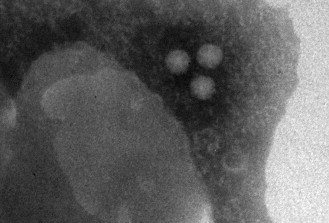
Fig. 1
Fig. 1
Negative stained electron micrograph of cheetah feces showing round virus-like particles measuring 30 nm. Note the presence of star-like patterns typical of astrovirus.
Fig. 2
Fig. 2
(A) Bayesian phylogenetic tree of predicted 122–132 amino acid partial astroviral RNA-dependent-RNA polymerase sequences based on MUSCLE alignment. Bayesian posterior probabilities of branchings as percentages are in bold, and ML bootstrap values for branchings based on 200 re-samplings are given to the right. Avian nephritis virus 1 (GenBank accession number NP_620617) was designated as the outgroup. Virus genera are delineated by brackets. Branches with Bayesian posterior probabilities less than 50 are collapsed, and an area of trifurcation is marked by a circle. Cheetah astrovirus is bolded. Sequences retrieved from GenBank include Human astrovirus 1 (GenBank accession number AAW51881), Human astrovirus 2 (AAA65000), Human astrovirus 3 (AAD28539), Human astrovirus 4 (AAY84778), Human astrovirus 5 (AAY46273), Human astrovirus 8 (AAF85963), Ovine astrovirus (NP_059945), Mink astrovirus (AAO32082), Turkey astrovirus 1 (CAB95006), Turkey astrovirus 2 (NP_987087), and Avian Nephritis Virus 1 (NP_620617). (B) Bayesian phylogenetic tree of predicted 186–209 amino acid partial astroviral capsid sequences based on MUSCLE alignment. Bayesian posterior probabilities of branchings as percentages are in bold, and ML bootstrap values for branchings based on 200 re-samplings are given to the right. Avian nephritis virus 1 (GenBank accession number NP_620618) was designated as the outgroup. Virus genera are delineated by brackets. Cheetah astrovirus is bolded. Sequences retrieved from GenBank include Feline astrovirus (GenBank accession number AAC13556), Human astrovirus 1 (BAE97460), Human astrovirus 2 (AAA62427), Human astrovirus 3 (ABG00150), Human astrovirus 4 (BAA93440), Human astrovirus 5 (AAY46274), Human astrovirus 6 (AAK97065), Human astrovirus 7 (AAK31913), Human astrovirus 8 (AAF85964), Porcine astrovirus (CAB95000), Ovine astrovirus (NP_059944), Mink astrovirus (NP_795336), Turkey astrovirus 1 (CAB95007), Turkey astrovirus 2 (NP_987088), Turkey astrovirus 3 (AAV37187), Avian Nephritis Virus 1 (NP_620618), and Avian Nephritis Virus 2 (BAB21617).

References

    1. Altschul S.F., Madden T.L., Schäffer A.A., Zhang J., Zhang Z., Miller W., Lipman D.J. Gapped BLAST and PSI-BLAST: a new generation of protein database search programs. Nucleic Acids Res. 1997;25:3389–3402. - PMC - PubMed
    1. Attoui H., Fang Q., Jaafar F.M., Cantaloube J.F., Biagini P., de Micco P., de Lamballerie X. Common evolutionary origin of aquareoviruses and orthoreoviruses revealed by genome characterization of Golden shiner reovirus, Grass carp reovirus, Striped bass reovirus and golden ide reovirus (genus Aquareovirus, family Reoviridae) J. Gen. Virol. 2002;83:1941–1951. - PubMed
    1. Cattoli G., De Battisti C., Toffan A., Salviato A., Lavazza A., Cerioli M., Capua I. Co-circulation of distinct genetic lineages of astroviruses in turkeys and guinea fowl. Arch. Virol. 2007;152:595–602. - PubMed
    1. Dimmic M.W., Rest J.S., Mindell D.P., Goldstein R.A. rtREV: an amino acid substitution matrix for inference of retrovirus and reverse transcriptase phylogeny. J. Mol. Evol. 2002;55:65–73. - PubMed
    1. Dennehy P.H., Nelson S.M., Spangenberger S., Noel J.S., Monroe S.S., Glass R.I. A prospective case-control study of the role of astrovirus in acute diarrhea among hospitalized young children. J. Infect. Dis. 2001;184:10–15. - PubMed

Publication types

MeSH terms

Associated data
