


Using a field quantitative real-time PCR test to rapidly identify highly viremic rift valley fever cases
- PMID: 19171680
- PMCID: PMC2668310
- DOI: 10.1128/JCM.01905-08
Using a field quantitative real-time PCR test to rapidly identify highly viremic rift valley fever cases
Abstract
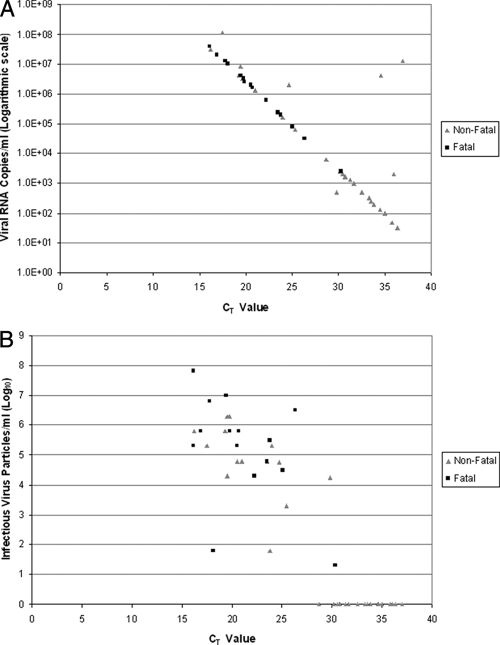
Approximately 8% of Rift Valley fever (RVF) cases develop severe disease, leading to hemorrhage, hepatitis, and/or encephalitis and resulting in up to 50% of deaths. A major obstacle in the management of RVF and other viral hemorrhagic fever cases in outbreaks that occur in rural settings is the inability to rapidly identify such cases, with poor prognosis early enough to allow for more-aggressive therapies. During an RVF outbreak in Kenya in 2006 to 2007, we evaluated whether quantitative real-time reverse transcription-PCR (qRT-PCR) could be used in the field to rapidly identify viremic RVF cases with risk of death. In 52 of 430 RVF cases analyzed by qRT-PCR and virus culture, 18 died (case fatality rate [CFR] = 34.6%). Levels of viremia in fatal cases were significantly higher than those in nonfatal cases (mean of 10(5.2) versus 10(2.9) per ml; P < 0.005). A negative correlation between the levels of infectious virus particles and the qRT-PCR crossover threshold (C(T)) values allowed the use of qRT-PCR to assess prognosis. The CFR was 50.0% among cases with C(T) values of <27.0 (corresponding to 2.1 x 10(4) viral RNA particles/ml of serum) and 4.5% among cases with C(T) values of >or=27.0. This cutoff yielded 93.8% sensitivity and a 95.5% negative predictive value; the specificity and positive predictive value were 58% and 50%, respectively. This study shows a correlation between high viremia and fatality and indicates that qRT-PCR testing can identify nearly all fatal RVF cases.
Figures

References
-
- Al-Afaleq, A. I., E. M. Abu Elzein, S. M. Mousa, and A. M. Abbas. 2003. A retrospective study of Rift Valley fever in Saudi Arabia. Rev. Sci. Tech. 22867-871. - PubMed
-
- Al-Hazmi, M., E. A. Ayoola, M. Abdurahman, S. Banzal, J. Ashraf, A. El-Bushra, A. Hazmi, M. Abdullah, H. Abbo, A. Elamin, T. Al-Sammani, M. Gadour, C. Monon, M. Hamza, I. Rahim, M. Hafez, M. Jambavalikar, H. Arishi, and A. Aqeel. 2003. Epidemic Rift Valley fever in Saudi Arabia: a clinical study of severe illness in humans. Clin. Infect. Dis. 36245-252. - PubMed
-
- Anyamba, A., K. J. Linthicum, and C. J. Tucker. 2001. Climate-disease connections: Rift Valley fever in Kenya. Cad. Saude Publica 17133-140. - PubMed
-
- Bishop, D. H., C. H. Calisher, J. Casals, M. P. Chumakov, S. Y. Gaidamovich, C. Hannoun, D. K. Lvov, I. D. Marshall, N. Oker-Blom, R. F. Pettersson, J. S. Porterfield, P. K. Russell, R. E Shope, and E. G. Westaway. 1980. Bunyaviridae. Intervirology 14125-143. - PubMed
-
- Centers for Disease Control and Prevention. 2007. Rift Valley fever outbreak—Kenya, November 2006-January 2007. MMWR Morb. Mortal. Wkly. Rep. 5673-76. - PubMed
Publication types
MeSH terms
LinkOut - more resources
Full Text Sources
