


Prevalence of abnormal lipid profiles and the relationship with the development of microalbuminuria in adolescents with type 1 diabetes
- PMID: 19171721
- PMCID: PMC2660471
- DOI: 10.2337/dc08-1641
Prevalence of abnormal lipid profiles and the relationship with the development of microalbuminuria in adolescents with type 1 diabetes
Abstract
Objective: To explore the prevalence of lipid abnormalities and their relationship with albumin excretion and microalbuminuria in adolescents with type 1 diabetes.
Research design and methods: The study population comprised 895 young subjects with type 1 diabetes (490 males); median age at the baseline assessment was 14.5 years (range 10-21.1), and median diabetes duration was 4.8 years (0.2-17). A total of 2,194 nonfasting blood samples were collected longitudinally for determination of total cholesterol, LDL cholesterol, HDL cholesterol, TG, and non-HDL cholesterol. Additional annually collected data on anthropometric parameters, A1C, and albumin-to-creatinine ratio (ACR) were available.
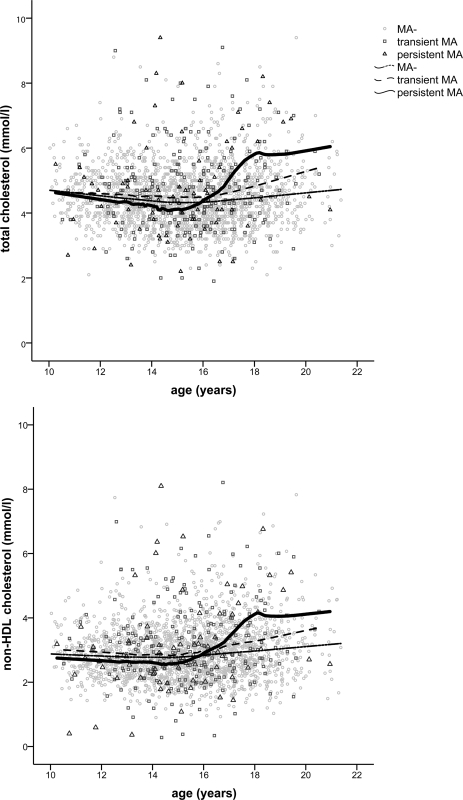
Results: Total cholesterol, LDL cholesterol, HDL cholesterol, and non-HDL cholesterol were higher in females than in males (all P < 0.001). A significant proportion of subjects presented sustained lipid abnormalities during follow-up: total cholesterol >5.2 mmol/l (18.6%), non-HDL cholesterol >3.4 mmol/l (25.9%), TG >1.7 mmol/l (20.1%), and LDL cholesterol >3.4 mmol/l (9.6%). Age and duration were significantly related to all lipid parameters (P < 0.001); A1C was independently related to all parameters (P < 0.001) except HDL cholesterol, whereas BMI SD scores were related to all parameters (P < 0.05) except total cholesterol. Total cholesterol and non-HDL cholesterol were independently related to longitudinal changes in ACR (B coefficient +/- SE): 0.03 +/- 0.01/1 mmol/l, P = 0.009, and 0.32 +/- 0.014/1 mmol/l, P = 0.02, respectively. Overall mean total cholesterol and non-HDL cholesterol were higher in microalbuminuria positive (n = 115) than in normoalbuminuric subjects (n = 780): total cholesterol 4.7 +/- 1.2 vs. 4.5 +/- 0.8 mmol/l (P = 0.04) and non-HDL cholesterol 3.2 +/- 1.2 vs. 2.9 +/- 0.8 mmol/l (P = 0.03).
Conclusions: In this longitudinal study of adolescents with type 1 diabetes, sustained lipid abnormalities were related to age, duration, BMI, and A1C. Furthermore, ACR was related to both total cholesterol and non-HDL cholesterol, indicating a potential role in the pathogenesis of diabetic nephropathy.
Figures
References
-
- Libby P, Nathan DM, Abraham K, et al. : Report of the National Heart, Lung, and Blood Institute: National Institute of Diabetes and Digestive and Kidney Diseases Working Group on Cardiovascular Complications of Type 1 Diabetes Mellitus. Circulation 2005; 111: 3489– 3493 - PubMed
-
- Durrington PN: Diabetic dyslipidaemia. Baillieres Best Pract Res Clin Endocrinol Metab 1999; 13: 265– 278 - PubMed
-
- Bonnet F, Cooper ME: Potential influence of lipids in diabetic nephropathy: insights from experimental data and clinical studies. Diabetes Metab 2000; 26: 254– 264 - PubMed
-
- Perkins BA, Ficociello LH, Silva KH, et al. : Regression of microalbuminuria in type 1 diabetes. N Engl J Med 2003; 348: 2285– 2293 - PubMed
Publication types
MeSH terms
Substances
Grants and funding
LinkOut - more resources
Full Text Sources
Other Literature Sources
Medical
Miscellaneous
