. 2009 Apr;87(4):423-33.
doi: 10.1007/s00109-009-0441-8. Epub 2009 Jan 28.

Ethyl pyruvate improves survival in awake hemorrhage

Affiliations

Ethyl pyruvate improves survival in awake hemorrhage

Bolin Cai et al. J Mol Med (Berl). 2009 Apr.

Abstract

Classical experimental models of hemorrhage are characterized by the use of anesthetics that may interfere with the typical immune responses and pathology of hemorrhage/resuscitation. Thus, therapeutic strategies successful in anesthetized animals might not be beneficial in clinical trials. In this study, we analyzed whether ethyl pyruvate could provide therapeutic benefits during resuscitation in awake (unanesthetized) hemorrhage. Our results indicate that hemorrhage in unanesthetized animals required approximately 25% higher blood withdrawal than anesthetized animals to achieve the same targeted mean arterial blood pressure. Resuscitation with Hextend reestablished circulatory volume and improved survival during resuscitation of awake rodents. Yet, over 75% of the animals resuscitated with Hextend died within the first hours after hemorrhage. Resuscitation with Hextend containing 50 mM ethyl pyruvate protected over 87% of the animals. This survival benefit did not correlate with significant changes in the metabolic markers but with an anti-inflammatory potential during resuscitation. Unlike classical hemorrhage in anesthetized animals, ethyl pyruvate reestablished mean arterial blood pressure significantly earlier than Hextend in unanesthetized rodents. Unanesthetized animals showed twofold higher serum tumor necrosis factor (TNF)-alpha than anesthetized animals subjected to the same blood pressure. This process was not due to the response of a single organ, but affected all the analyzed organs including the lung, heart, spleen, and liver. Although resuscitation with Hextend failed to attenuate systemic TNF-alpha levels, it inhibited TNF-alpha levels in the lung, heart, and liver but not in the spleen. Unlike Hextend, resuscitation with ethyl pyruvate prevented high serum TNF-alpha levels and blunted TNF-alpha responses in all the organs including the spleen. These studies indicate that the inflammatory responses in anesthetized animals differ from that in unanesthetized animals and that awake hemorrhage can provide advantages in the study of anti-inflammatory strategies during resuscitation. Ethyl pyruvate may attenuate systemic inflammatory responses during resuscitation and improve survival in experimental models of awake hemorrhage.


Figures
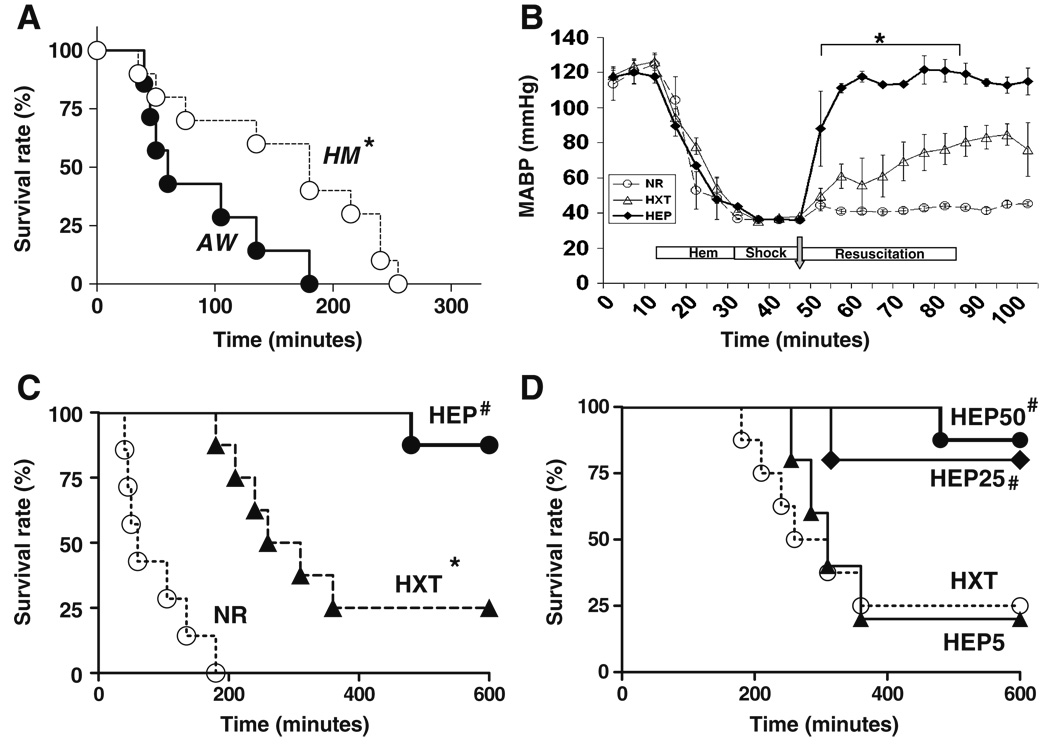
Fig. 1
Fig. 1
Resuscitation with Hextend supplemented with ethyl pyruvate improved survival in awake hemorrhage. Adult male Sprague–Dawley hemorrhagic rats received no resuscitation treatment (NR) or were resuscitated with 15 mL/kg (i.v.) Hextend (HXT) or Hextend supplemented with 50 mM ethyl pyruvate (HEP). a Survival in experimental hemorrhage induced in awake, conscious (AW) or anesthetized (HM) animals. P<0.05 survival log rank test AH vs. HM (asterisk). b Arterial blood pressure was recorded during the hemorrhage and the resuscitation treatment. c Resuscitation with Hextend supplemented with 50 mM ethyl pyruvate (HEP50) statistically protected the animals from experimental hemorrhage in awake animals (n=7/group). d Ethyl pyruvate improved survival in hemorrhage in a concentration-dependent manner in the animals treated with 50 mM (HEP50), 25 mM (HEP25), or 5 mM (HEP5) ethyl pyruvate. P<0.05 survival log rank test vs. NR (asterisk) or HXT (number symbol)
Fig. 2
Fig. 2
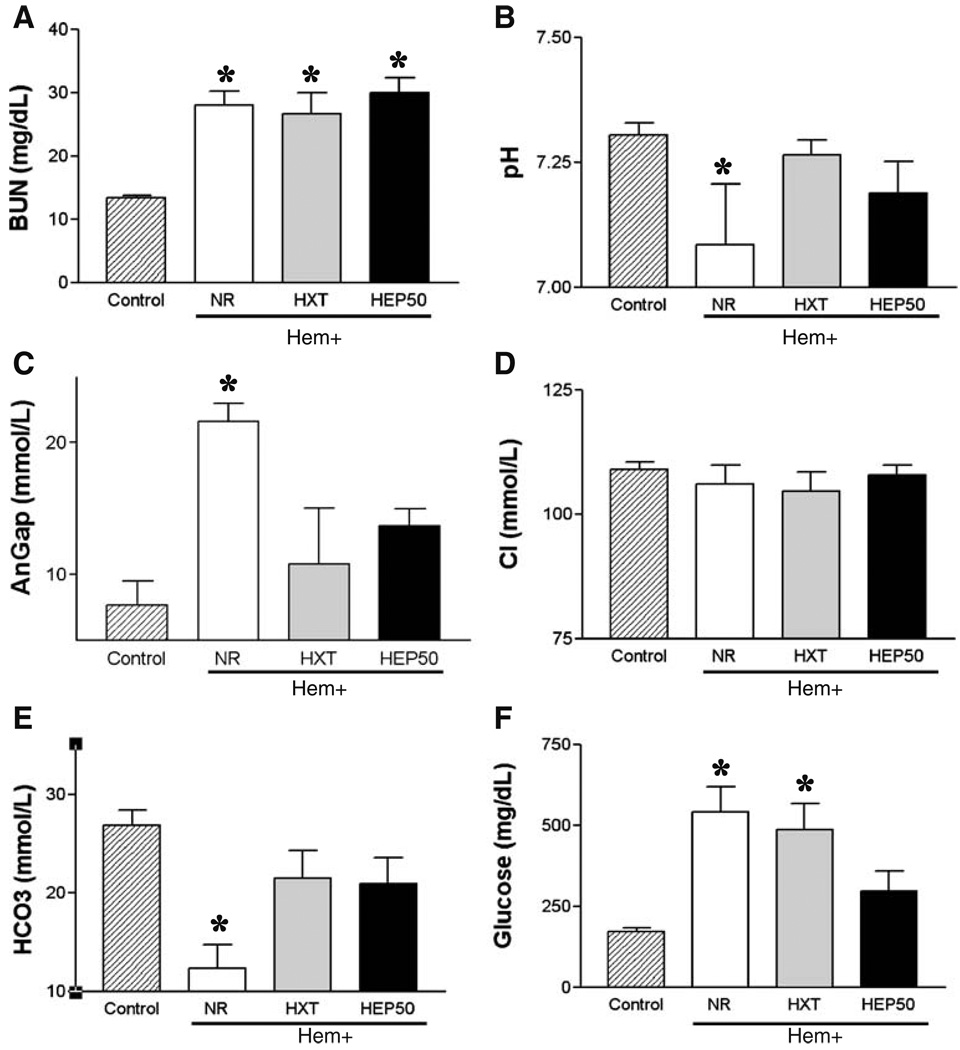
Blood chemistry analyses in awake hemorrhage. Blood from control adult male Sprague–Dawley rats or hemorrhagic awake animals without resuscitation treatment (NR) or resuscitated with 15 mL/kg (i.v.) Hextend (HXT) or Hextend supplemented with 50 mM ethyl pyruvate (HEP) was collected at 2 h after the hemorrhagic load to analyze a blood urea nitrogen (BUN), b pH, c the anion gap (AnGap), d chloride (Cl), e bicarbonate (HCO3), and f glucose. Number symbol represents p<0.05 for HEP vs. HXT. Asterisk represents p<0.05 vs. control (n=5/group; one-way ANOVA with Bonferroni’s corrections)
Fig. 3
Fig. 3
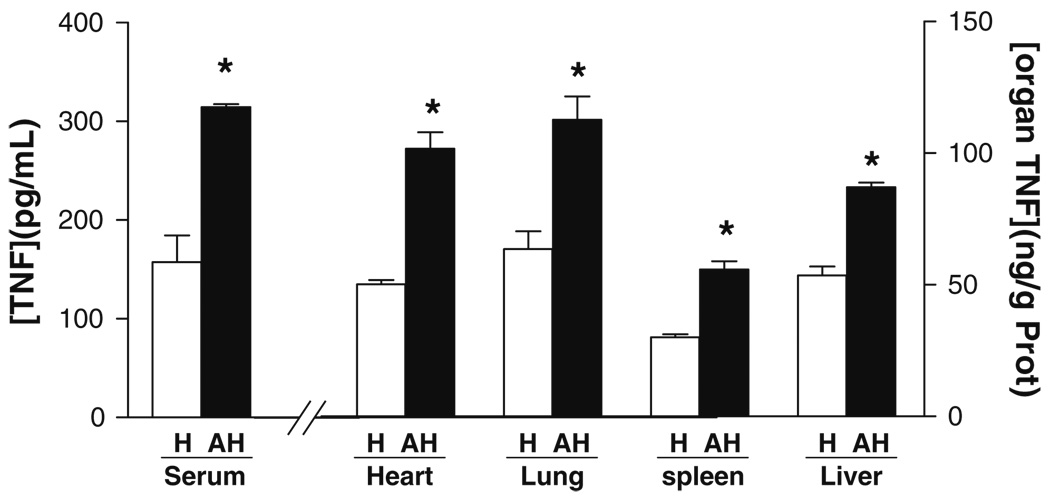
Systemic TNF-α responses in awake hemorrhage. Blood and organs from adult male Sprague–Dawley from anesthetized (H) or awake (AH) animals subjected to hemorrhage were collected at 2 h after the hemorrhagic load to analyze TNF-α protein concentration in the serum and specific organs. Asterisk represents p<0.05 vs. control (n=5/group; one-way ANOVA with Bonferroni’s corrections)
Fig. 4
Fig. 4
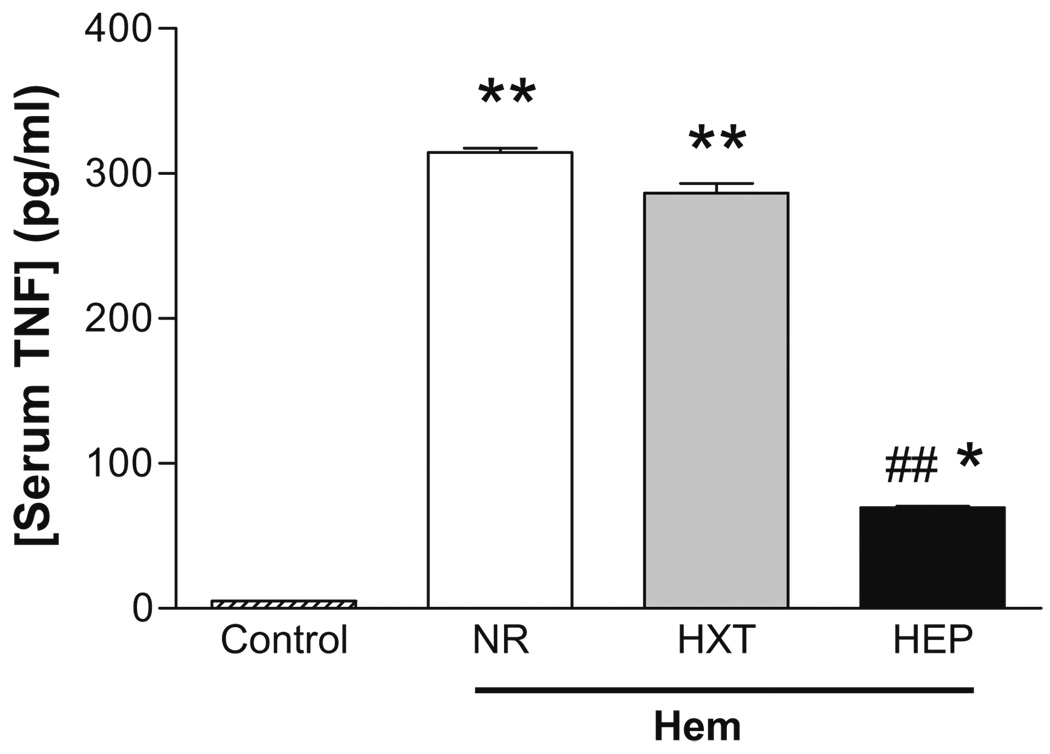
Resuscitation with ethyl pyruvate attenuated serum TNF-α levels in awake hemorrhage. Blood from control adult male Sprague–Dawley rats or hemorrhagic animals without resuscitation treatment (NR) or resuscitated with 15 mL/kg (i.v.) Hextend (HXT) or Hextend supplemented with 50 mM ethyl pyruvate (HEP) was collected at 2 h after the hemorrhagic load to analyze serum TNF-α levels. Number symbols represent p<0.01 for HEP vs. HXT. Asterisk represents p<0.05 HEP vs. control. Two asterisks represent p<0.01 HEP vs. control (n=5/group; one-way ANOVA with Bonferroni’s corrections)
Fig. 5
Fig. 5
Resuscitation with ethyl pyruvate attenuated TNF-α levels in major organs in awake hemorrhage. Organs from control or animals subjected to hemorrhage were analyzed at 2 h to determine TNF-α concentration in the lung (a), heart (b), spleen (c), and liver (d). Number symbol represents p<0.05 for HEP vs. HXT. Asterisk represents p<0.05 as compared to control (n=5/group; one-way ANOVA with Bonferroni’s corrections)
Fig. 6
Fig. 6
Ethyl pyruvate inhibited in vivo NF-κB and PARP activation during resuscitation. Organs from control or hemorrhagic animals without resuscitation treatment (NR) or resuscitated with 15 mL/kg (i.v.) Hextend (HXT) or Hextend supplemented with 50 mM ethyl pyruvate (HEP) were analyzed at 2 h to analyze the activation of the p65NF-κB and PARP. Number symbol represents p<0.05 for HEP vs. HXT. Asterisk represents p<0.05 as compared to control (n=5/group; one-way ANOVA with Bonferroni’s corrections)

References

    1. Mannucci PM, Levi M. Prevention and treatment of major blood loss. N Engl J Med. 2007;356:2301–2311. - PubMed
    1. Rushing GD, Britt LD. Reperfusion injury after hemorrhage: a collective review. Ann Surg. 2008;247:929–937. - PubMed
    1. Ulloa L, Tracey KJ. The “cytokine profile”: a code for sepsis. Trends Mol Med. 2005;11:56–63. - PubMed
    1. Ulloa L. The vagus nerve and the nicotinic anti-inflammatory pathway. Nat Rev Drug Discov. 2005;4:673–684. - PubMed
    1. Tracey KJ, Cerami A. Tumor necrosis factor, other cytokines and disease. Annu Rev Cell Biol. 1993;9:317–343. - PubMed

Publication types

MeSH terms

LinkOut - more resources