SIRT1, is it a tumor promoter or tumor suppressor?
- PMID: 19173036
- PMCID: PMC2631220
- DOI: 10.7150/ijbs.5.147
SIRT1, is it a tumor promoter or tumor suppressor?
Abstract
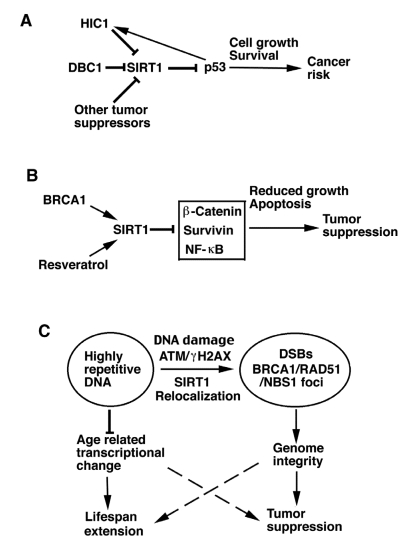
SIRT1 has been considered as a tumor promoter because of its increased expression in some types of cancers and its role in inactivating proteins that are involved in tumor suppression and DNA damage repair. However, recent studies demonstrated that SIRT1 levels are reduced in some other types of cancers, and that SIRT1 deficiency results in genetic instability and tumorigenesis, while overexpression of SIRT1 attenuates cancer formation in mice heterozygous for tumor suppressor p53 or APC. Here, I review these recent findings and discuss the possibility that activation of SIRT1 both extends lifespan and inhibits cancer formation.
Keywords: DNA damage repair; SIRT1; tumor promoter; tumor suppressor.
Conflict of interest statement
Conflict of Interest: The author has declared that no conflict of interest exists.
Figures
References
-
- Blander G, Guarente L. The Sir2 family of protein deacetylases. Annu Rev Biochem. 2004;73:417–435. - PubMed
-
- Guarente L. Sir2 links chromatin silencing, metabolism, and aging. Genes Dev. 2000;14:1021–1026. - PubMed
-
- Saunders LR, Verdin E. Sirtuins: critical regulators at the crossroads between cancer and aging. Oncogene. 2007;26:5489–5504. - PubMed
-
- Lavu S, Boss O, Elliott PJ et al. Sirtuins--novel therapeutic targets to treat age-associated diseases. Nat Rev Drug Discov. 2008;7:841–853. - PubMed
-
- Haigis MC, Guarente LP. Mammalian sirtuins--emerging roles in physiology, aging, and calorie restriction. Genes Dev. 2006;20:2913–2921. - PubMed
Publication types
MeSH terms
Substances
Grants and funding
LinkOut - more resources
Full Text Sources
Other Literature Sources
Research Materials
Miscellaneous