


Review
doi: 10.1016/j.cvfa.2008.10.013.
Pathophysiology of diarrhea in calves
Affiliations
- PMID: 19174281
- PMCID: PMC7125768
- DOI: 10.1016/j.cvfa.2008.10.013
Item in Clipboard
Review
Pathophysiology of diarrhea in calves
Vet Clin North Am Food Anim Pract.
2009 Mar.
Abstract
Infectious diarrhea in calves is most commonly associated with enterotoxigenic Escherichia coli, Cryptosporidium parvum, rotavirus, coronavirus, or some combination of these pathogens. Each of these agents leads to diarrhea through either secretion or malabsorption/maldigestion, though the specific mechanisms and pathways may differ. Specific pharmacologic control and treatment are dependent on gaining a greater understanding of the pathophysiology of these organisms.
Figures
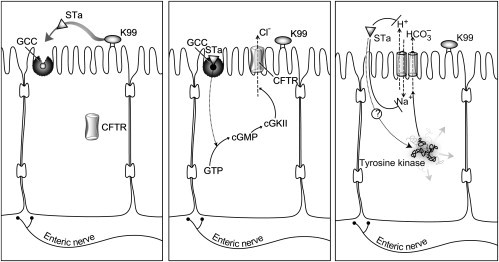
Frame 1: K99 ETEC binds to an intestinal epithelial cell, and heat stable toxin (STa) is secreted, which binds to the receptor GCC. The enteric nervous system becomes activated by the secretion of STa, but the mechanism of this activation is unclear. At this point, CFTR is not active. Frame 2: STa binds to GCC, which converts guanylyl triphosphate (GTP) to cGMP. cGMP activates cGKII to phosphorylate the CFTR, and the CFTR moves to the luminal surface and is activated, leading to chloride (Cl) secretion. Frame 3: Secreted STa activates tyrosine kinase through an unknown pathway, which leads to bicarbonate (HCO3) secretion. STa also directly inhibits the sodium–hydrogen exchanger, decreasing the movement of sodium (Na) and hydrogen (H) across the membrane.
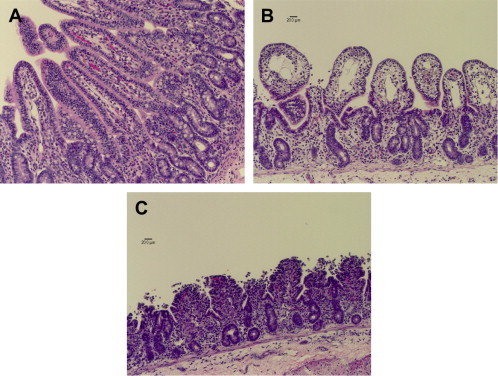
Normal and C parvum–infected intestinal mucosa from a calf ileum at 100× magnification. (A) Normal calf ileal mucosa. (B) and (C). Calf ileal mucosa experimentally infected with C parvum. Note the blunting of the villi and the hyperplasia of the crypts. There are more severe histologic changes in (C), because the villi are more atrophied and the mucosa no longer completely covers the lamina propria (hematoxylin and eosin).
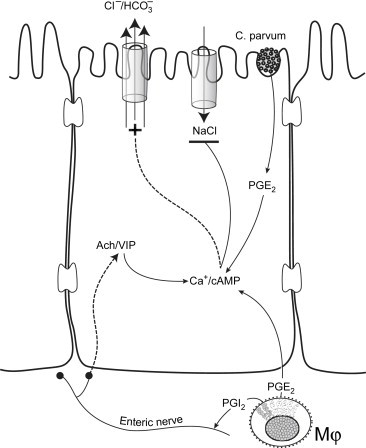
Infection of intestinal epithelial cells with C parvum induces the epithelial cell to secrete PGE2 and leads to activation of macrophages (M4) in the lamina propria. This leads to secretion of PGE2 and PGI2 from the mesenchymal cells. PGI2 activates the enteric nervous system to secrete acetylcholine (Ach) and VIP. The secretion of Ach, VIP, and PGE2 leads to an increase in intracellular calcium and cAMP, which activates anion secretion (Cl and HCO3) and inhibits neutral sodium and chloride absorption (NaCl).
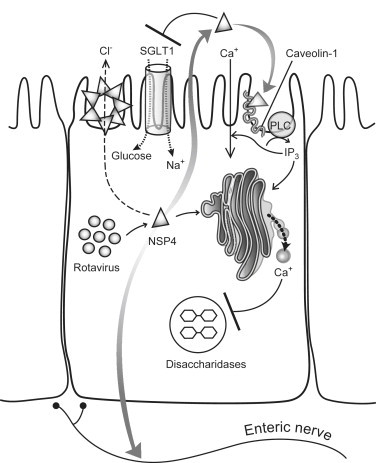
Once rotavirus replicates in an intestinal epithelial cell, the enterotoxin NSP4 is produced. It has autocrine effects by causing calcium (Ca) release from the endoplasmic reticulum. NSP4 has paracrine effects by being secreted and binding to caveolin-1. This activates PLC, which increases cytoplasmic IP3. IP3 increases intracellular calcium by increasing release from the endoplasmic reticulum and increasing calcium movement across the luminal membrane. The increased intracellular calcium inhibits movement of disaccharidases to the luminal surface. NSP4 directly inhibits the SGLT1 which decreases the absorption of sodium (Na) and glucose, and increases chloride (Cl) secretion by an unknown mechanism, but may involve a channel created by NSP4. NSP4 also activates the enteric nervous system by an unknown mechanism.
References
-
- NAHMS. Reference of 1997 beef cow-calf production management and disease control. USDA survey 1998.
-
- NAHMS. Dairy heifer morbidity, mortality, and health management focusing on preweaned heifers. USDA survey 1994.
-
- Sherwood D., Snodgrass D.R., Lawson G.H. Prevalence of enterotoxigenic Escherichia coli in calves in Scotland and northern England. Vet Rec. 1983;113(10):208–212. - PubMed
Publication types
MeSH terms
LinkOut - more resources
Full Text Sources
Other Literature Sources
Medical
