


Review
doi: 10.1016/j.cvfa.2008.10.001.
Treatment of calf diarrhea: intravenous fluid therapy
Affiliations
- PMID: 19174284
- PMCID: PMC7126998
- DOI: 10.1016/j.cvfa.2008.10.001
Item in Clipboard
Review
Treatment of calf diarrhea: intravenous fluid therapy
Vet Clin North Am Food Anim Pract.
2009 Mar.
Abstract
Severely dehydrated calves that are unable to suckle need intravenous fluids for effective resuscitation. Intravenous fluid therapy is also indicated for sick calves without obvious dehydration, such as calves with strong ion acidosis, ruminal acidosis (rumen drinkers), severe pneumonia, septicemia, or hypothermia. This article presents an updated overview of intravenous fluid therapy for calves, recent insights into the development of metabolic acidosis in young calves resulting from accumulation of D-lactate, a simplified algorithm for intravenous fluid therapy, and a procedure for ear vein catheterization under field conditions.
Figures
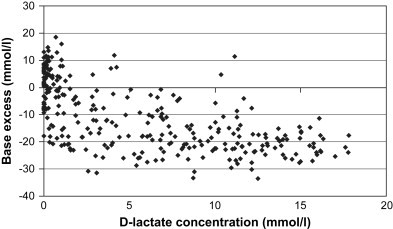
Blood base excess and serum D-lactate concentrations in 300 calves with neonatal diarrhea. (From Lorenz I. Influence of D-lactate on metabolic acidosis and on prognosis in neonatal calves with diarrhoea. J Vet Med A 2004;51:425–8; with permission.)
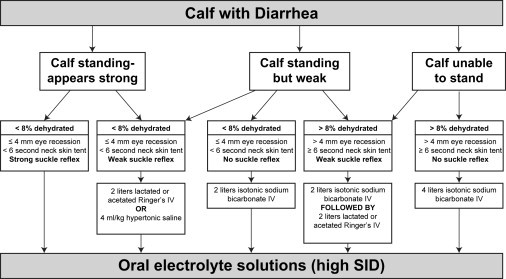
Algorithm for initial fluid therapy of dehydrated calves with diarrhea.
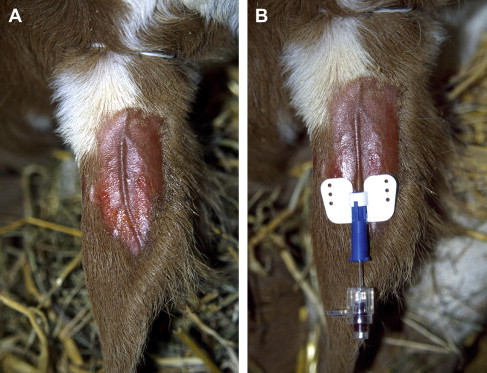
Placement of 22 gauge 1-inch (0.9 × 25 mm) catheter into cranial ear vein. (A) The vein is blocked with a rubber band at the base of the ear. The venipuncture site is shaved and sprayed with alcohol. (B) The catheter is advanced into the vein at least 0.5 in (1 cm) at once. The guide wire steel needle is then retracted slightly before the catheter is fully advanced into the ear vein. Confirm correct catheter position by checking for blood in the catheter hub and then withdraw guide wire needle completely.
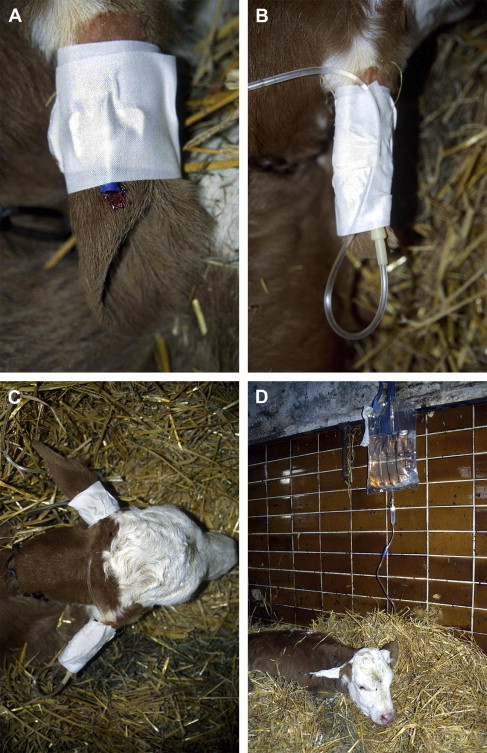
(A) Fixation of the ear vein catheter with one strip of adhesive tape after removing rubber band. Press adhesive tape firmly to the ear. (B) Fix the fluid line in a loop with second strip of adhesive tape. (C) Fix the fluid line to the opposite ear with a third strip of adhesive tape. (D) Administration of 5 L isotonic saline spiked with 250 mL 8.4% sodium bicarbonate by ear vein catheterization under field conditions.
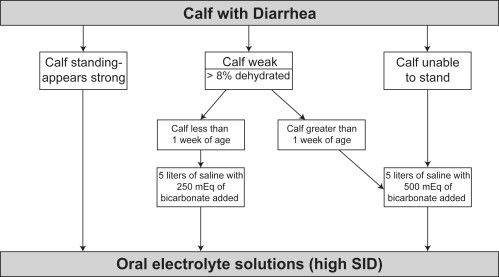
Simplified algorithm for fluid therapy of dehydrated calves. This approach requires that the practitioner carry only 5-L bags of 0.9% saline and 250-mL or 500-mL bottles of hypertonic sodium bicarbonate in practice. 8.4% sodium bicarbonate contains 1 mEq of bicarbonate per milliliter (so a 250-mL bottle equals 250 mEq of bicarbonate). 5% sodium bicarbonate contains 0.6 mEq of bicarbonate per milliliter (so a 500-mL bottle contains 298 mEq of bicarbonate).
References
-
- United States Department of Agriculture . National Animal Health Monitoring System; Fort Collins (CO): 2002. Part II: changes in the United States dairy industry, 1991–2002. #N388.0603.
-
- Svensson C., Linder A., Olsson S.O. Mortality in Swedish dairy calves and replacement heifers. J Dairy Sci. 2006;89:4769–4777. - PubMed
-
- Naylor JM, Zello GA, Abeysekara S. Advances in oral and intravenous fluid therapy of calves with gastrointestinal disease. In: Proceedings of the 24th World Buiatrics Congress. Nice, France; 2006. p. 139–50.
Publication types
MeSH terms
LinkOut - more resources
Full Text Sources
Medical
