Acupuncture treatment for pain: systematic review of randomised clinical trials with acupuncture, placebo acupuncture, and no acupuncture groups
- PMID: 19174438
- PMCID: PMC2769056
- DOI: 10.1136/bmj.a3115
Acupuncture treatment for pain: systematic review of randomised clinical trials with acupuncture, placebo acupuncture, and no acupuncture groups
Abstract
Objectives: To study the analgesic effect of acupuncture and placebo acupuncture and to explore whether the type of the placebo acupuncture is associated with the estimated effect of acupuncture.
Design: Systematic review and meta-analysis of three armed randomised clinical trials.
Data sources: Cochrane Library, Medline, Embase, Biological Abstracts, and PsycLIT. Data extraction and analysis Standardised mean differences from each trial were used to estimate the effect of acupuncture and placebo acupuncture. The different types of placebo acupuncture were ranked from 1 to 5 according to assessment of the possibility of a physiological effect, and this ranking was meta-regressed with the effect of acupuncture.
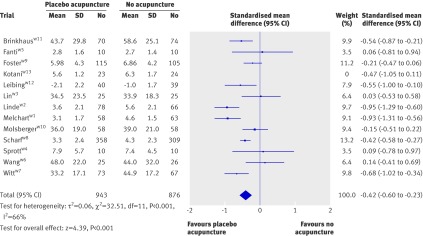
Data synthesis: Thirteen trials (3025 patients) involving a variety of pain conditions were eligible. The allocation of patients was adequately concealed in eight trials. The clinicians managing the acupuncture and placebo acupuncture treatments were not blinded in any of the trials. One clearly outlying trial (70 patients) was excluded. A small difference was found between acupuncture and placebo acupuncture: standardised mean difference -0.17 (95% confidence interval -0.26 to -0.08), corresponding to 4 mm (2 mm to 6 mm) on a 100 mm visual analogue scale. No statistically significant heterogeneity was present (P=0.10, I(2)=36%). A moderate difference was found between placebo acupuncture and no acupuncture: standardised mean difference -0.42 (-0.60 to -0.23). However, considerable heterogeneity (P<0.001, I(2)=66%) was also found, as large trials reported both small and large effects of placebo. No association was detected between the type of placebo acupuncture and the effect of acupuncture (P=0.60).
Conclusions: A small analgesic effect of acupuncture was found, which seems to lack clinical relevance and cannot be clearly distinguished from bias. Whether needling at acupuncture points, or at any site, reduces pain independently of the psychological impact of the treatment ritual is unclear.
Conflict of interest statement
Competing interests: None declared.
Figures

Comment in
-
Does acupuncture relieve pain?BMJ. 2009 Jan 27;338:a2760. doi: 10.1136/bmj.a2760. BMJ. 2009. PMID: 19174437 No abstract available.
References
-
- Kaptchuk TJ. The web that has no weaver: understanding Chinese medicine. New York: Contemporary Books, 2000.
-
- Irnich D, Beyer A. Neurobiological mechanisms of acupuncture analgesia. Schmerz 2002;16:93-102. - PubMed
-
- Ghia JM, Mao W, Toomey TC, Gregg JM. Acupuncture and chronic pain mechanisms. Pain 1976;2:285-99. - PubMed
-
- Lewit K. The needle effect in the relief of myofascial pain. Pain 1979;6:83-90. - PubMed
Publication types
MeSH terms
Substances
LinkOut - more resources
Full Text Sources
Medical