. 2009 Jan 28;29(4):1224-34.
doi: 10.1523/JNEUROSCI.4858-08.2009.

Genetically determined interaction between the dopamine transporter and the D2 receptor on prefronto-striatal activity and volume in humans

Affiliations

Genetically determined interaction between the dopamine transporter and the D2 receptor on prefronto-striatal activity and volume in humans

Alessandro Bertolino et al. J Neurosci. .

Abstract

Dopamine modulation of neuronal activity during memory tasks identifies a nonlinear inverted-U shaped function. Both the dopamine transporter (DAT) and dopamine D(2) receptors (encoded by DRD(2)) critically regulate dopamine signaling in the striatum and in prefrontal cortex during memory. Moreover, in vitro studies have demonstrated that DAT and D(2) proteins reciprocally regulate each other presynaptically. Therefore, we have evaluated the genetic interaction between a DRD(2) polymorphism (rs1076560) causing reduced presynaptic D(2) receptor expression and the DAT 3'-VNTR variant (affecting DAT expression) in a large sample of healthy subjects undergoing blood oxygenation level-dependent (BOLD)-functional magnetic resonance imaging (MRI) during memory tasks and structural MRI. Results indicated a significant DRD(2)/DAT interaction in prefrontal cortex and striatum BOLD activity during both working memory and encoding of recognition memory. The differential effect on BOLD activity of the DAT variant was mostly manifest in the context of the DRD(2) allele associated with lower presynaptic expression. Similar results were also evident for gray matter volume in caudate. These interactions describe a nonlinear relationship between compound genotypes and brain activity or gray matter volume. Complementary data from striatal protein extracts from wild-type and D(2) knock-out animals (D2R(-/-)) indicate that DAT and D(2) proteins interact in vivo. Together, our results demonstrate that the interaction between genetic variants in DRD(2) and DAT critically modulates the nonlinear relationship between dopamine and neuronal activity during memory processing.


Figures
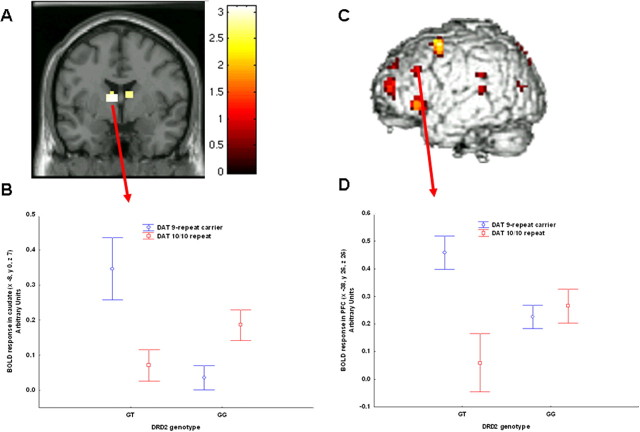
Figure 1.
Figure 1.
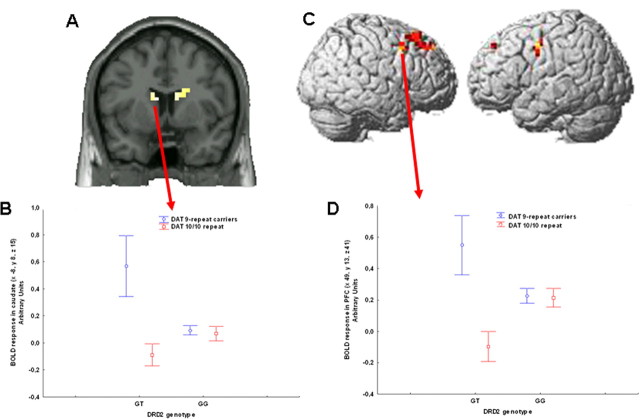
A, Coronal MRI section through the caudate nuclei indicating locales with DRD2-DAT genotype interaction on BOLD response during working memory (image thresholded at p < 0.005, uncorrected); B, mean ± SE of BOLD response in caudate of the interaction between DRD2 and DAT genotypes. C, Three-dimensional rendering indicating the interaction between DRD2-DAT genotypes on cortical working memory; D, mean ± SE confidence intervals of BOLD response of the interaction between DRD2-DAT genotype in left middle frontal gyrus activity during working memory.
Figure 2.
Figure 2.
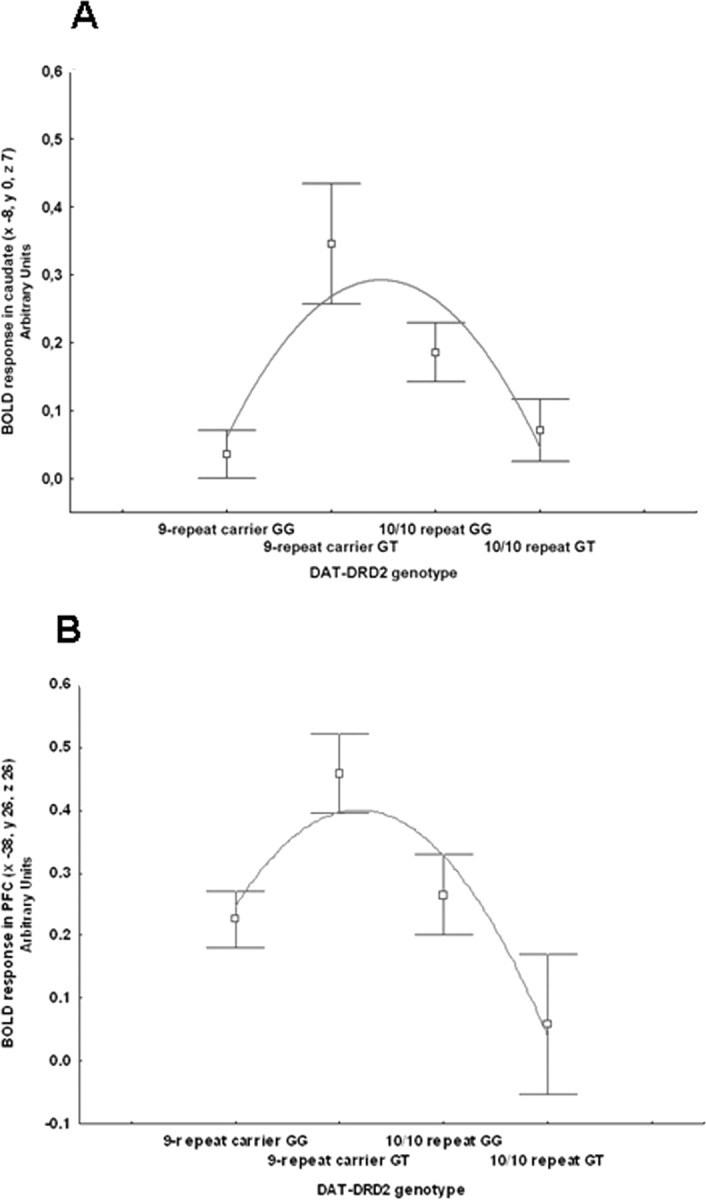
A, B, Mean ± SE of BOLD response in caudate (A) and in middle frontal gyrus (PFC; B) during working memory in compound genotype groups. Since we expected that the genotypes potentially associated with putative intermediate levels of dopamine would show more focused activity for a similar level of behavioral performance, genotype groups are ordered from putative less dopamine reuptake (DAT 9-carriers have less DAT expression) and release (DRD2 GG subjects have greater presynaptic D2 mRNA) to greater reuptake and release (DAT 10–10 repeat DRD2 GT subjects). The relationship between compound genotype and BOLD response is nonlinear. Genotypes on the y-axis are ordered to reflect the nature of our hypothesis about the relationship between putative levels of dopamine stimulation determined by compound genotypes and BOLD activity for a given level of performance. Thus, genotypes at the two extremes of the curve are hypothesized to have intermediate levels of dopamine stimulation and more efficient BOLD activity (less activity for a given behavioral performance).
Figure 3.
Figure 3.
A, Coronal MRI section through the caudate nuclei indicating locales with DRD2-DAT genotype interaction on BOLD response during encoding of recognition memory (image thresholded at p < 0.005, uncorrected); B, mean ± SE of BOLD response of the interaction between DRD2 and DAT genotypes. C, Three-dimensional rendering indicating the interaction between DRD2-DAT genotypes on cortical activity during encoding of recognition memory; D, mean ± SE of BOLD response of the interaction between DRD2-DAT genotype in right middle frontal gyrus activity during encoding of recognition memory.
Figure 4.
Figure 4.
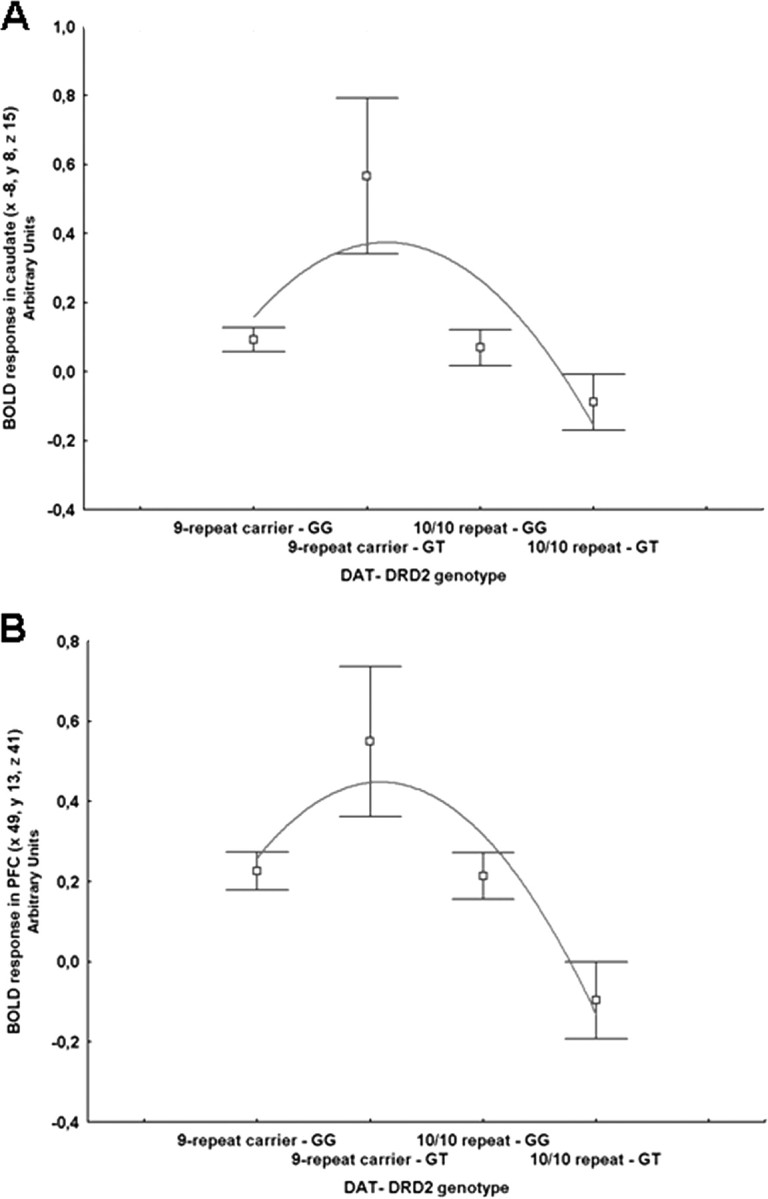
A, B, Mean ± SE of BOLD response in caudate (A) and in middle frontal gyrus (PFC; B) during encoding of recognition memory in compound genotype groups ordered from putative less dopamine reuptake (DAT 9-carriers have less DAT expression) and release (DRD2 GG subjects have greater presynaptic D2 mRNA) to greater reuptake and release (DAT 10–10 repeat DRD2 GT subjects). The relationship between compound genotype and BOLD response is nonlinear.
Figure 5.
Figure 5.
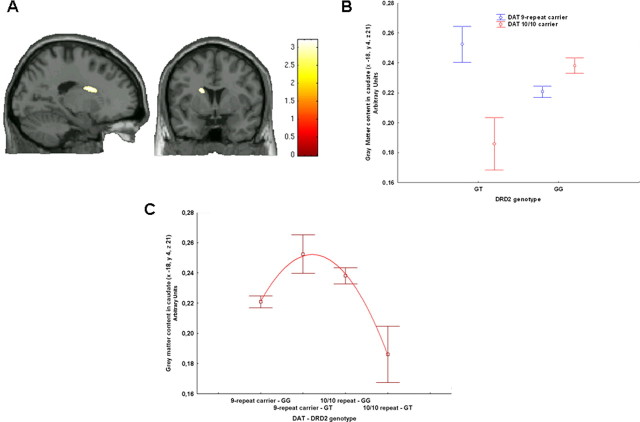
A, Sagittal and coronal MRI sections through the caudate nuclei indicating locales with DRD2-DAT genotype interaction on gray matter content (image thresholded at p < 0.005, uncorrected); B, mean ± SE of gray matter content of the interaction between DRD2 and DAT genotypes; C, mean ± SE of gray matter content in caudate in compound genotype groups ordered from putative less dopamine reuptake (DAT 9-carriers have less DAT expression) and release (DRD2 GG subjects have greater presynaptic D2 mRNA) to greater reuptake and release (DAT 10–10 repeat DRD2 GT subjects). The relationship between compound genotype and gray matter content is nonlinear.
Figure 6.
Figure 6.
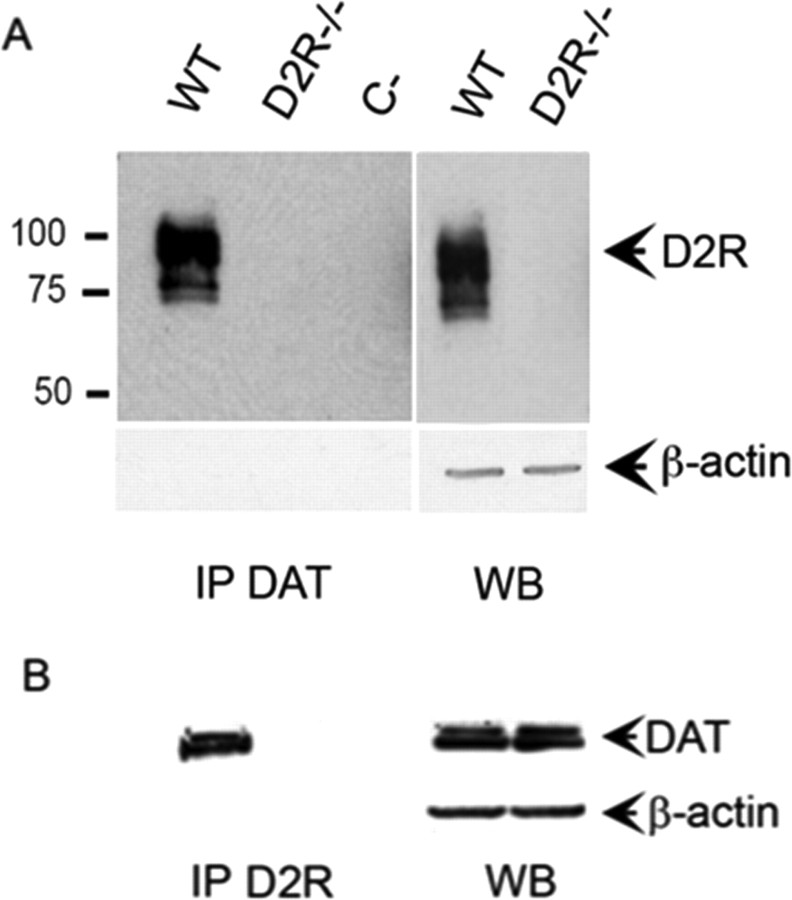
Immunoprecipitation experiments show D2R-DAT interaction in vivo. Striatal membranes were prepared from WT and D2R−/− mice. Proteins (500 μg) were used for immunoprecipitation experiments using either DAT or D2R specific antibodies. A, Samples were immunoprecipitated with anti-DAT and reveled with anti-D2R antibodies (first 2 lanes). Note the presence of immunoprecipitated D2R only in WT striata but not from D2R−/− striatal membranes; C, control experiments were performed using normal IgG rabbit. Western blots (WB) were performed using 50 μg striatal membranes showing the presence of D2R only in WT extracts. B, Same as in A, but proteins were precipitated with anti-D2R antibody and revealed with anti-DAT antibody; C, control experiments were performed using normal IgG mouse. Note that DAT was precipitated only from WT extracts. Western blots, as in A, were revealed using anti-DAT antibody showing presence of DAT in WT and D2R−/− extracts. Actin was used as internal control of loaded quantities of striatal extracts in A and B.

References

    1. Alexander GE, DeLong MR, Strick PL. Parallel organization of functionally segregated circuits linking basal ganglia and cortex. Annu Rev Neurosci. 1986;9:357–381. - PubMed
    1. Arnsten AF, Cai JX, Steere JC, Goldman-Rakic PS. Dopamine D2 receptor mechanisms contribute to age-related cognitive decline: the effects of quinpirole on memory and motor performance in monkeys. J Neurosci. 1995;15:3429–3439. - PMC - PubMed
    1. Ashburner J, Friston KJ. Unified segmentation. Neuroimage. 2005;26:839–851. - PubMed
    1. Baik JH, Picetti R, Saiardi A, Thiriet G, Dierich A, Depaulis A, Le Meur M, Borrelli E. Parkinsonian-like locomotor impairment in mice lacking dopamine D2 receptors. Nature. 1995;377:424–428. - PubMed
    1. Bertolino A, Caforio G, Blasi G, De Candia M, Latorre V, Petruzzella V, Altamura M, Nappi G, Papa S, Callicott JH, Mattay VS, Bellomo A, Scarabino T, Weinberger DR, Nardini M. Interaction of COMT Val108/158 Met genotype and olanzapine treatment on prefrontal cortical function in patients with schizophrenia. Am J Psychiatry. 2004;161:1798–1805. - PubMed

Publication types

MeSH terms

Substances

LinkOut - more resources