. 2009 Feb 24;48(7):1517-24.
doi: 10.1021/bi802298r.

Characterization of a heparin-binding site on the catalytic domain of factor XIa: mechanism of heparin acceleration of factor XIa inhibition by the serpins antithrombin and C1-inhibitor

Affiliations

Characterization of a heparin-binding site on the catalytic domain of factor XIa: mechanism of heparin acceleration of factor XIa inhibition by the serpins antithrombin and C1-inhibitor

Likui Yang et al. Biochemistry. .

Abstract

Heparin accelerates inhibition of factor XIa (fXIa) by the serpins antithrombin (AT) and C1-inhibitor (C1-INH) by more than 2 orders of magnitude. The mechanism of the heparin-mediated acceleration of fXIa inhibition by these serpins is incompletely understood, as heparin appears to interact with both the catalytic and noncatalytic domains of the protease. We replaced the basic residues of the fXIa 170 loop (Lys-170, Arg-171, Arg-173, Lys-175, and Lys-179; chymotrypsin numbering) with Ala, using an expression system that allows separation of the fXIa catalytic domain (CD) from noncatalytic domains. Heparin-mediated inhibition of 170 loop CD variants with AT was impaired 3-10-fold relative to that of the wild-type (CD-WT). In reactions with C1-INH, Arg-171 was the most critical residue contributing approximately 2-3-fold to heparin-mediated inhibition of CD-WT. A template mechanism did not fully account for the effect of heparin with either serpin, as the second-order inhibition rate constants did not exhibit a characteristic bell-shaped dependence on heparin concentration. Further studies revealed that the C1-INH inhibition of full-length fXIa containing Ala substitutions for basic residues of the 148 loop is not enhanced by heparin. Inhibition by AT of a full-length fXIa variant containing an Ala substitution for Arg-37 in the fXIa CD was approximately 5-fold greater than for wild-type fXIa in the absence of heparin. These results suggest that basic residues of the fXIa 170 loop form a heparin-binding site and that the accelerating effect of heparin on inhibition of fXIa by AT or C1-INH may be mediated by charge neutralization and/or allosteric mechanisms that overcome the repulsive inhibitory interactions of serpins with basic residues on the fXIa 148 and 37 loops.


Figures
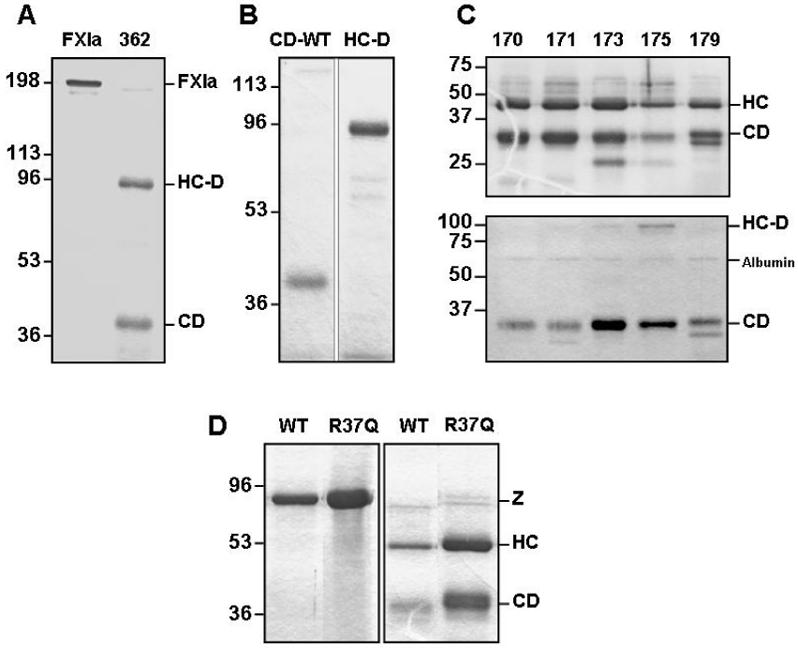
Figure 1
Figure 1
(A) Non-reducing SDS-polyacrylamide gel of full length fXIa and fXIa-Ser362-482 (labeled 362) lacking the disulfide bond. (B) The first lane is the 1G5.12 affinity purified catalytic domain (CD-WT) of fXIa-Ser362-482 and the second lane is the flow-through heavy chain dimer (HC-D). (C) The top panel is a reducing gel of the Ala substitution mutants of fXIa-Ser362-482 and the bottom panel is a non-reducing gel showing purified catalytic domains (CD) of the same mutants, along with the position of residual heavy chain dimer (HC-D) and traces of albumin from conditioned media. (D) Reducing gel of full-length fXI (left panel) and fXIa (right panel). Shown are wild type fXI/fXIa (WT) and fXI/fXIa-R37Q. Abbreviations to the right of the panel are: (Z) - zymogen fXI, (HC) - fXIa heavy chain, and (CD) - fXIa catalytic domain. Positions of molecular mass standards are shown to the left of each panel.
Figure 2
Figure 2
Heparin concentration dependence of fXIa catalytic domain inhibition by AT. (A) The heparin dependence of k2 for AT inhibition of CD-WT (○), K170A (●), R171A (□), R173A (■), K175A (△), K179A (▲) and the triple mutant KRR/A (▽) are shown for unfractionated heparin. k2 values (Table 2) were determined from the remaining activities of CDs as described under “Materials and Methods”. (B) The same as panel A except that k2 values for AT inhibition of fXIa CDs were determined in the presence of increasing concentrations of a high-affinity fractionated heparin composed of ∼64 saccharides. (C) The same as panel A except that k2 values for AT inhibition of fXIa CDs were determined in the presence of increasing concentrations of a high-affinity fractionated heparin composed of ∼35 saccharides.
Figure 3
Figure 3
Heparin concentration dependence of fXIa catalytic domain inhibition by C1-INH. (A) The heparin dependence of k2 for C1-INH inhibition of CD-WT (○), K170A (●), R171A (□), R173A (■), K175A (△), K179A (▲) and the triple mutant KRR/A (▽) are shown for unfractionated heparin. k2 values (Table 3) were determined from the remaining activities of CDs as described under “Materials and Methods”. (B) The same as panel A except that k2 values for C1-INH inhibition of CD-WT (○) and CD-KRR/A (▽) were determined in the presence of increasing concentrations of a high-affinity fractionated heparin composed of ∼64 saccharides.
Figure 4
Figure 4
Heparin concentration dependence of AT inhibition of fXIa. Shown is the dependence of k2 for AT inhibition of full-length fXIa-WT (○) and the autolysis loop mutant fXIa-144-149A (●) on heparin concentrations using unfractionated heparin. k2 values were determined from the remaining fXIa activity as described under “Materials and Methods”.
Figure 5
Figure 5
Structure of the catalytic domain of fXIa. Shown is the peptide backbone for the crystal structure of factor XIa catalytic domain in complex with p-aminobenzamidine. The side chains of basic residues in the 170-helix, 220-loop and Arg-37 are shown in blue. The active site serine residue (Ser-195) is in green. The backbone of autolysis loop residues 144-149 are colored in red. The coordinates (Protein Data Bank code 1ZHM) of the catalytic domain of fXIa were used to prepare the figure (30).

References

    1. Wiggins RC, Bouma BN, Cochrane CG, Griffin JH. Role of high molecular-weight kininogen in surface-binding and activation of coagulation factor XI and prekallikrein. Proc. Natl. Acad. Sci. (USA) 1977;74:4636–4640. - PMC - PubMed
    1. Walsh PN, Griffin JH. Contributions of human platelets to the proteolytic activation of blood coagulation factors XII and XI. Blood. 1981;57:106–118. - PubMed
    1. Kurachi K, Davie EW. Activation of human factor XI (plasma thromboplastin antecedent) by factor XIIa (activated Hageman factor) Biochemistry. 1977;16:5831–5839. - PubMed
    1. Gailani D, Broze GJ., Jr. Factor XI activation in a revised model of blood coagulation. Science. 1991;253:909–912. - PubMed
    1. Ragni MV, Sinha D, Seaman F, Lewis JH, Spero JA, Walsh PN. Comparison of bleeding tendency, factor XI coagulant activity, and factor XI antigen in 25 factor XI-deficient kindreds. Blood. 1985;65:719–724. - PubMed

Publication types

Associated data
