


Development of a multi-locus sequence typing scheme for Laribacter hongkongensis, a novel bacterium associated with freshwater fish-borne gastroenteritis and traveler's diarrhea
- PMID: 19178751
- PMCID: PMC2644701
- DOI: 10.1186/1471-2180-9-21
Development of a multi-locus sequence typing scheme for Laribacter hongkongensis, a novel bacterium associated with freshwater fish-borne gastroenteritis and traveler's diarrhea
Abstract
Background: Laribacter hongkongensis is a newly discovered, facultative anaerobic, Gram-negative, motile, sea gull-shaped rod associated with freshwater fish borne gastroenteritis and traveler's diarrhea. A highly reproducible and discriminative typing system is essential for better understanding of the epidemiology of L. hongkongensis. In this study, a multilocus sequence typing (MLST) system was developed for L. hongkongensis. The system was used to characterize 146 L. hongkongensis isolates, including 39 from humans and 107 from fish.
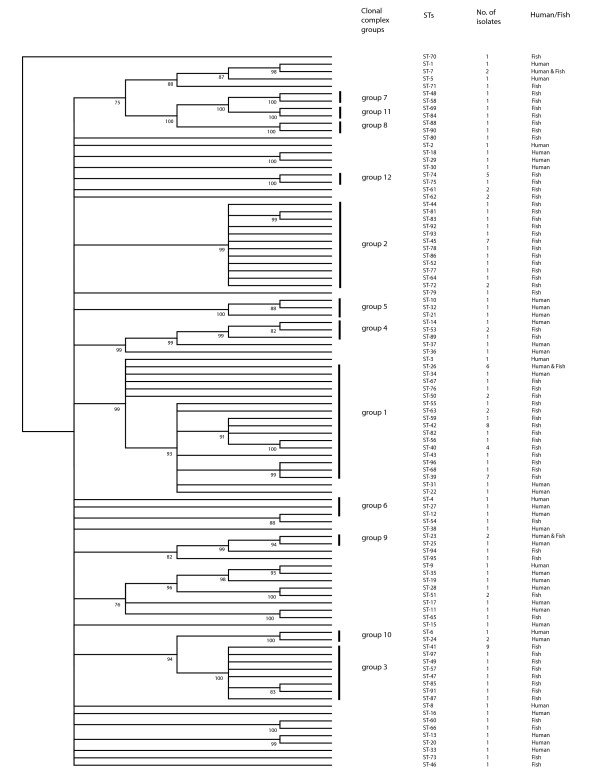
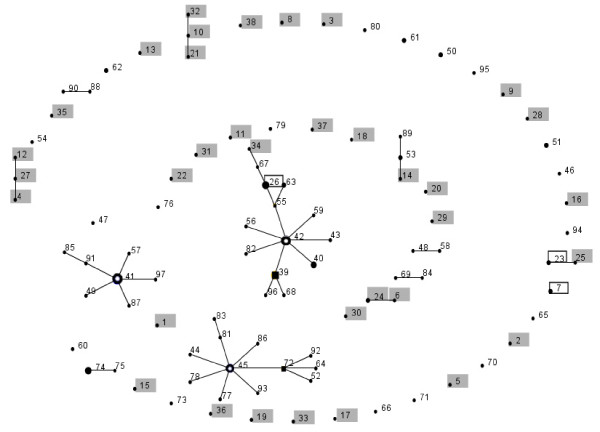
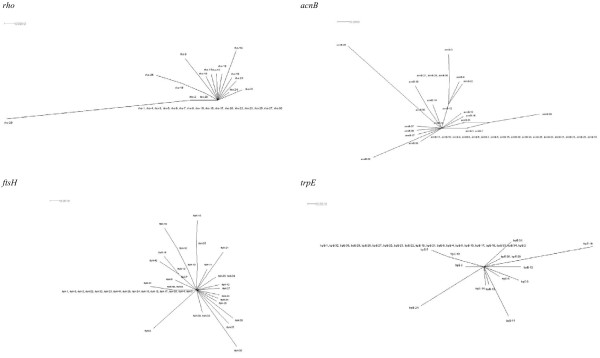
Results: Fragments (362 to 504 bp) of seven housekeeping genes were amplified and sequenced. Among the 3068 bp of the seven loci, 332 polymorphic sites were observed. The median number of alleles at each locus was 34 [range 22 (ilvC) to 45 (thiC)]. All seven genes showed very low d(n)/d(s) ratios of < 0.04, indicating that no strong positive selective pressure is present. A total of 97 different sequence types (STs) were assigned to the 146 isolates, with 80 STs identified only once. The overall discriminatory power was 0.9861. eBURST grouped the isolates into 12 lineages, with six groups containing only isolates from fish and three groups only isolates from humans. Standardized index of association (I(S)(A)) measurement showed significant linkage disequilibrium in isolates from both humans and fish. The I(S)(A) for the isolates from humans and fish were 0.270 and 0.636, indicating the isolates from fish were more clonal than the isolates from humans. Only one interconnected network (acnB) was detected in the split graphs. The P-value (P = 0) of sum of the squares of condensed fragments in Sawyer's test showed evidence of intragenic recombination in the rho, acnB and thiC loci, but the P-value (P = 1) of maximum condensed fragment in these gene loci did not show evidence of intragenic recombination. Congruence analysis showed that all the pairwise comparisons of the 7 MLST loci were incongruent, indicating that recombination played a substantial role in the evolution of L. hongkongensis. A website for L. hongkongensis MLST was set up and can be accessed at http://mlstdb.hku.hk:14206/MLST_index.html.
Conclusion: A highly reproducible and discriminative MLST system was developed for L. hongkongensis.
Figures
References
-
- Woo PC, Lau SK, Teng JL, Que TL, Yung RW, Luk WK, Lai RW, Hui WT, Wong SS, Yau HH, Yuen KY. Association of Laribacter hongkongensis in community-acquired human gastroenteritis with travel and with eating fish: a multicentre case-control study. Lancet. 2004;363:1941–1947. doi: 10.1016/S0140-6736(04)16407-6. - DOI - PubMed
Publication types
MeSH terms
Substances
LinkOut - more resources
Full Text Sources
Medical
