. 2009 Jan 30;323(5914):630-3.
doi: 10.1126/science.1166175.

Survival from hypoxia in C. elegans by inactivation of aminoacyl-tRNA synthetases

Affiliations

Survival from hypoxia in C. elegans by inactivation of aminoacyl-tRNA synthetases

Lori L Anderson et al. Science. .

Abstract

Hypoxia is important in a wide range of biological processes, such as animal hibernation and cell survival, and is particularly relevant in many diseases. The sensitivity of cells and organisms to hypoxic injury varies widely, but the molecular basis for this variation is incompletely understood. Using forward genetic screens in Caenorhabditis elegans, we isolated a hypoxia-resistant reduction-of-function mutant of rrt-1 that encodes an arginyl-transfer RNA (tRNA) synthetase, an enzyme essential for protein translation. Knockdown of rrt-1, and of most other genes encoding aminoacyl-tRNA synthetases, rescued animals from hypoxia-induced death, and the level of hypoxia resistance was inversely correlated with translation rate. The unfolded protein response was induced by hypoxia and was required for the hypoxia resistance of the reduction-of-function mutant of rrt-1. Thus, translational suppression produces hypoxia resistance, in part by reducing unfolded protein toxicity.


Figures
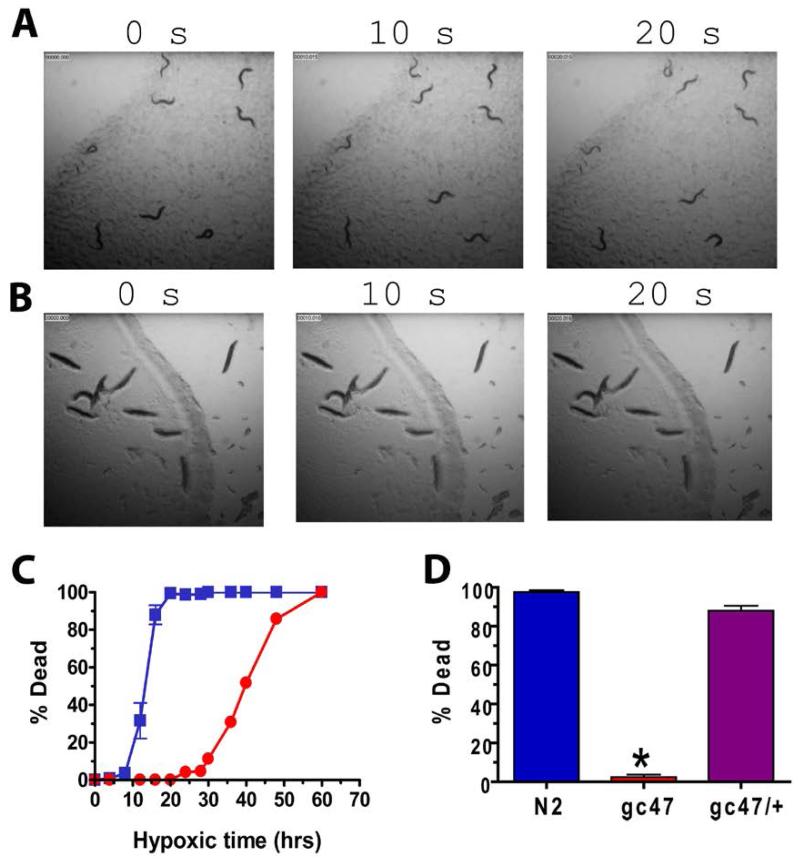
Fig. 1
Fig. 1. gc47 is a potent regulator of hypoxic cell death in C. elegans
(A,B) Time lapse images of (A) gc47 and (B) N2 adult worms following a 24 hr recovery from a 20 hr hypoxic insult. (C) Percent dead animals for N2 (blue squares) and gc47 (red circles) after a 24 hour recovery as a function of length of hypoxic insult. (D) gc47 is recessive. Percent death of homozygous gc47 (red; trials = 13), heterozygous gc47/+ (purple; trials = 9), and N2 (blue; trials = 16). mean ± s.e.m with at least 30 animals/trial.; * p < 0.01 (two-tailed t test).
Fig. 2
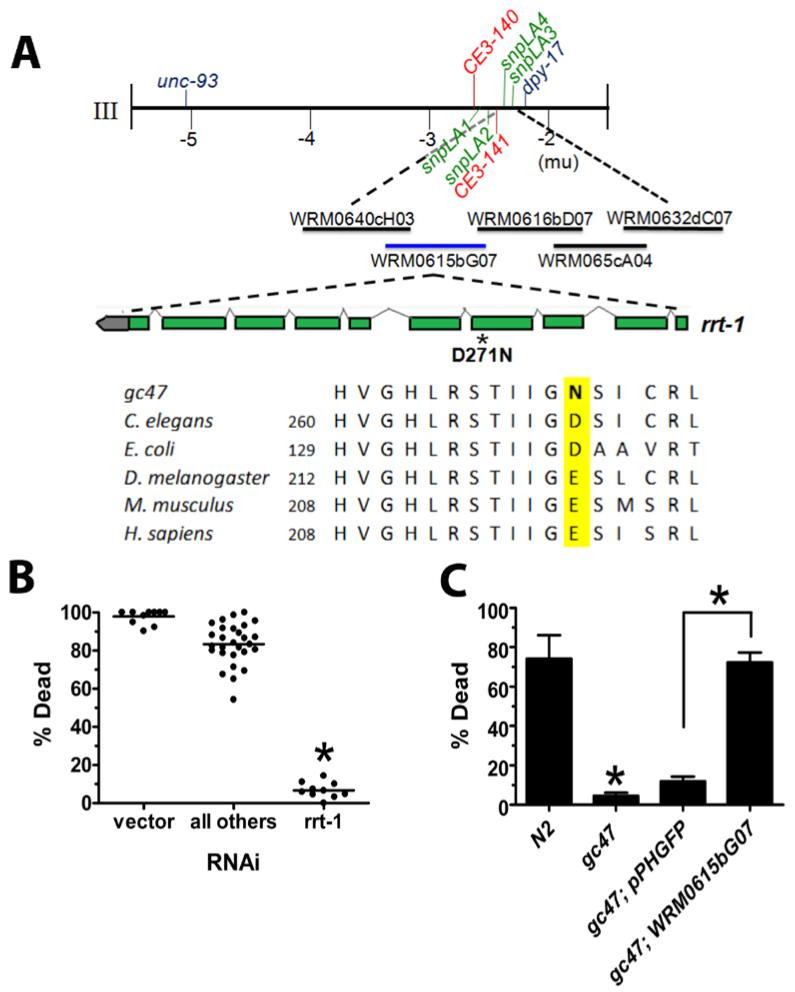
Fig. 2. gc47 is an allele of rrt-1
(A) Genetic mapping of gc47. A portion of the genetic map of chromosome III is shown, with genes causing visible phenotypes in blue and relevant single nucleotide polymorphisms between Hawaiian CB4856 and N2 indicated in red (previously reported) or green (reported herein). Three-factor mapping with the visible markers and SNPs placed gc47 in a 106 kb interval between CE3-141 and snpLA3. Fosmids used to attempt transformation rescue are shown below with the rescuing fosmid shown in blue. Alignment is with rrt-1 orthologs. (B) RNAi of genes within the 106 kbp mapping interval. Hypoxia-induced death of animals treated with 29/32 predicted genes within the mapping interval are shown. The empty vector is shown as a non-resistant control. rrt-1 RNAi confers highly significant hypoxia resistance (P < 0.01; two-tailed t test, n = 30 animals/data point). (C) Transformation rescue of gc47. Hypoxia-induced animal death was scored in N2 wild type, gc47 (full genotype: rrt-1(gc47) dpy-17(e164)), and gc47 transformed with the transformation marker pPHGFP alone or in addition, the rescuing fosmid WRM0615bG07. mean ± s.e.m. of > 2 trials of > 20 animals/trial); * p < 0.01 (two-tailed t test).
Fig. 3
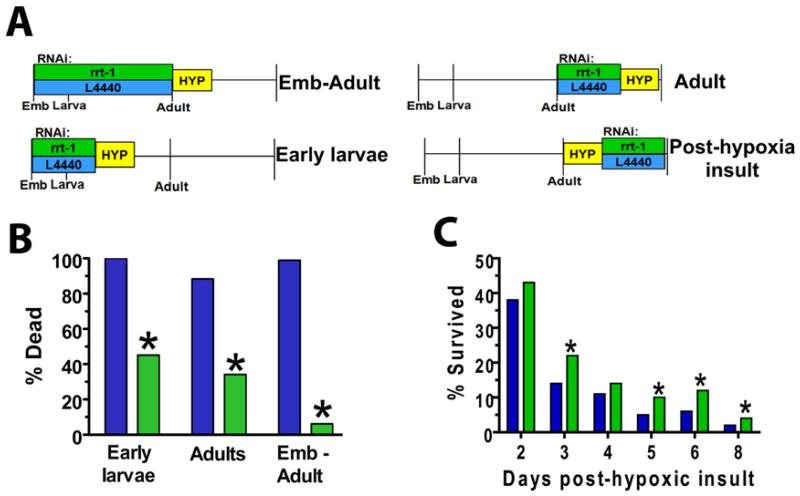
Fig. 3. rrt-1 acutely controls hypoxic sensitivity, during and after the insult
(A) Schematic of the experimental protocol. Wild-type animals were exposed to rrt-1 or L4440 empty vector RNAi at the times indicated and treated with a 20 hour (B) or 16 hour (C) hypoxic incubation (HYP, yellow boxes). “Emb” represents embryo. (B) Hypoxia resistance by RNAi knockdown of rrt-1 is not developmental stage dependent. n = 40 animals/condition. *p < 0.05 versus L4440 (Fisher’s exact test, two-sided). (C) Inhibition of rrt-1 is effective after hypoxic insult. % Survived = 100(#animals alive at day of interest/# animals alive initially after 24 hr recovery). *p < 0.05 vs L4440 (Fisher’s exact test, two-sided). n > 300 initially alive worms per RNAi over 3 independent trials.
Fig. 4
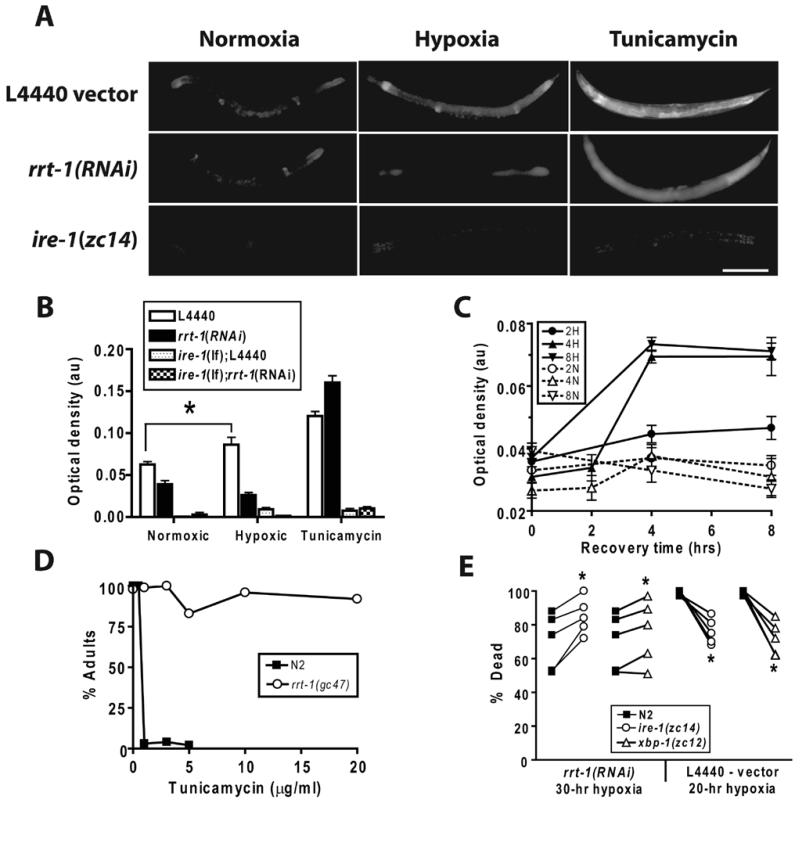
Fig. 4. The unfolded protein response is induced by hypoxia and is required for high level hypoxia resistance of rrt-1(RNAi)
(A) Phsp-4::GFP expression in age matched young adult C. elegans after incubation for six hours in M9 buffer in a normoxic or hypoxic environment or with 25 μg/ml tunicamycin. zcIs4[Phsp-4::GFP] animals were raised on empty vector or rrt-1(RNAi) bacteria; ire-1(zc14);zcIs4 animals were raised on empty vector. scale bar = 200 μm (B) Quantification of Phsp-4::GFP expression under the various conditions and genetic backgrounds. * - p < 0.01, unpaired 2-sided t-test. (C) Time course of Phsp-4::GFP induction after hypoxic or normoxic incubations of 2, 4, or 8 hours. (D) Sensitivity to developmental arrest by tunicamycin in wild type and rrt-1(gc47) animals. Freshly laid eggs were allowed to develop on agar plates containing the indicated concentrations of tunicamycin. The percent of animals reaching adulthood after seven days of development was scored. (E) Hypoxic sensitivity of wild type or UPR pathway mutant animals exposed to rrt-1(RNAi) (30 hour hypoxic incubation) or empty vector control (20 hour hypoxic incubation). * - p < 0.05, paired t-test.

References

    1. Scott BA, Avidan MS, Crowder CM. Science. 2002;296:2388. - PubMed
    1. Ibba M, Soll D. Annu Rev Biochem. 2000;69:617. - PubMed
    1. Landes C, et al. Biochimie. 1995;77:194. - PubMed
    1. Delagoutte B, Moras D, Cavarelli J. Embo J. 2000;19:5599. - PMC - PubMed
    1. Kyriacou SV, Deutscher MP. Molecular Cell. 2008;29:419. - PMC - PubMed

Publication types

MeSH terms