. 2009 Apr;37(5):e36.
doi: 10.1093/nar/gkp034. Epub 2009 Jan 30.

Integrating sequence with FPC fingerprint maps

Affiliations

Integrating sequence with FPC fingerprint maps

William Nelson et al. Nucleic Acids Res. 2009 Apr.

Abstract

Recent advances in both clone fingerprinting and draft sequencing technology have made it increasingly common for species to have a bacterial artificial clone (BAC) fingerprint map, BAC end sequences (BESs) and draft genomic sequence. The FPC (fingerprinted contigs) software package contains three modules that maximize the value of these resources. The BSS (blast some sequence) module provides a way to easily view the results of aligning draft sequence to the BESs, and integrates the results with the following two modules. The MTP (minimal tiling path) module uses sequence and fingerprints to determine a minimal tiling path of clones. The DSI (draft sequence integration) module aligns draft sequences to FPC contigs, displays them alongside the contigs and identifies potential discrepancies; the alignment can be based on either individual BES alignments to the draft, or on the locations of BESs that have been assembled into the draft. FPC also supports high-throughput fingerprint map generation as its time-intensive functions have been parallelized for Unix-based desktops or servers with multiple CPUs. Simulation results are provided for the MTP, DSI and parallelization. These features are in the FPC V9.3 software package, which is freely available.


Figures
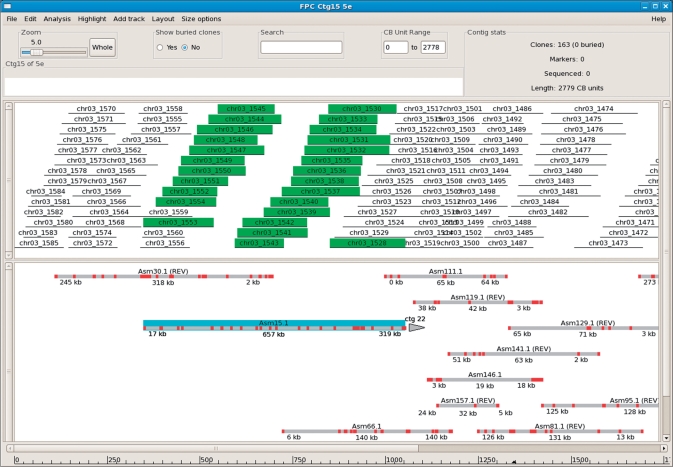
Figure 1.
Figure 1.
DSI alignment within FPC. The top track shows the clones of FPC contig 15, while the bottom track shows the aligned draft sequence contigs. Draft contig Asm15.1 was clicked with the mouse causing it to highlight in blue, and the associated clones (those having BESs contained in Asm1.1) are also highlighted in the clone track. Alignments that have a reversed orientation are indicated by the notation ‘REV’, as seen on Asm30.1 at the left. The alignment of Asm15.1 illustrates detection of an assembly error, as described in the text.The draft contig lines are drawn to match the extent of the clones with which they share BES anchors; this makes small contigs appear larger than they actually are. Also, the alignment start/end labels reflect the locations of the first/last BES anchors, so they typically do not start exactly at 0 kb or end at the sequence endpoint.
Figure 2.
Figure 2.
An MTP clone pair, with confirming spanner and flankers. The tick marks represent bands and vertically aligned tick marks represent shared bands. All the bands are shown for candidate MTP clones CL and CR. Only the shared bands are shown for the spanner and flanker. Three bands are not confirmed by either the spanner or the flanker clones.
Figure 3.
Figure 3.
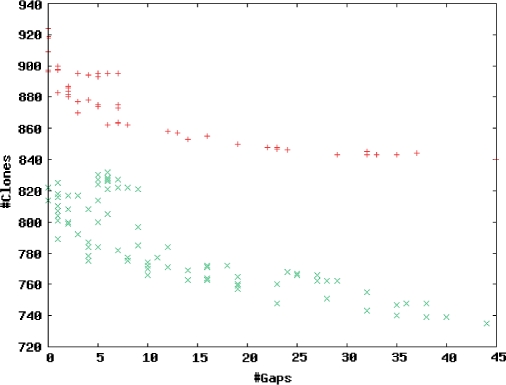
Effect of different parameters and fingerprint error levels on MTP performance for agarose and HICF. Aggregated MTP clone count and gap count are plotted from simulations of rice chr3, human chr21 and fly chr3L (total genomic sequence 95.2 Mb) for 10× clone coverage for HICF (‘×’) and agarose (‘+’). For HICF, the FPC MinOlap parameter was varied from 0 to 10 and the MinShared parameter was varied from 0 to 30, where MinOlap is the minimal amount of overlap between two clones based on FPC coordinates and MinShared is the minimal number of shared bands. For agarose, MinOlap varied from −6 to 10 and MinShared varied from 0 to 12.

References

    1. Weber JL, Myers EW. Human whole-genome shotgun sequencing. Genome Res. 1997;7:401–409. - PubMed
    1. Soderlund C, Humphray S, Dunham A, French L. Contigs built with fingerprints, markers, and FPC V4.7. Genome Res. 2000;10:1772–1787. - PMC - PubMed
    1. Soderlund C, Longden I, Mott R. FPC: a system for building contigs from restriction fingerprinted clones. Comput. Appl. Biosci. 1997;13:523–535. - PubMed
    1. Wei F, Coe E, Nelson W, Bharti AK, Engler F, Butler E, Kim H, Goicoechea JL, Chen M, Lee S, et al. Physical and genetic structure of the maize genome reflects its complex evolutionary history. PLoS Genet. 2007;3:e123. - PMC - PubMed
    1. Kim H, Hurwitz B, Yu Y, Collura K, Gill N, Sanmiguel P, Mullikin JC, Maher C, Nelson W, Wissotski M, et al. Construction, alignment and analysis of twelve framework physical maps that represent the ten genome types of the genus Oryza. Genome Biol. 2008;9:R45. - PMC - PubMed

Publication types