Treatment of severe aplastic anemia with a combination of horse antithymocyte globulin and cyclosporine, with or without sirolimus: a prospective randomized study
- PMID: 19181786
- PMCID: PMC2649367
- DOI: 10.3324/haematol.13829
Treatment of severe aplastic anemia with a combination of horse antithymocyte globulin and cyclosporine, with or without sirolimus: a prospective randomized study
Abstract
Background: We hypothesized that the addition of sirolimus to standard horse antithymocyte globulin (h-ATG) and cyclosporine (CsA) would improve response rates in severe aplastic anemia, due to its complementary and synergistic properties to cyclosporine A.
Design and methods: To test this hypothesis, we conducted a prospective randomized study comparing hATG/CsA/sirolimus to standard h-ATG/CsA. A total of 77 patients were treated from June 2003 to November 2005; 35 received h-ATG/CsA/sirolimus and 42 h-ATG/CsA. The two groups were well matched demographically and in blood counts prior to therapy. The primary end-point was hematologic response rate at 3 months, defined as no longer meeting the criteria for severe aplastic anemia. The study was powered to show a superior hematologic response rate of h-ATG/CsA/sirolimus compared to standard h-ATG/CsA.
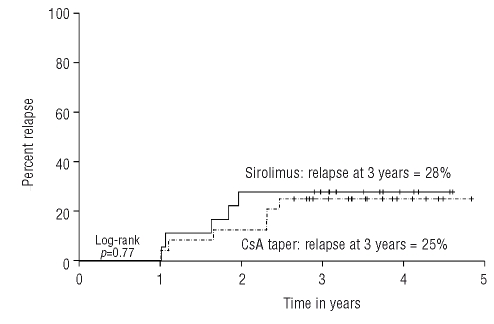
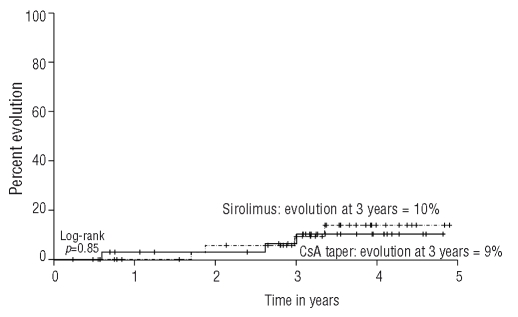
Results: The overall response rate at 3 months was 37% for h-ATG/CsA/sirolimus and 50% for h-ATG/CsA and at 6 months 51% for h-ATG/CsA/sirolimus and 62% for h-ATG/CsA. After a planned interim analysis of 30 evaluable patients in each arm, accrual to the h-ATG/CsA/sirolimus arm was closed, as the conditional power for rejecting the null hypothesis was less than 1%. The rate of relapse, clonal evolution, and survival (secondary outcomes) did not differ significantly between patients treated with the two different regimens.
Conclusions: Despite a theoretical rationale for its use, sirolimus did not improve the response rate in patients with severe aplastic anemia when compared to standard h-ATG/CsA.
Trial registration: ClinicalTrials.gov NCT00061360.
Figures

Comment in
-
Immunosuppressive treatment for aplastic anemia: are we hitting the ceiling?Haematologica. 2009 Mar;94(3):310-2. doi: 10.3324/haematol.2008.002329. Haematologica. 2009. PMID: 19252172 Free PMC article.
References
-
- Locasciulli A, Oneto R, Bacigalupo A, Socie G, Korthof ET, Bekassy A, et al. Outcomes of patients with acquired aplastic anemia given first line bone marrow transplantation or immunosuppressive treatment in the last decade: a report from the European Group for Blood and Marrow Transplantation. Haematologica. 2007;92:11–8. - PubMed
-
- Rosenfeld S, Follman D, Nu¤ez O, Young NS. Antithymocyte globulin and cyclosporine for severe aplastic anemia. Association between hematologic response and long-term outcome. JAMA. 2003;289:1130–5. - PubMed
-
- Bacigalupo A, Bruno B, Saracco P, Di Bona E, Locasciulli A, Locatelli F, et al. Antilymphocyte globulin, cyclosporine, prednisolone, and granulocyte colony-stimulating factor for severe aplastic anemia: an update of the GITMO/EBMT study on 100 patients. European Group for Blood and Marrow Transplantation (EBMT) Working Party on Severe Aplastic Anemia and the Gruppo Italiano Trapianti di Midollo Osseo (GITMO) Blood. 2000;95:1931–4. - PubMed
-
- Kojima S, Hibi S, Kosaka Y, Yamamoto M, Tsuchida M, Mugishima H, et al. Immunosuppressive therapy using antithymocyte globulin, cyclosporine, and danazol with or without human granulocyte colony-stimulating factor in children with acquired aplastic anemia. Blood. 2000;96:2049–54. - PubMed
-
- Fuhrer M, Rampf U, Baumann I, Faldum A, Niemeyer C, Janka-Schaub G, et al. Immunosuppressive therapy for aplastic anemia in children: a more severe disease predicts better survival. Blood. 2005;106:2102–4. - PubMed
Publication types
MeSH terms
Substances
Associated data
Grants and funding
LinkOut - more resources
Full Text Sources
Medical