Percutaneous radiofrequency ablation for the hepatocellular carcinoma abutting the diaphragm: assessment of safety and therapeutic efficacy
- PMID: 19182501
- PMCID: PMC2647171
- DOI: 10.3348/kjr.2009.10.1.34
Percutaneous radiofrequency ablation for the hepatocellular carcinoma abutting the diaphragm: assessment of safety and therapeutic efficacy
Abstract
Objective: To assess the safety and therapeutic efficacy of a percutaneous radiofrequency (RF) ablation for the hepatocellular carcinoma (HCC) abutting the diaphragm.
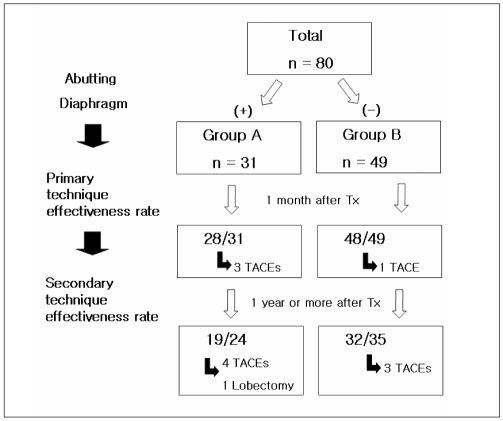
Materials and methods: We retrospectively assessed 80 patients who underwent a percutaneous RF ablation for a single nodular (< 4 cm) HCC over the last four years. Each patient underwent an ultrasound-guided RF ablation using internally cooled electrodes for the first-line treatment. We divided patients into two subgroups based on whether the index tumor was abutting (less than 5 mm) the diaphragm or not: group A (abutting; n = 31) versus group B (non-abutting; n = 49). We compared the two subgroups for complications and therapeutic efficacy using image and the review of medical records. The statistical assessment included an independent t-test, Fisher's exact test, and chi-square test.
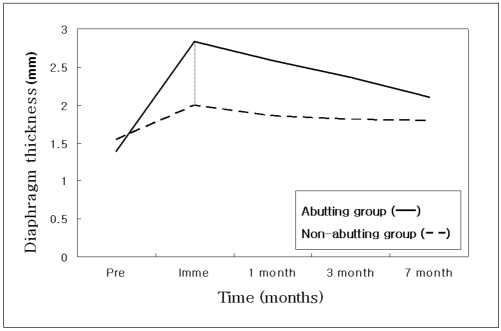
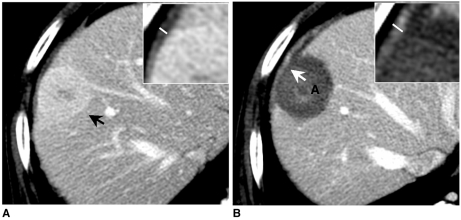
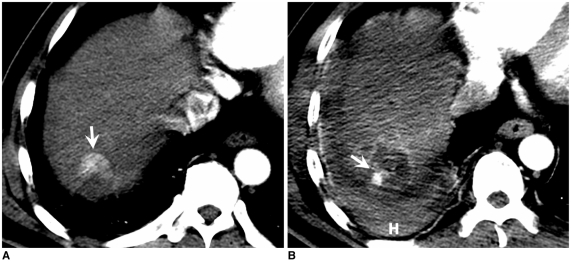
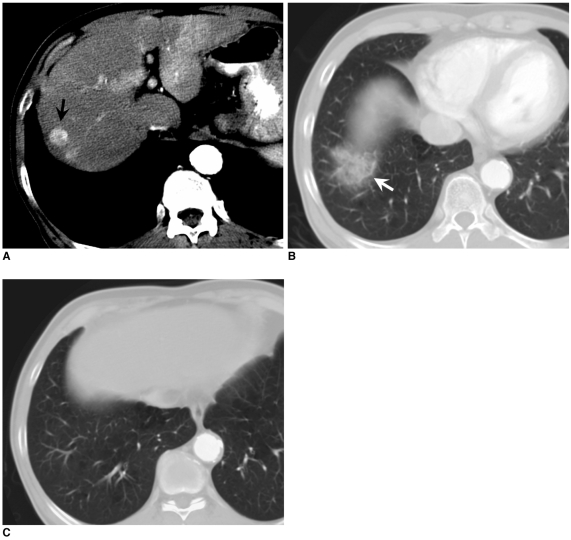
Results: The assessment of the diaphragmatic swelling at CT immediately following the procedure was more severe in group A than group B (mean thickness change:1.44 vs. 0.46 mm, p = 0.00). Further, right shoulder pain was more common in group A than B (p = 0.01). Although minor complications (hemothorax 1 case, pleural effusion 1 case) were noted only in group A, no major thoracic complication occurred in either group. The technical success rate was lower in group A than group B (84% vs. 98%, p = 0.03). As well, the primary and secondary technique effectiveness rates in group A and group B were 90% versus 98% (p = 0.29) and 79% versus 91% (p = 0.25), respectively. The local tumor progression rate was higher in group A than in group B (29% vs. 6%, p = 0.02).
Conclusion: We found that the percutaneous RF ablation for the HCC abutting the diaphragm is a safe procedure without major complications. However, it is less effective with regard to technical success and local tumor control.
Figures
References
-
- Iannitti DA, Dupuy DE, Mayo-Smith WW, Murphy B. Hepatic radiofrequency ablation. Arch Surg. 2002;137:422–426. - PubMed
-
- Livraghi T, Goldberg SN, Lazzaroni S, Meloni F, Ierace T, Solbiati L, et al. Hepatocellular carcinoma: radio-frequency ablation of medium and large lesions. Radiology. 2000;214:761–768. - PubMed
-
- de Baere T, Risse O, Kuoch V, Dromain C, Sengel C, Smayra T, et al. Adverse events during radiofrequency treatment of 582 hepatic tumors. AJR Am J Roentgenol. 2003;181:695–700. - PubMed
-
- Rhim H, Dodd GD, 3rd, Chintapalli KN, Wood BJ, Dupuy DE, Hvizda JL, et al. Radiofrequency thermal ablation of abdominal tumors: lessons learned from complications. Radiographics. 2004;24:41–52. - PubMed
Publication types
MeSH terms
LinkOut - more resources
Full Text Sources
Medical
Research Materials