


Human occludin is a hepatitis C virus entry factor required for infection of mouse cells
- PMID: 19182773
- PMCID: PMC2762424
- DOI: 10.1038/nature07684
Human occludin is a hepatitis C virus entry factor required for infection of mouse cells
Abstract
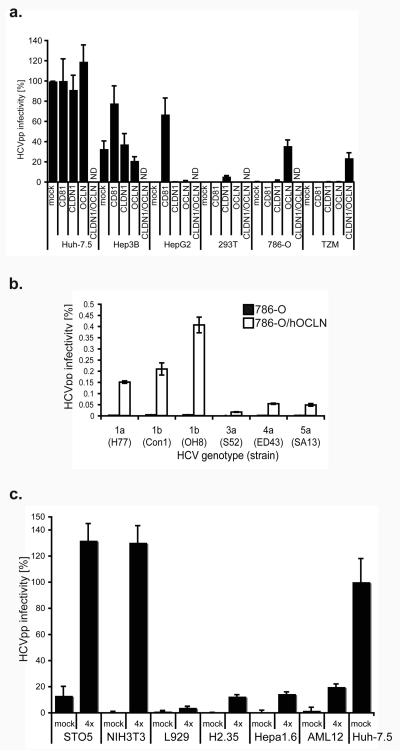
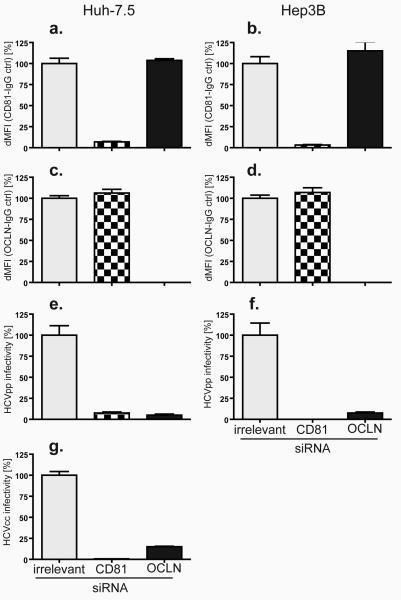
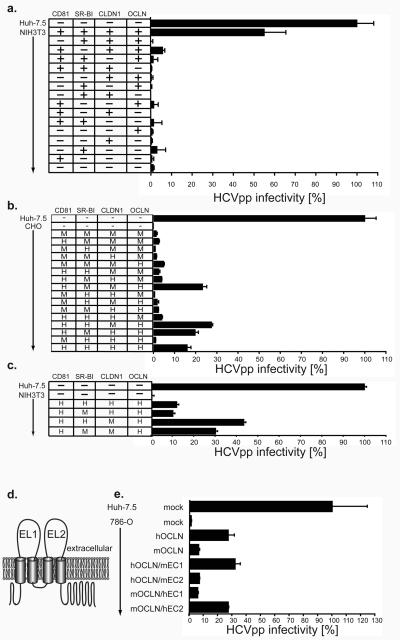
Hepatitis C virus (HCV) is a leading cause of liver disease worldwide. The development of much needed specific antiviral therapies and an effective vaccine has been hampered by the lack of a convenient small animal model. The determinants restricting HCV tropism to human and chimpanzee hosts are unknown. Replication of the viral RNA has been demonstrated in mouse cells, but these cells are not infectable with either lentiviral particles bearing HCV glycoproteins (HCVpp) or HCV produced in cell culture (HCVcc) (A.P., M.E. and C.M.R., unpublished observations), suggesting that there is a block at the level of entry. Here we show, using an iterative complementary DNA library screening approach, that human occludin (OCLN) is an essential HCV cell entry factor that is able to render murine cells infectable with HCVpp. Similarly, OCLN is required for the HCV-susceptibility of human cells, because its overexpression in uninfectable cells specifically enhanced HCVpp uptake, whereas its silencing in permissive cells impaired both HCVpp and HCVcc infection. In addition to OCLN, HCVpp infection of murine cells required expression of the previously identified HCV entry factors CD81 (ref. 4), scavenger receptor class B type I (SR-BI, also known as SCARB1) and claudin-1 (CLDN1). Although the mouse versions of SR-BI and CLDN1 function at least as well as the human proteins in promoting HCV entry, both OCLN and CD81 must be of human origin to allow efficient infection. The species-specific determinants of OCLN were mapped to its second extracellular loop. The identification of OCLN as a new HCV entry factor further highlights the importance of the tight junction complex in the viral entry process, and provides an important advance towards efforts to develop small animal models for HCV.
Figures
Comment in
-
Virology: Final entry key for hepatitis C.Nature. 2009 Feb 12;457(7231):797-8. doi: 10.1038/457797a. Nature. 2009. PMID: 19212389 No abstract available.
-
Closing the gap: the tight junction protein occludin and hepatitis C virus entry.Hepatology. 2009 May;49(5):1770-2. doi: 10.1002/hep.22935. Hepatology. 2009. PMID: 19402114 No abstract available.
-
Occludin a new HCV entry factor: is the list of essential hepatitis C virus receptors complete?Gastroenterology. 2009 Aug;137(2):727-8. doi: 10.1053/j.gastro.2009.06.023. Epub 2009 Jun 27. Gastroenterology. 2009. PMID: 19563843 No abstract available.
-
The complexities of hepatitis C virus entry.J Hepatol. 2009 Sep;51(3):609-11. doi: 10.1016/j.jhep.2009.06.014. Epub 2009 Jul 2. J Hepatol. 2009. PMID: 19604595 No abstract available.
-
Hepatitis C: a mouse at the end of the tunnel.Cell Res. 2013 Dec;23(12):1343-4. doi: 10.1038/cr.2013.132. Epub 2013 Sep 24. Cell Res. 2013. PMID: 24060850 Free PMC article.
References
-
- Pileri P, et al. Binding of hepatitis C virus to CD81. Science. 1998;282:938. - PubMed
Publication types
MeSH terms
Substances
Grants and funding
LinkOut - more resources
Full Text Sources
Other Literature Sources
Medical
Molecular Biology Databases
Research Materials
Miscellaneous
