. 2009 Mar;5(3):166-73.
doi: 10.1038/nchembio.143. Epub 2009 Feb 1.

Mechanistic and functional insights into fatty acid activation in Mycobacterium tuberculosis

Affiliations

Mechanistic and functional insights into fatty acid activation in Mycobacterium tuberculosis

Pooja Arora et al. Nat Chem Biol. 2009 Mar.

Abstract

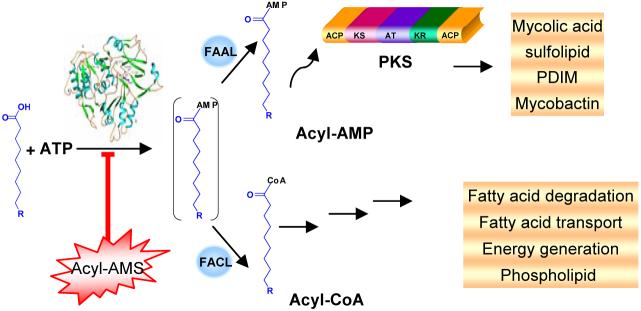
The recent discovery of fatty acyl-AMP ligases (FAALs) in Mycobacterium tuberculosis (Mtb) provided a new perspective of fatty acid activation. These proteins convert fatty acids to the corresponding adenylates, which are intermediates of acyl-CoA-synthesizing fatty acyl-CoA ligases (FACLs). Presently, it is not evident how obligate pathogens such as Mtb have evolved such new themes of functional versatility and whether the activation of fatty acids to acyladenylates could indeed be a general mechanism. Here, based on elucidation of the first structure of an FAAL protein and by generating loss-of-function and gain-of-function mutants that interconvert FAAL and FACL activities, we demonstrate that an insertion motif dictates formation of acyladenylate. Because FAALs in Mtb are crucial nodes in the biosynthetic network of virulent lipids, inhibitors directed against these proteins provide a unique multipronged approach to simultaneously disrupting several pathways.


Figures
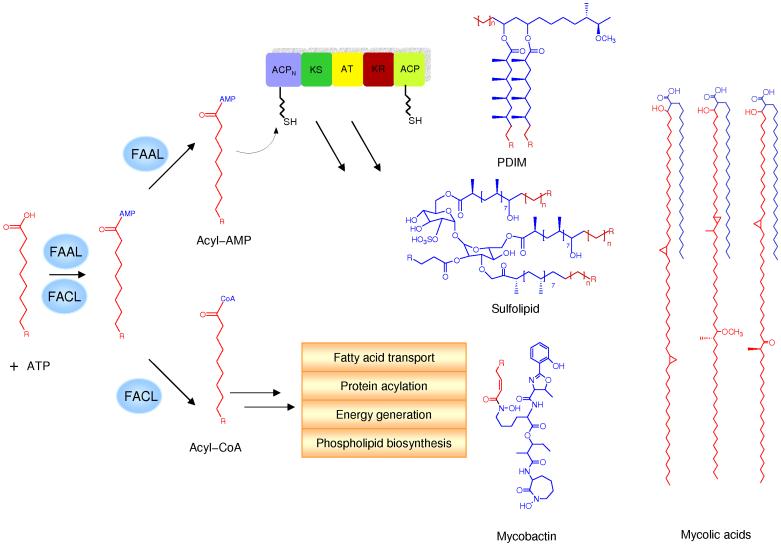
Figure 1
Figure 1. Dichotomy in the metabolic functions of FAALs and FACLs
FAALs and FACLs utilize fatty acid pools and activate them to a common acyl- adenylate intermediate. FACLs convert fatty acids to acyl-CoA and utilize them for fatty acid transport, protein acylation, energy generation, and phospholipid biosynthesis. FAAL produced acyl- adenylate is utilized by polyketide synthase enzymes for the synthesis of complex lipids like PDIM, sulpholipids, mycolic acids, and mycobactin.
Figure 2
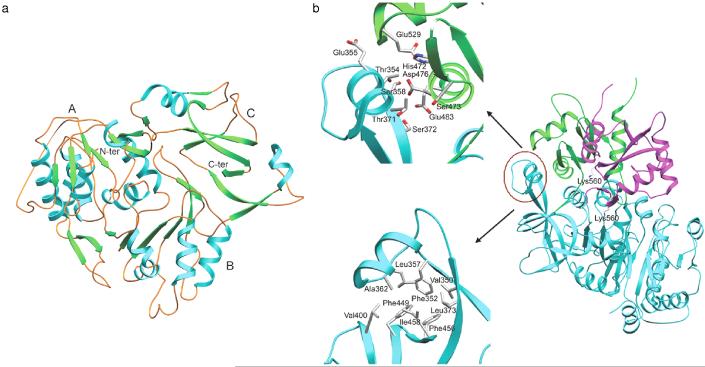
Figure 2. Crystal structure of FAAL28 N-terminal domain and structural analysis of the FAAL insertion
(a) Structure of FAAL28 N-terminal domain protein N1, demonstrates α+β topology of the A and B subdomain and a distorted β barrel for C subdomain, N and the C-termini are marked. (b) FAAL28 C-terminal domain of FAAL28 modeled on the basis of PheA (1amu) structure in putative AMP bound conformation (green), acetyl CoA synthetase structure (1pg4) in putative CoA bound conformation (magenta), and FAAL28 N-terminal domain structure (cyan) with highlighted FAAL specific insertion. Inset highlights residues in the FAAL specific insertion facing towards the putative C-terminal domain (top) and strong hydrophobic interaction of residues in the FAAL specific insertion with the N-terminal domain (bottom).
Figure 3
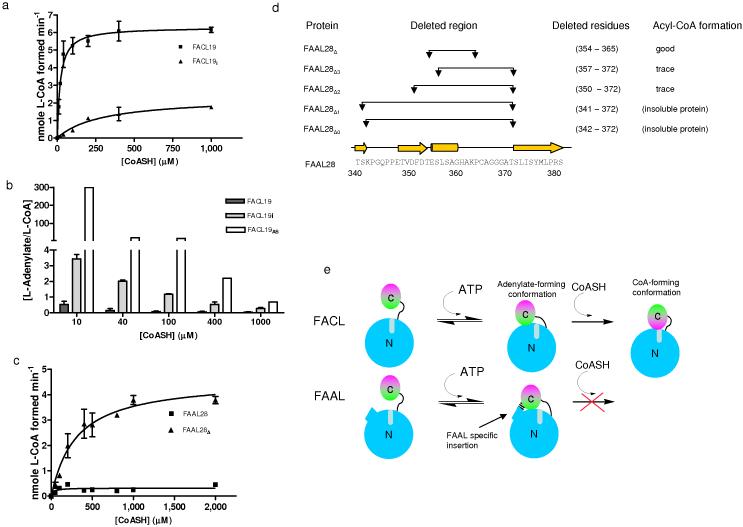
Figure 3. Interconversion of FACL and FAAL activities
(a) Kinetic analysis of CoA formation by wild type FACL19 and FACL19i proteins by Michaelis-Menten plot. The data point is represents mean ± SEM of three independent experiments. (b) The ratio of acyl-adenylate to acyl-CoA formed by FACL19, FACL19i and FACL19AS at different concentrations of CoASH substrate. (c) Kinetic analysis of CoA formation by wild type FAAL28 and FAAL28Δ proteins by Michaelis-Menten plot. The data point is represents mean ±SEM of three independent experiments. (d) Various deletion proteins of FAAL28 generated for the study mapped to the sequence and their corresponding biochemical characteristics. (e) Schematic representation of proposed structural role of the FAAL specific insertion in acyl-AMP formation.
Figure 4
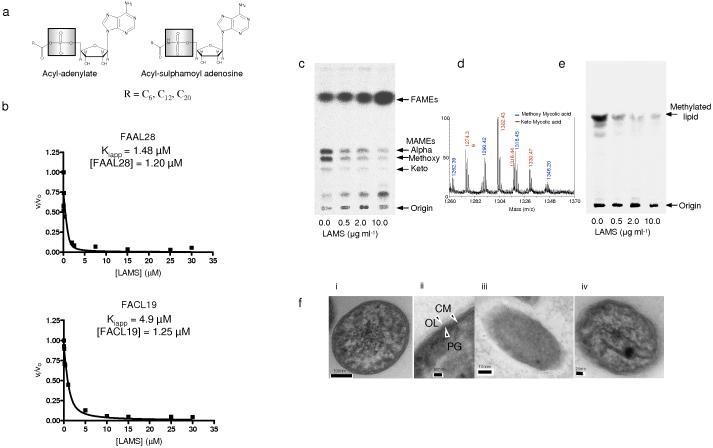
Figure 4. Inhibition of FAAL and FACL enzymes by acyl-sulfamoyl analogues
(a) Chemical structures of acyl-adenylate and the non-hydrolyzable acyl-sulfamoyl adenosine analogues. (b) IC50 values of FAAL28 and FACL19 proteins with Lauroyl-sulfamate (LAMS). (c) 14C-acetate incorporation assay to analyze fatty acid and mycolic acid biosynthesis. (d) Confirmation of mycolic acids by mass spectrometry (e) 14C-propionate labeling to study biosynthesis of extractable lipids like PDIM and SL-1. (f) Ultrastructural studies of M. tuberculosis to study the effect of acyl-sulfamoyl analogues on cell morphology. (i) Transmission electron micrographs of thin section of untreated M. tuberculosis as control. (ii) Untreated cells show a thin cytoplasmic membrane (CM), and a thick electron-dense layer corresponding to the cell wall peptidoglycan (PG) and a thin and poorly stained outer layer (OL). (iii) and (iv) Cells treated with hexanoyl- and lauroyl-AMS respectively. These cells lack the typical lipid coat and have irregular shape.
Figure 5
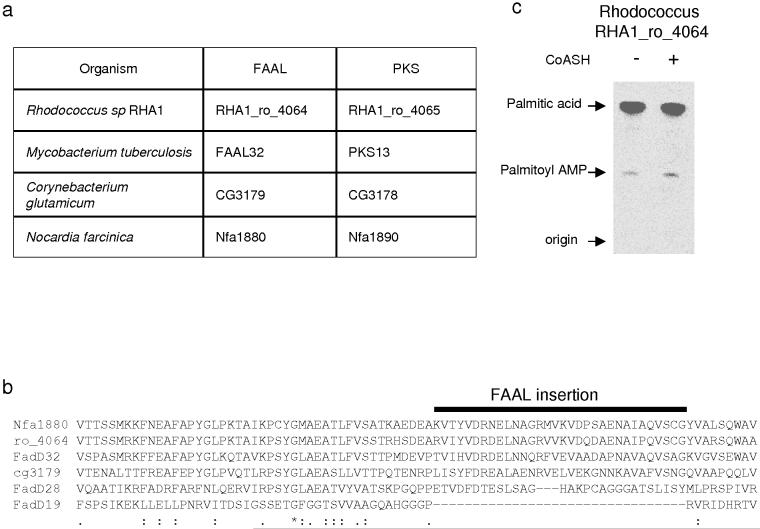
Figure 5. Characterization of FAAL in other Actinomycetes
(a) Conserved FAAL, PKS homologous pair across mycolates (b) Multiple sequence alignment of Nfa1880 (Nocardia farcinica), ro_4064 (Rhodococcus sp RHA1), FAAL32 (Mycobacterium tuberculosis), cg3179 (Corynebacterium glutamicum) with the mycobacterial FAAL28 (acyl-AMP forming) and FACL19 (acyl-CoA forming). The bold line on top highlights the FAAL specific insertion. (c) Enzyme assay of ro_4064 protein carried out using palmitic acid in the presence or absence of 1mM CoASH. The products were separated on TLC and the autoradiogram is depicted.
Figure 6
Figure 6

References

    1. Trivedi OA, et al. Enzymic activation and transfer of fatty acids as acyl-adenylates in mycobacteria. Nature. 2004;428:441–5. - PubMed
    1. Weber T, Marahiel MA. Exploring the domain structure of modular nonribosomal peptide synthetases. Structure. 2001;9:R3–9. - PubMed
    1. Fischbach MA, Walsh CT. Assembly-line enzymology for polyketide and nonribosomal Peptide antibiotics: logic, machinery, and mechanisms. Chem Rev. 2006;106:3468–96. - PubMed
    1. Stachelhaus T, Mootz HD, Marahiel MA. The specificity-conferring code of adenylation domains in nonribosomal peptide synthetases. Chem Biol. 1999;6:493–505. - PubMed
    1. Gomez JE, McKinney JD. M. tuberculosis persistence, latency, and drug tolerance. Tuberculosis (Edinb) 2004;84:29–44. - PubMed

Publication types

MeSH terms