. 2009 Mar;41(3):376-81.
doi: 10.1038/ng.322. Epub 2009 Feb 1.

Differential chromatin marking of introns and expressed exons by H3K36me3

Affiliations

Differential chromatin marking of introns and expressed exons by H3K36me3

Paulina Kolasinska-Zwierz et al. Nat Genet. 2009 Mar.

Abstract

Variation in patterns of methylations of histone tails reflects and modulates chromatin structure and function. To provide a framework for the analysis of chromatin function in Caenorhabditis elegans, we generated a genome-wide map of histone H3 tail methylations. We find that C. elegans genes show distributions of histone modifications that are similar to those of other organisms, with H3K4me3 near transcription start sites, H3K36me3 in the body of genes and H3K9me3 enriched on silent genes. We also observe a novel pattern: exons are preferentially marked with H3K36me3 relative to introns. H3K36me3 exon marking is dependent on transcription and is found at lower levels in alternatively spliced exons, supporting a splicing-related marking mechanism. We further show that the difference in H3K36me3 marking between exons and introns is evolutionarily conserved in human and mouse. We propose that H3K36me3 exon marking in chromatin provides a dynamic link between transcription and splicing.


Figures
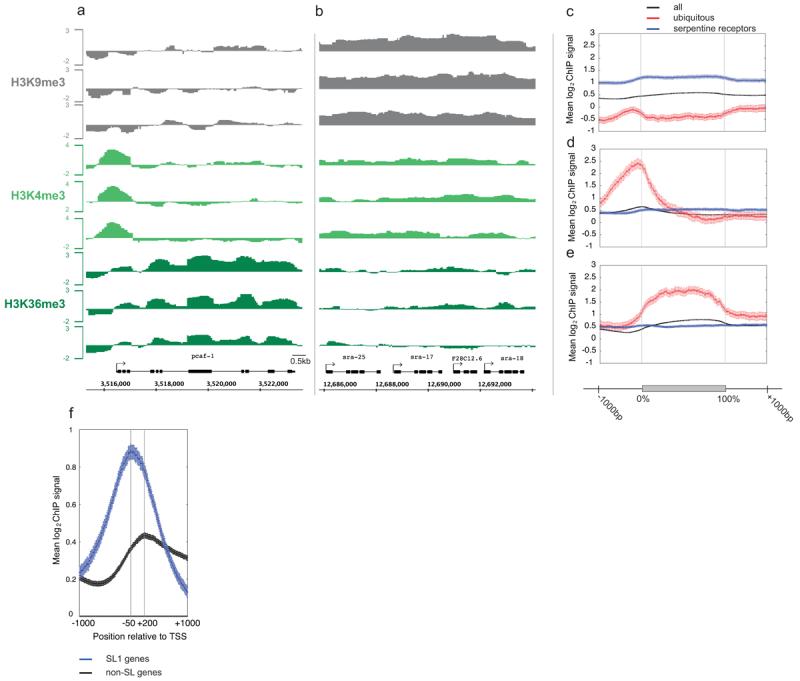
Figure 1
Figure 1. Patterns of histone methylations across C. elegans genes
(a, b). Mean log2 ChIP signal of normalized triplicate samples across a genomic region containing (a) an actively transcribed gene and (b) a cluster of transcriptionally repressed genes. (c) H3K9me3, (d) H3K4me3, and (e) H3K36me3 mean log2 ChIP signals across all genes (black), ubiq genes (red) and serp genes (blue) aligned at the first and last nucleotides (0% and 100%) and extended with 1kb upstream and downstream sequence. (f) H3K4me3 mean log2 ChIP signals from −1000 to +1000 relative to TSSs (transcript start sites; defined as the first known nucleotide in the mature transcript, not including trans-spliced leaders). Blue, SL1 genes; black, genes not annotated to contain spliced leaders.
Figure 2
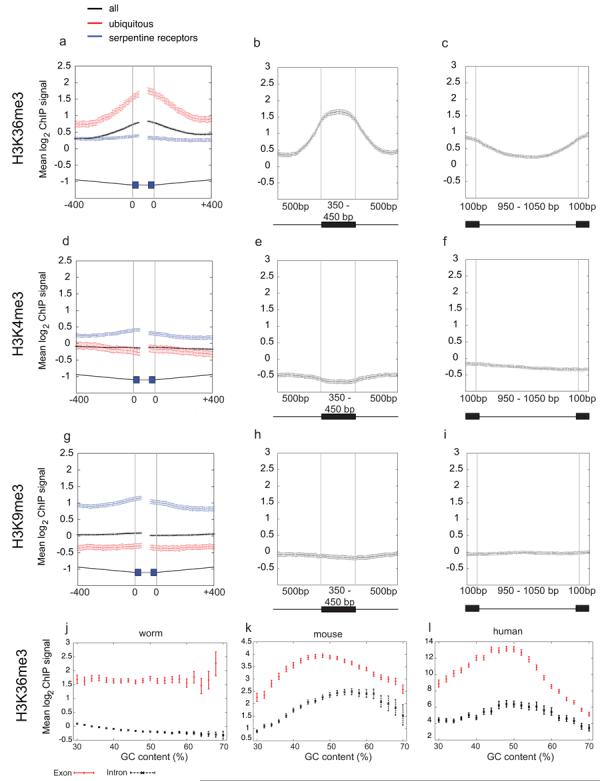
Figure 2. H3K36me3 is enriched across C. elegans exonic chromatin
Mean log2 ChIP signals for (a-c) H3K36me3 (d-f) H3K4me3 and (g-i) H3K9me3. (a, d, g) plot signals across intron/exon and exon/intron boundaries where introns are at least 400bp and exons at least 80bp, excluding first and last exons. Black, exons of all genes; red, ubiq genes; blue, serp genes. In the gene model, thin grey lines represent 400bp of intron sequence, black boxes 40bp of exon sequence, and thick grey lines the centres of exons that vary in length. (b, e, h) mean log2 ChIP signals across exons of length 350-450bp flanked on both sides by introns of >=500bp. (c, f, i) mean log2 ChIP signals across introns of length 950-1050bp. In diagrams below plots, black boxes represent exons and black lines introns. Exon enrichment of H3K36me3 relative to a neighboring intron was confirmed by qPCR of non-amplified ChIP material in 8/8 cases tested (not shown). (j,k,l) H3K36me3 signals for exons and introns according to GC content. In C. elegans (j), mouse (k), and human (l), exon signals are higher than those of introns at every % GC implicating that enrichment of H3K36me3 on exons is not due to GC bias.
Figure 3
Figure 3. Alternative exons have lower H3K36me3 signal than constitutive exons
(a-e) Mean log2 ChIP signal of each C. elegans trio exon (a-c) or the average tag count for each mouse trio exon (d, e) is shown for the indicated histone modification. (f) Cartoon of alternative and constitutive trios of exons used in the analysis; colours correspond to data bars in (a-e). Exon sizes in alternative and constitutive sets were length matched. In (a) and (d) the alternative central exons (red) have significantly lower H3K36me3 signal than their matched constitutive central exons or than their constitutive neighbours (p<0.01). The matched central exons do not show reduced H3K36me3 relative to their neighbours. There is also no significant difference in signals for the alternative exons compared to the matched exons for other histone modifications. The higher signals for exon 1 in (b) and (e) are due to closer proximity to the TSS. For C. elegans trios, n=54, and for mouse n=190. Bars are 95% confidence intervals. (g, h) Cumulative GC content of constitutive and alternative exons in the alternative trios. (g) C. elegans (h) mouse. Alternative exons are similar in GC content to constitutive exons.
Figure 4
Figure 4. H3K36me3 is enriched across human and mouse exonic chromatin
Average tag counts of middle exons after ChIP of (a) H3K36me3 (d) H3K4me3 from mouse MEF chromatin or (g) H3K36me3 (j) H3K4me3 (m) H3K27me1 from human CD4+ T cell chromatin across intron/exon and exon/intron boundaries where introns are at least 500bp and exons at least 200bp. In the gene model, thin grey lines represent 500bp intron sequence, black boxes 100bp exon sequence, and thick grey lines the centres of exons that vary in length. Mean ChIP tag counts across exons (b, e, h, k, n) or introns (c, f, i, l, o) for (b, c) mouse H3K36me3 (e, f) mouse H3K4me3 (h, i) human H3K36me3 (k, l) human H3K4me3 (n, o) human H3K27me1. Exons of length 350-450bp and introns of length 5-6kb were used, excluding the first 2kb of the gene to eliminate promoter specific signals. In diagrams below plots, black boxes represent exons and black lines introns.

Comment in

  • Processing the H3K36me3 signature.
    Sims RJ 3rd, Reinberg D. Sims RJ 3rd, et al. Nat Genet. 2009 Mar;41(3):270-1. doi: 10.1038/ng0309-270. Nat Genet. 2009. PMID: 19240748 No abstract available.

Similar articles

Cited by

References

    1. Berger SL. The complex language of chromatin regulation during transcription. Nature. 2007;447:407–12. - PubMed
    1. Kouzarides T. Chromatin modifications and their function. Cell. 2007;128:693–705. - PubMed
    1. Shilatifard A. Chromatin modifications by methylation and ubiquitination: implications in the regulation of gene expression. Annu Rev Biochem. 2006;75:243–69. - PubMed
    1. Consortium C.e.S. Genome sequence of the nematode C. elegans: a platform for investigating biology. The C. elegans Sequencing Consortium. Science. 1998;282:2012–8. - PubMed
    1. Fire A, et al. Potent and specific genetic interference by double-stranded RNA in Caenorhabditis elegans. Nature. 1998;391:806–11. - PubMed

Publication types

MeSH terms