


Open versus two forms of arthroscopic rotator cuff repair
- PMID: 19184264
- PMCID: PMC2650068
- DOI: 10.1007/s11999-009-0706-0
Open versus two forms of arthroscopic rotator cuff repair
Abstract
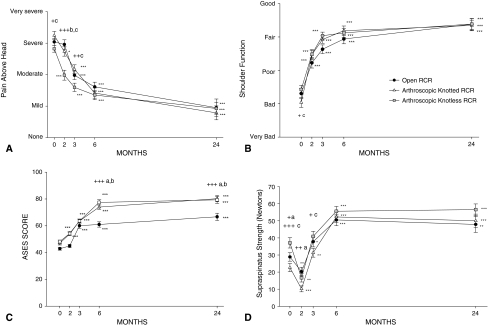
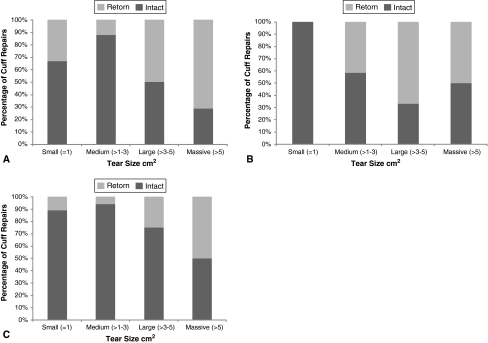
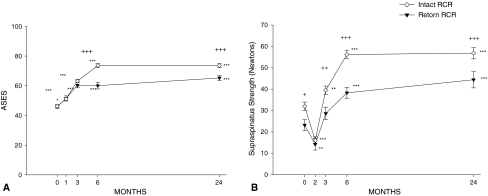
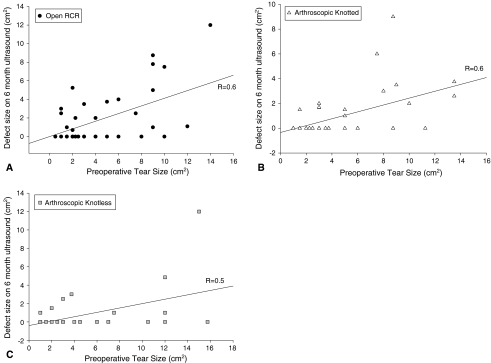
There have been technologic advances in the methods for repairing torn rotator cuffs. We compared the clinical and structural outcomes of three different forms of rotator cuff repair with up to 24 months' followup. We wished to assess how surgical technique affected clinical outcomes and see how these correlated to repair integrity. Three cohorts of patients had repair of a symptomatic rotator cuff tear using (1) an open technique (n = 49); (2) arthroscopic knotted (n = 53); or (3) arthroscopic knotless (n = 57) by one surgeon. Standardized patient- and examiner-determined outcomes were obtained preoperatively and at 6 weeks, 3 and 6 months, and 2 years postoperatively. Ultrasound studies were performed with a validated protocol at 6 months and 2 years postsurgery. Clinical outcomes were similar with the exception that the arthroscopic groups had, on average, 20% better American Shoulder and Elbow Surgeons scores than the open group at 6 months and 2 years. Retear correlated with tear size and operation time and occurred more frequently after open repair (39%) than after arthroscopic knotted (25%) and arthroscopic knotless (16%) repair. An intact cuff on ultrasound corresponded to better results for supraspinatus strength, patient outcomes, and rotator cuff functional ability.
Level of evidence: Level III, therapeutic study. See Guidelines for Authors for a complete description of levels of evidence.
Figures
References
-
- {'text': '', 'ref_index': 1, 'ids': [{'type': 'DOI', 'value': '10.1177/0363546506290187', 'is_inner': False, 'url': 'https://doi.org/10.1177/0363546506290187'}, {'type': 'PubMed', 'value': '16870821', 'is_inner': True, 'url': 'https://pubmed.ncbi.nlm.nih.gov/16870821/'}]}
- Anderson K, Boothby M, Aschenbrener D, van Holsbeeck M. Outcome and structural integrity after arthroscopic rotator cuff repair using 2 rows of fixation: minimum 2-year follow-up. Am J Sports Med. 2006;34:1899–1905. - PubMed
-
- {'text': '', 'ref_index': 1, 'ids': [{'type': 'DOI', 'value': '10.1016/j.jse.2005.09.017', 'is_inner': False, 'url': 'https://doi.org/10.1016/j.jse.2005.09.017'}, {'type': 'PubMed', 'value': '16679227', 'is_inner': True, 'url': 'https://pubmed.ncbi.nlm.nih.gov/16679227/'}]}
- Bishop J, Klepps S, Lo IK, Bird J, Gladstone JN, Flatow EL. Cuff integrity after arthroscopic versus open rotator cuff repair: a prospective study. J Shoulder Elbow Surg. 2006;15:290–299. - PubMed
-
- {'text': '', 'ref_index': 1, 'ids': [{'type': 'DOI', 'value': '10.2106/JBJS.D.02035', 'is_inner': False, 'url': 'https://doi.org/10.2106/jbjs.d.02035'}, {'type': 'PubMed', 'value': '15930531', 'is_inner': True, 'url': 'https://pubmed.ncbi.nlm.nih.gov/15930531/'}]}
- Boileau P, Brassart N, Watkinson DJ, Carles M, Hatzidakis AM, Krishnan SG. Arthroscopic repair of full-thickness tears of the supraspinatus: does the tendon really heal? J Bone Joint Surg Am. 2005;87:1229–1240. - PubMed
-
- {'text': '', 'ref_index': 1, 'ids': [{'type': 'DOI', 'value': '10.1067/mse.2002.121923', 'is_inner': False, 'url': 'https://doi.org/10.1067/mse.2002.121923'}, {'type': 'PubMed', 'value': '12070492', 'is_inner': True, 'url': 'https://pubmed.ncbi.nlm.nih.gov/12070492/'}]}
- Bryant L, Shnier R, Bryant C, Murrell GA. A comparison of clinical estimation, ultrasonography, magnetic resonance imaging, and arthroscopy in determining the size of rotator cuff tears. J Shoulder Elbow Surg. 2002;11:219–224. - PubMed
-
- {'text': '', 'ref_index': 1, 'ids': [{'type': 'PubMed', 'value': '3941132', 'is_inner': True, 'url': 'https://pubmed.ncbi.nlm.nih.gov/3941132/'}]}
- Calvert PT, Packer NP, Stoker DJ, Bayley JI, Kessel L. Arthrography of the shoulder after operative repair of the torn rotator cuff. J Bone Joint Surg Br. 1986;68:147–150. - PubMed
Publication types
MeSH terms
LinkOut - more resources
Full Text Sources
Other Literature Sources
Research Materials
