


Mediation analysis with principal stratification
- PMID: 19184975
- PMCID: PMC2669107
- DOI: 10.1002/sim.3533
Mediation analysis with principal stratification
Abstract
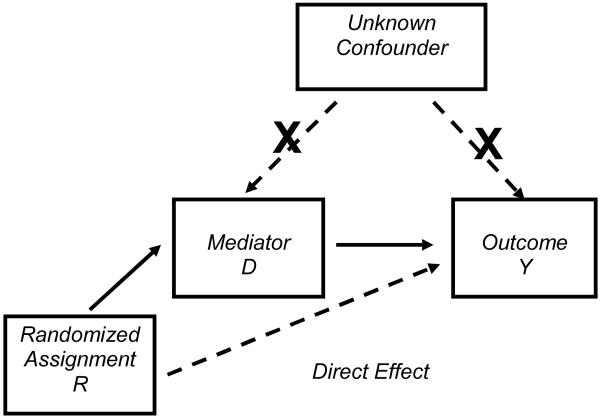
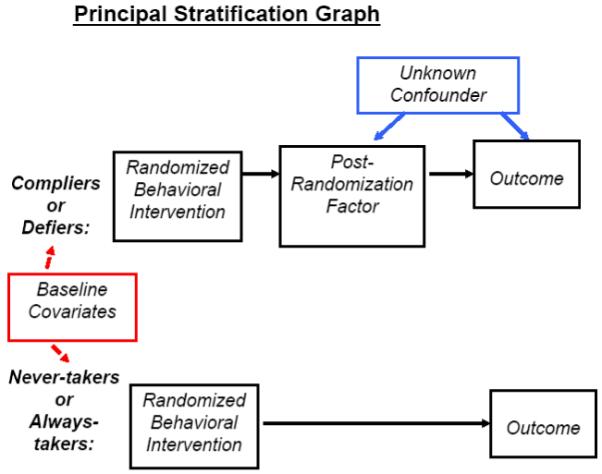
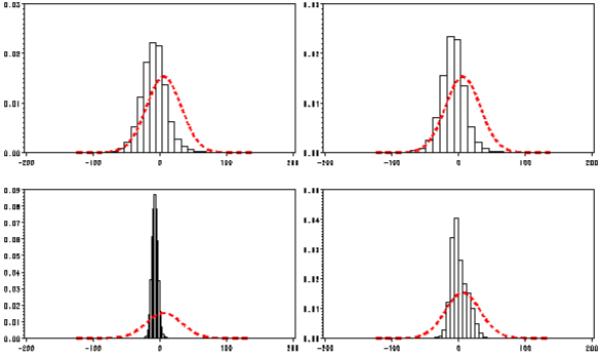
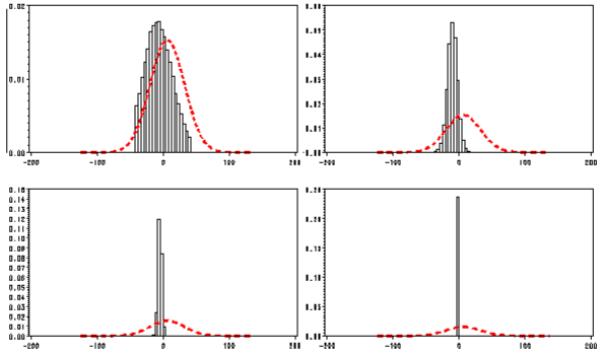
In assessing the mechanism of treatment efficacy in randomized clinical trials, investigators often perform mediation analyses by analyzing if the significant intent-to-treat treatment effect on outcome occurs through or around a third intermediate or mediating variable: indirect and direct effects, respectively. Standard mediation analyses assume sequential ignorability, i.e. conditional on covariates the intermediate or mediating factor is randomly assigned, as is the treatment in a randomized clinical trial. This research focuses on the application of the principal stratification (PS) approach for estimating the direct effect of a randomized treatment but without the standard sequential ignorability assumption. This approach is used to estimate the direct effect of treatment as a difference between expectations of potential outcomes within latent subgroups of participants for whom the intermediate variable behavior would be constant, regardless of the randomized treatment assignment. Using a Bayesian estimation procedure, we also assess the sensitivity of results based on the PS approach to heterogeneity of the variances among these principal strata. We assess this approach with simulations and apply it to two psychiatric examples. Both examples and the simulations indicated robustness of our findings to the homogeneous variance assumption. However, simulations showed that the magnitude of treatment effects derived under the PS approach were sensitive to model mis-specification.
Copyright (c) 2009 John Wiley & Sons, Ltd.
Figures
References
-
- Rubin D. Direct and indirect causal effects via potential outcomes. Scandinavian Journal of Statistics. 2004;31:161–170.
-
- Mealli F, Imbens GW, Ferro S, Biggeri A. Analyzing a Randomized Trial on Breast Self-Examination with Noncompliance and Missing Outcomes. Biostatistics. 2004;5:207–222. - PubMed
-
- Baron RM, Kenny DA. The moderator-mediator distinction in social psychological research: conceptual, strategic, and statistical considerations. Journal of Personality and Social Psychology. 1986;51:1173–1182. - PubMed
Publication types
MeSH terms
Grants and funding
LinkOut - more resources
Full Text Sources
Other Literature Sources
Medical