


Mechanical ventilation induces diaphragmatic mitochondrial dysfunction and increased oxidant production
- PMID: 19185055
- PMCID: PMC2906125
- DOI: 10.1016/j.freeradbiomed.2009.01.002
Mechanical ventilation induces diaphragmatic mitochondrial dysfunction and increased oxidant production
Abstract
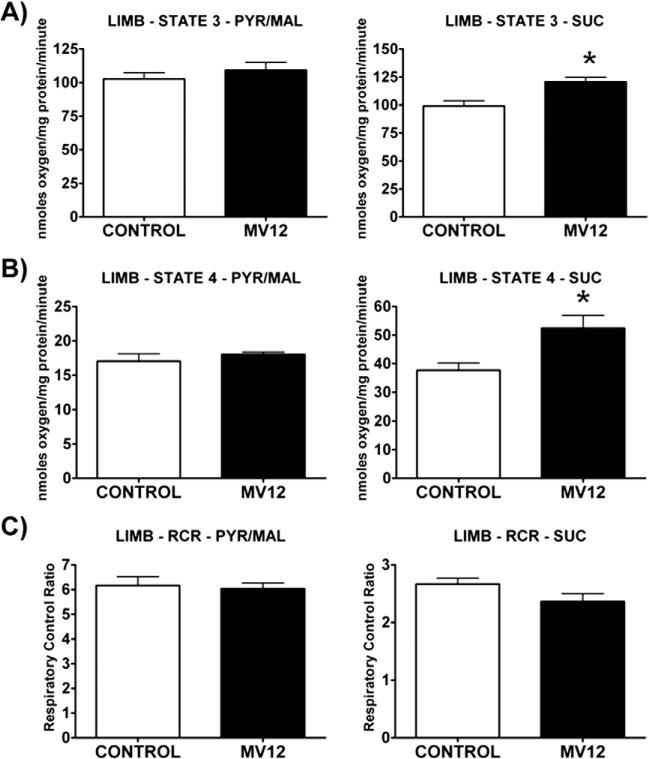
Mechanical ventilation (MV) is a life-saving intervention used in patients with acute respiratory failure. Unfortunately, prolonged MV results in diaphragmatic weakness, which is an important contributor to the failure to wean patients from MV. Our laboratory has previously shown that reactive oxygen species (ROS) play a critical role in mediating diaphragmatic weakness after MV. However, the pathways responsible for MV-induced diaphragmatic ROS production remain unknown. These experiments tested the hypothesis that prolonged MV results in an increase in mitochondrial ROS release, mitochondrial oxidative damage, and mitochondrial dysfunction. To test this hypothesis, adult (3-4 months of age) female Sprague-Dawley rats were assigned to either a control or a 12-h MV group. After treatment, diaphragms were removed and mitochondria were isolated for subsequent respiratory and biochemical measurements. Compared to control, prolonged MV resulted in a lower respiratory control ratio in diaphragmatic mitochondria. Furthermore, diaphragmatic mitochondria from MV animals released higher rates of ROS in both State 3 and State 4 respiration. Prolonged MV was also associated with diaphragmatic mitochondrial oxidative damage as indicated by increased lipid peroxidation and protein oxidation. Finally, our data also reveal that the activities of the electron transport chain complexes II, III, and IV are depressed in mitochondria isolated from diaphragms of MV animals. In conclusion, these results are consistent with the concept that diaphragmatic inactivity promotes an increase in mitochondrial ROS emission, mitochondrial oxidative damage, and mitochondrial respiratory dysfunction.
Figures




References
-
- Betters JL, Criswell DS, Shanely RA, Van Gammeren D, Falk D, Deruisseau KC, Deering M, Yimlamai T, Powers SK. Trolox attenuates mechanical ventilation-induced diaphragmatic dysfunction and proteolysis. Am. J. Respir. Crit. Care Med. 2004;170:1179–1184. - PubMed
-
- Criswell DS, Shanely RA, Betters JJ, McKenzie MJ, Sellman JE, Van Gammeren DL, Powers SK. Cumulative effects of aging and mechanical ventilation on in vitro diaphragm function. Chest. 2003;124:2302–2308. - PubMed
-
- Deruisseau KC, Kavazis AN, Deering MA, Falk DJ, Van Gammeren D, Yimlamai T, Ordway GA, Powers SK. Mechanical ventilation induces alterations of the ubiquitin–proteasome pathway in the diaphragm. J. Appl. Physiol. 2005;98:1314–1321. - PubMed
-
- Gayan-Ramirez G, Decramer M. Effects of mechanical ventilation on diaphragm function and biology. Eur. Respir. J. 2002;20:1579–1586. - PubMed
-
- Levine S, Nguyen T, Taylor N, Friscia ME, Budak MT, Rothenberg P, Zhu J, Sachdeva R, Sonnad S, Kaiser LR, Rubinstein NA, Powers SK, Shrager JB. Rapid disuse atrophy of diaphragm fibers in mechanically ventilated humans. N. Engl. J. Med. 2008;358:1327–1335. - PubMed
Publication types
MeSH terms
Substances
Grants and funding
LinkOut - more resources
Full Text Sources
Other Literature Sources
