


Defining an evidence-based cutpoint for medication adherence in heart failure
- PMID: 19185635
- PMCID: PMC2668834
- DOI: 10.1016/j.ahj.2008.10.001
Defining an evidence-based cutpoint for medication adherence in heart failure
Abstract
Background: Despite the importance of medication adherence in heart failure, clinically relevant cutpoints for distinguishing the level of adherence associated with outcomes are unknown.
Objective: The purpose of this study is to determine the cutpoint above which there is a positive relationship between level of medication adherence and event-free survival.
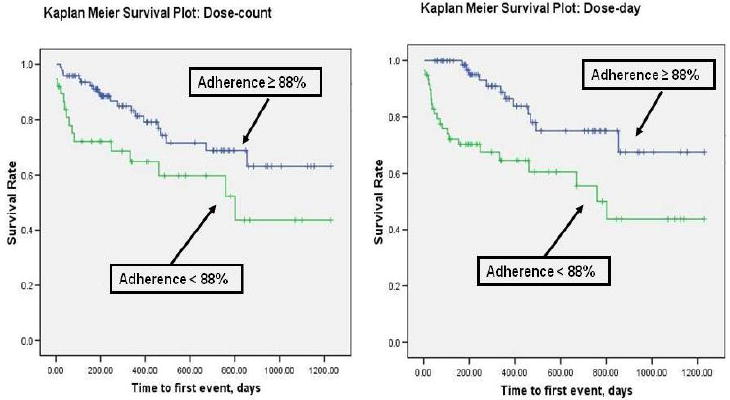
Methods: This was a longitudinal study of 135 patients with heart failure. Medication adherence was measured using a valid and objective measure, the Medication Event Monitoring System. Two indicators of adherence were assessed by the Medication Event Monitoring System (AARDEX, Union City, CA): (1) dose count, percentage of prescribed doses taken, and (2) dose days, percentage of days the correct number of doses was taken. Patients were followed up to 3.5 years to collect data on outcomes. A series of Kaplan-Meier plots with log-rank tests, Cox survival analyses, and receiver operating characteristic curves were assessed comparing event-free survival in patients divided at one-point incremental cutpoints.
Results: Event-free survival was significantly better when the prescribed number of doses taken (dose count) or the correct dose (dose day) was > or =88%. This level was confirmed in a Cox regression model controlling for age, gender, ejection fraction, New York Heart Association, comorbidity, angiotensin-converting enzyme inhibitor use, and beta-blocker use. Receiver operating characteristic curves showed that adherence rates above 88% produced the optimal combination of sensitivity and specificity with respect to predicting better event-free survival. With 88% as the adherence cutpoint, the hazard ratio for time to first event for the nonadherent group was 2.2 by dose count (P = .021) and 3.2 by dose day (P = .002).
Conclusion: The results of this study provide clinicians and researchers with an evidence-based recommendation about the level of adherence needed to achieve optimal clinical outcomes.
Conflict of interest statement
Figures
References
-
- Rosamond W, Flegal K, Furie K, et al. Heart disease and stroke statistics--2008 update: a report from the American Heart Association Statistics Committee and Stroke Statistics Subcommittee. Circulation. 2008;117:e25–146. - PubMed
-
- Hope CJ, Wu J, Tu W, et al. Association of medication adherence, knowledge, and skills with emergency department visits by adults 50 years or older with congestive heart failure. Am J Health Syst Pharm. 2004;61:2043–2049. - PubMed
-
- Li H, Morrow-Howell N, Proctor EK. Post-acute home care and hospital readmission of elderly patients with congestive heart failure. Health Soc Work. 2004;29:275–285. - PubMed
-
- Cote I, Farris K, Feeny D. Is adherence to drug treatment correlated with health-related quality of life? Qual Life Res. 2003;12:621–633. - PubMed
-
- DiMatteo MR. Variations in patients’ adherence to medical recommendations: A quantitative review of 50 years of research. Med Care. 2004;42:200–209. - PubMed
