


Giant deep lobe parotid gland pleomorphic adenoma involving the parapharyngeal space. Report of three cases and review of the diagnostic and therapeutic approaches
- PMID: 19186458
- PMCID: PMC2689534
Giant deep lobe parotid gland pleomorphic adenoma involving the parapharyngeal space. Report of three cases and review of the diagnostic and therapeutic approaches
Abstract
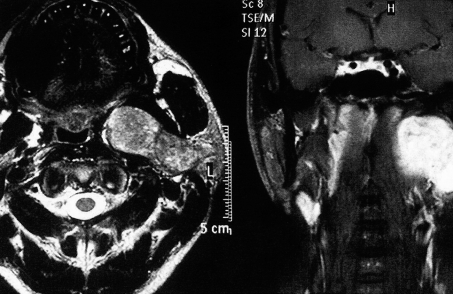
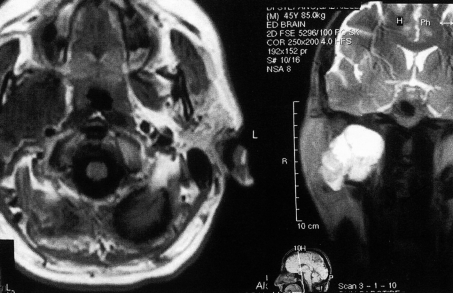
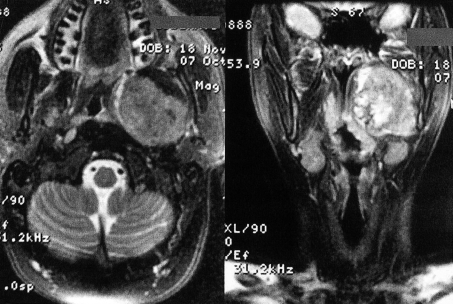
Aim of the present report is to discuss and underline the diagnostic algorithm and the surgical approach to giant parotid pleomorphic adenomas arising in the deep lobe and growing in the parapharyngeal space. Three cases are described and a review is made of the international literature concerning giant deep lobe parotid gland pleomorphic adenoma. Diagnosis was based on imaging, computed tomography scan and magnetic resonance imaging and upon cytology, by means of fine needle aspiration biopsy. The surgical approach varied according to the location of the tumour. All patients were discharged without complications and no cases of permanent facial nerve palsy were observed. An exhaustive pre-operative diagnostic algorithm is required before approaching this lesion. Fine needle aspiration biopsy is, in our opinion, mandatory to avoid histological surprises. The surgical approach should provide excellent visibility with wide surgical exposure to secure local neurovascular structures.
Scopo del lavoro è incentrare l’attenzione sul protocollo diagnostico e sulle tecniche chirurgiche in merito al trattamento degli adenomi pleomorfi giganti del lobo profondo della parotide con crescita nello spazio parafaringeo. Riportiamo la nostra esperienza con tre casi consecutivi recenti di adenoma pleomorfo gigante del lobo profondo della parotide con crescita nello spazio parafaringeo. La diagnosi si fonda sull’impiego di tomografia computerizzata, risonanza magnetica e dell’esame citologico mediante agobiopsia. Le tecniche chirurgiche variano a seconda dell’estensione e della localizzazione della neoplasia. Tutti i pazienti sono stati dimessi dopo una completa asportazione della neoplasia senza presentare complicanze intra- e peri-operatorie e, in particolare, deficit del nervo facciale. In conclusione, un completo e approfondito iter diagnostico è necessario prima di trattare neoplasie localizzate in questa sede. L’agobiopsia, secondo noi, è necessaria per evitare sorprese istologiche spiacevoli. L’approccio chirurgico deve fornire una ampia visione del letto chirurgico in modo da assicurare una completa escissione preservando le strutture neurovascolari.
Figures
References
-
- Batsakis JG, Sneige N. Parapharyngeal and retropharyngeal space diseases. Ann Otol Rhinol Laryngol 1989;98:320-1. - PubMed
-
- Eveson JW, Cawson RA. Salivary gland tumours. A review of 2410 cases with particular reference to histological types, site, age and sex distribution. J Pathol 1985;146:51-8. - PubMed
-
- Morita N, Miyata K, Sakamoto T, Wada T. Pleomorphic adenoma in the parapharyngeal space: report of three cases. J Oral Maxillofac Surg 1995;53:605-10. - PubMed
-
- Izzo L, Frati R, Cianfrone F, Sassayannis PG, Costi U, Galati G, et al. Parotid gland cancer: a case report of a primitive adenocarcinoma arising from a multirecurrent pleomorphic adenoma. J Exp Clin Cancer Res 2004;23:153-6. - PubMed
-
- Contucci AM, Corina L, Sergi B, Fadda G, Paludetti G. Correlation between fine needle aspiration biopsy and histologic findings in parotid masses. Personal experience. Acta Otorhinolaryngol Ital 2003;23:314-8. - PubMed
Publication types
MeSH terms
LinkOut - more resources
Full Text Sources