Comparative Study
. 2009 Feb 1;15(3):832-9.
doi: 10.1158/1078-0432.CCR-08-1456.

CAT-8015: a second-generation pseudomonas exotoxin A-based immunotherapy targeting CD22-expressing hematologic malignancies

Affiliations
Comparative Study

CAT-8015: a second-generation pseudomonas exotoxin A-based immunotherapy targeting CD22-expressing hematologic malignancies

Ralph F Alderson et al. Clin Cancer Res. .

Abstract

Purpose: To compare the in vitro and in vivo efficacy of CAT-8015, a second-generation recombinant immunotoxin composed of disulfide-linked affinity matured V(H) and V(L) chains of the mouse anti-CD22 monoclonal antibody RFB4 fused to PE38, to the parental compound CAT-3888.

Experimental design: The biological activity of CAT-8015 was examined in vitro using B-cell tumor lines and in vivo in a JD38-based s.c. tumor model in NCr athymic mice. Pharmacokinetics and interspecies scaling of CAT-8015 were evaluated in mice, rats, and cynomolgus monkeys. The potential toxicity of CAT-8015 was assessed in monkeys in a toxicologic study and compared with CAT-3888.

Results: The IC50 values of CAT-8015 in vitro using the EHEB, MEC1, Daudi, CA46, and JD38 cell lines ranged from 0.3 to 8.6 ng/mL. Pharmacokinetic studies with CAT-8015 were conducted in mouse, rat, and cynomolgus monkey. The t1/2 was calculated to be 0.42, 0.61, and 0.79 hours and the Vss was 1.37, 5.57, and 140.3 mL in mouse, rat, and monkey, respectively. In vivo, when JD38 tumor-bearing animals were treated with CAT-8015 at doses > or =75 microg/kg at 48-hour intervals for a total of three doses, a rapid reduction in tumor volume and in some cases complete remission in tumor growth was observed. The comparative toxicologic study showed comparable clinical and anatomic pathology changes for CAT-8015 and CAT-3888.

Conclusions: CAT-8015 is a CD22-targeting immunotoxin that, in preclinical studies, has greatly improved efficacy compared with CAT-3888.


Figures
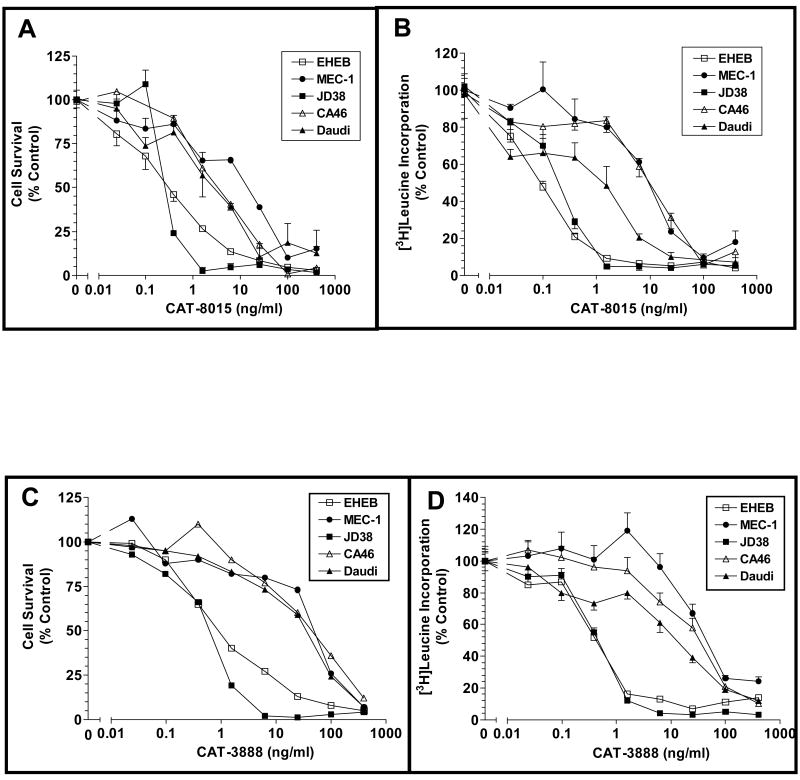
Figure 1
Figure 1
In vitro cytotoxicity of CAT-8015 and CAT-3888 on B cell tumor lines and effect of immunotoxin treatment on the level of [3H]leucine incorporation. (A and B) The B cell lines EHEB, MEC-1, JD38, CA46, and Daudi were incubated in the presence of the indicated concentrations of CAT-8015. (A) shows the dose dependent effect of CAT-8015 on lymphoma cell survival and (B) shows the inhibition of protein synthesis. (C and D) Effect of immunotoxin CAT-3888 treatment on lymphoma cell survival (C) and protein synthesis (D). The effect of the immunotoxin treatment on cell survival was determined using MTS after 48 hour incubation. Values represent the mean OD ± the standard error of the mean (SEM) of triplicate determinations. To assess the effect of CAT-8015 and CAT-3888 on protein synthesis the level of [3H]leucine incorporation by B cell tumor lines was measured. The tumor cell lines were incubated with immunotoxin for 48 hr and [3H]leucine was added to the culture medium for the final 2.5 hr. The incorporation of [3H]leucine into precipitable protein was then determined. Values represent the mean ± SEM of triplicate determinations.
Figure 2
Figure 2
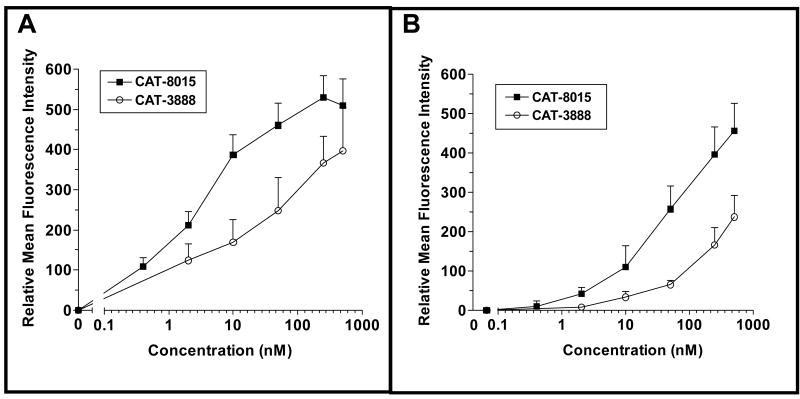
Binding of CAT-8015 or CAT-3888 to human or monkey PBMCs. Human (A) or monkey (B) purified PBMCs were incubated with biotinylated CAT-8015 at concentrations shown and then with streptavidin-FITC. Following washing in PBS, the samples were analyzed on a FACSCalibur flow cytometer (Becton-Dickinson).
Figure 3
Figure 3
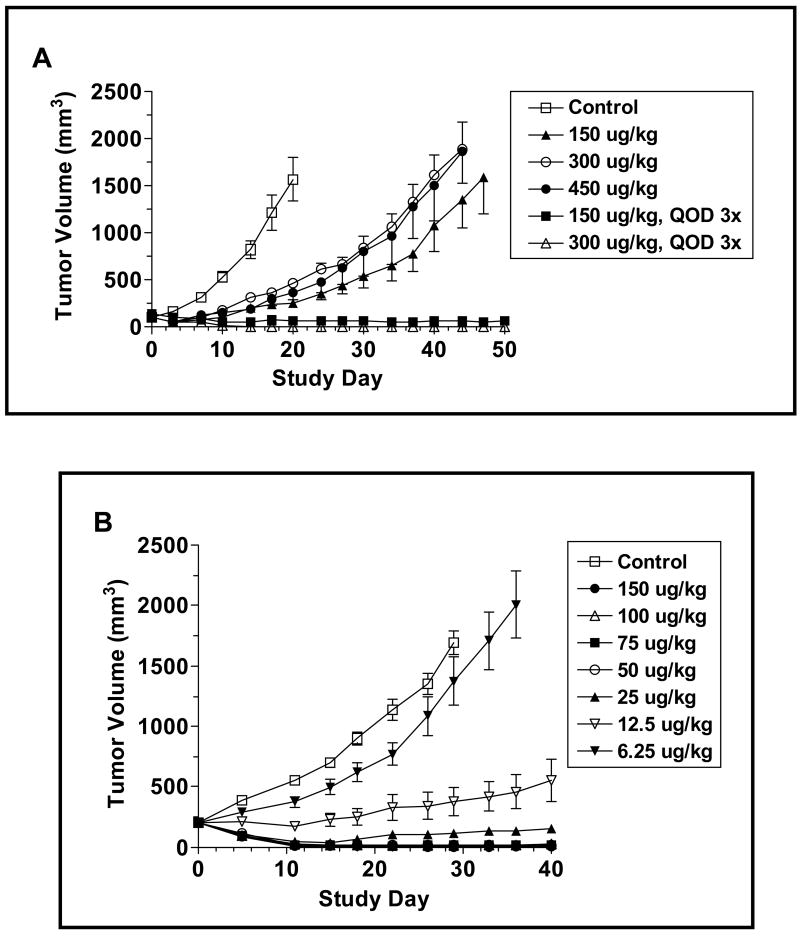
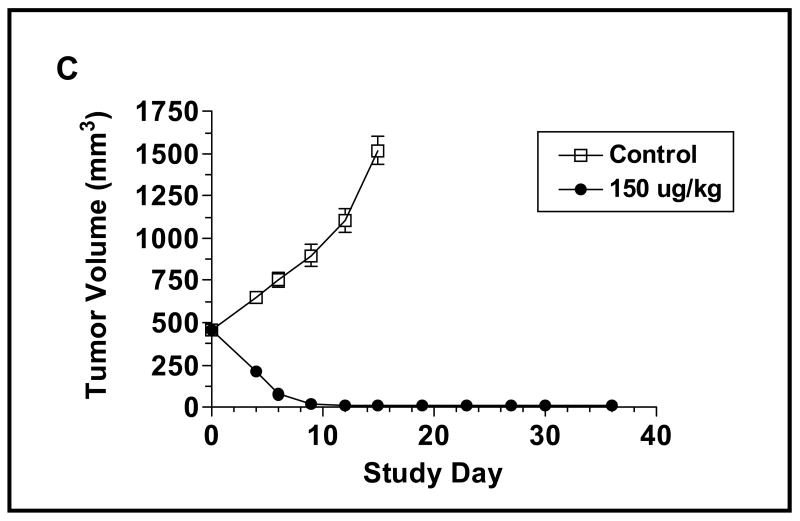
Effect of CAT-8015 on the growth of JD38 sc tumors in NCr athymic nude animals. Animals bearing JD38 sc tumors were randomized into groups based on tumor size on Study Day 0. (A) The animals were treated once (Study Day 0) or Q2D, x3 (Study Day 0, 2, and 4) with CAT-8015. The data points represent the mean ± SEM (n = 8). (B) JD38 tumor-bearing animals were treated Q2D, x3 on Study Day 0, 2, and 4 with an expanded range of doses of CAT-8015. (C) JD38 tumors with an average volume of 450 mm3 were treated Q2D, x3 on Study Day 0, 2, and 4 with vehicle or CAT-8015 at 150 μg/kg.
Figure 3
Figure 3
Effect of CAT-8015 on the growth of JD38 sc tumors in NCr athymic nude animals. Animals bearing JD38 sc tumors were randomized into groups based on tumor size on Study Day 0. (A) The animals were treated once (Study Day 0) or Q2D, x3 (Study Day 0, 2, and 4) with CAT-8015. The data points represent the mean ± SEM (n = 8). (B) JD38 tumor-bearing animals were treated Q2D, x3 on Study Day 0, 2, and 4 with an expanded range of doses of CAT-8015. (C) JD38 tumors with an average volume of 450 mm3 were treated Q2D, x3 on Study Day 0, 2, and 4 with vehicle or CAT-8015 at 150 μg/kg.
Figure 4
Figure 4
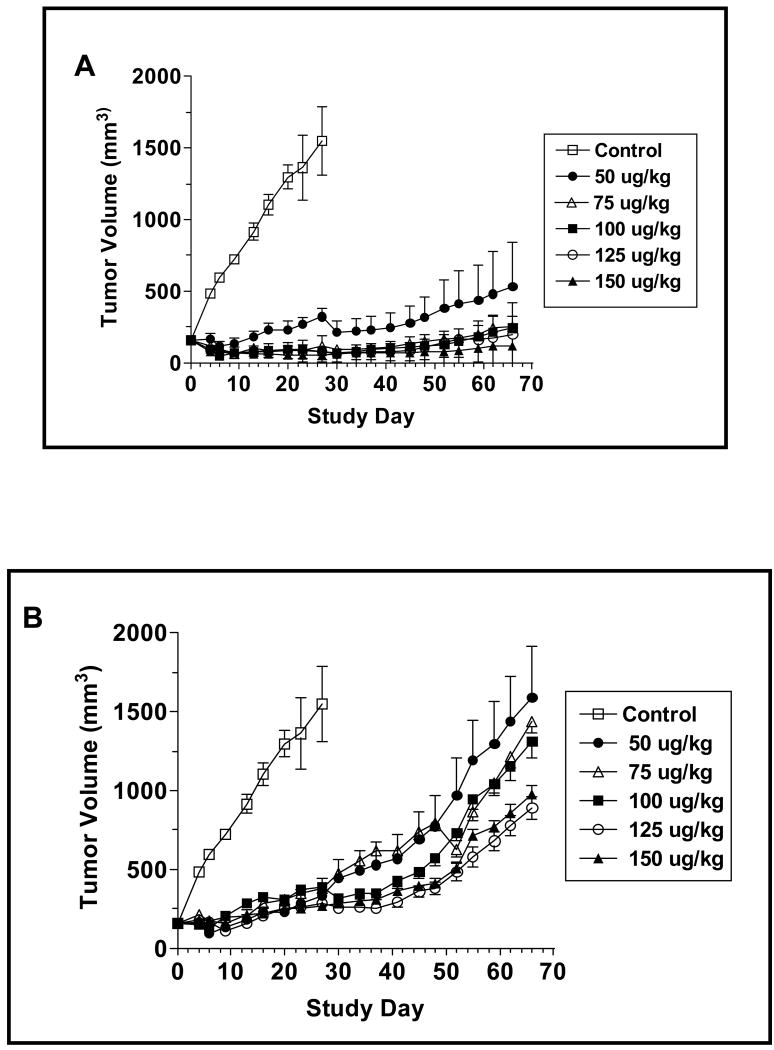
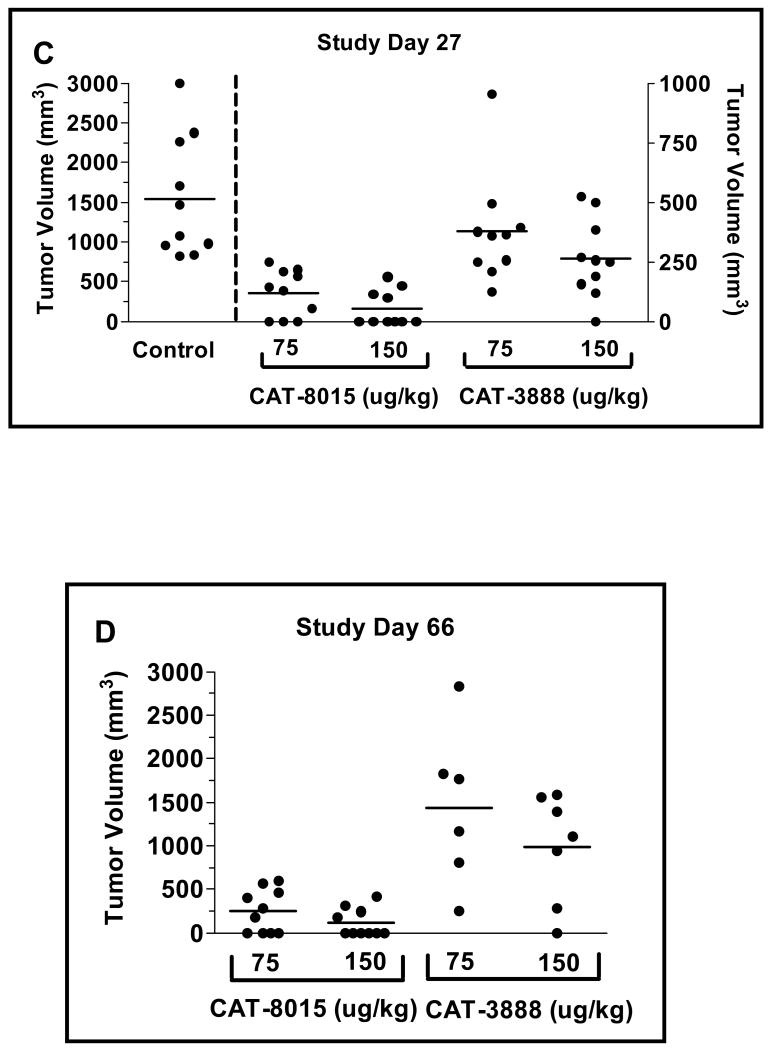
Comparison of the antitumor activity of CAT-3888 (A) and CAT-8015 (B). The immunotoxins were administered Q2D, x3 starting on Study Day 0 at 50, 75, 100, 125, 150 μg/kg or with the vehicle (control). The data points represent the average tumor volumes from groups with an n of 6 - 10. Scatter plots of the individual tumor volumes in the groups treated with 75 or 150 μg/kg CAT-8015 or CAT-3888 on Study Day 27 (C) or 66 (D). The solid bar represents the standard error of the mean. Comparing the mean tumor volumes in the groups receiving CAT-8015 at 75 or 150 μg/kg to the mean tumor volume of the control group the p value was >0.0001 in both cases. Comparing the mean tumor volumes in the groups dosed with CAT-8015 at 75 or 150 μg/kg to the respective groups dosed with CAT-3888 the p values were equal to 0.0013 and 0.0007, respectively.
Figure 4
Figure 4
Comparison of the antitumor activity of CAT-3888 (A) and CAT-8015 (B). The immunotoxins were administered Q2D, x3 starting on Study Day 0 at 50, 75, 100, 125, 150 μg/kg or with the vehicle (control). The data points represent the average tumor volumes from groups with an n of 6 - 10. Scatter plots of the individual tumor volumes in the groups treated with 75 or 150 μg/kg CAT-8015 or CAT-3888 on Study Day 27 (C) or 66 (D). The solid bar represents the standard error of the mean. Comparing the mean tumor volumes in the groups receiving CAT-8015 at 75 or 150 μg/kg to the mean tumor volume of the control group the p value was >0.0001 in both cases. Comparing the mean tumor volumes in the groups dosed with CAT-8015 at 75 or 150 μg/kg to the respective groups dosed with CAT-3888 the p values were equal to 0.0013 and 0.0007, respectively.

References

    1. Carter P. Improving the efficacy of antibody-based cancer therapies. Nature Rev Cancer. 2001;1:118–129. - PubMed
    1. Schiavo G, Gisou van der Goot F. The bacterial toxin tool kit. Nature Rev. 2001;2:530–537. - PubMed
    1. Law CL, Cerveny CG, Gordon KA, et al. Efficient elimination of B-lineage lymphomas by anti-CD20-auristatin conjugates. Clin Cancer Res. 2004;10:7842–7851. - PubMed
    1. Senter PD, Springer CJ. Selective activation of anticancer prodrugs by monoclonal antibody-enzyme conjugates. Adv Drug Delivery Reviews. 2001;53:247–264. - PubMed
    1. Pastan I, Hassan R, FitzGerald DJ, et al. Immunotoxin therapy of Cancer. Nature Rev Cancer. 2006;6:559–565. - PubMed

Publication types

MeSH terms