Review
. 2009 May 1;587(Pt 9):1881-8.
doi: 10.1113/jphysiol.2008.168211. Epub 2009 Feb 2.

Activity-dependent development of inhibitory synapses and innervation pattern: role of GABA signalling and beyond

Affiliations
Review

Activity-dependent development of inhibitory synapses and innervation pattern: role of GABA signalling and beyond

Z Josh Huang. J Physiol. .

Abstract

GABA-mediated synaptic inhibition is crucial in neural circuit operations. The development of GABAergic inhibitory synapses and innervation pattern in mammalian neocortex is a prolonged process, extending well into the postnatal period, and is regulated by neural activity and experience. Accumulating evidence supports the hypothesis that GABA signalling acts beyond synaptic transmission and regulates inhibitory synapse development; in other words, similar to glutamate signalling at developing excitatory synapses, GABA may coordinate pre- and post-synaptic maturation at inhibitory synapses. These findings raise numerous questions regarding the underlying mechanisms, including the role of GABA receptors and their link to synaptic adhesion molecules. Since synapse formation is a crucial component of axon growth, GABA signalling may also shape the axon arbor and innervation pattern of inhibitory neurons. A mechanism unique to GABAergic neurons is activity-dependent GABA synthesis, largely mediated through activity-regulated transcription of the rate-limiting enzyme GAD67. Such cell-wide as well as synaptic regulation of GABA signalling may constitute a mechanism by which input levels and patterns onto GABAergic neurons shape their innervation pattern during circuit development.


Figures
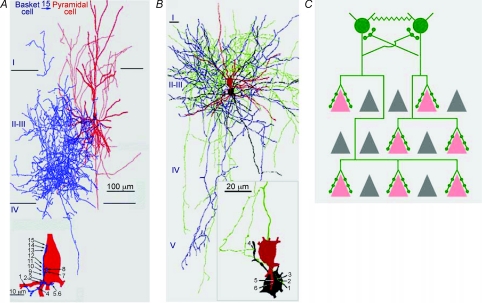
Figure 1
Figure 1. Perisomatic innervation pattern of the neocortical basket interneurons
A, highly exuberant axonal arborization of a neocortical basket interneuron (blue) and one of its many postsynaptic pyramidal cells (red). Although the basket axon overlaps with a large part of the pyramidal basal dendritic tree, all 15 electron microscopically verified synaptic junctions (bottom panel, right) are clustered around the soma or the most proximal dendrites (bottom panel, left) (adapted from Tamas et al. 1997). B, reconstructions of the two PV basket cells connected by both chemical and electrical synapses (presynaptic cell: soma and dendrites, red; axon, green; postsynaptic cell: soma, dendrites, black; axon blue). Cortical layers (I−V) are indicated on the left. The electron microscopically identified synaptic junctions (1 − 4) and gap junctions (5, 6) mediating the interaction between the coupled cells were found nearby on the soma and a proximal dendrite (inset) (adapted from Tamas et al. 2000). C, a schematic showing prominent features of the innervation pattern of cortical basket interneurons. A single basket cell axon (green) innervating the many pyramidal neurons (pink) in its vicinity with clusters of perisomatic synapses (green dots). Basket cells also innervate other basket cells via chemical and electrical (zigzaged lines) synapses. Grey triangles represent pyramidal neurons that are not innervated by these basket cells.
Figure 2
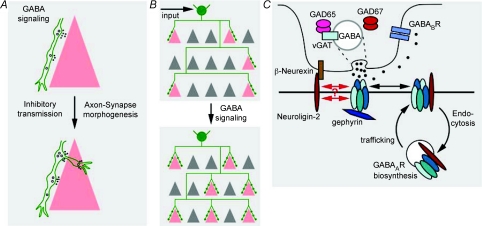
Figure 2. GAD67 and GABA act beyond inhibitory transmission and regulate inhibitory synapse development and innervation patterns
A, GABA signalling may regulate the morphogenesis of inhibitory synapses. B, since synapse formation is an integral part of axon growth and branching, activity-dependent GABA signalling may further influence the development of GABAergic axon arbor and innervation pattern. C, a hypothetical model depicting how GABA–GABA receptor signalling and neuroligin–neurexin adhesion may interact and co-operate to regulate the development of inhibitory synapses. Pentameric GABAARs are assembled in the endoplasmic reticulum. Most GABAARs are first delivered to extrasynaptic locations, they then either diffuse to and become trapped at postsynaptic sites or undergo endocytosis. NL2 and synaptic GABAARs stabilize each other, either through intracellular reciprocal interactions aided by scaffolding proteins such as gephyrin or through extracellular cis interaction. In addition, GABA activation of GABAARs might further stabilize synaptic GABAARs through structural changes or signalling mechanisms. Such activity- and GABA-mediated stabilization of GABAAR might further increase the levels of NL2 at cell–cell contacts and, in turn, stabilize presynaptic terminals through trans-synaptic interactions with neurexins.
Figure 3
Figure 3
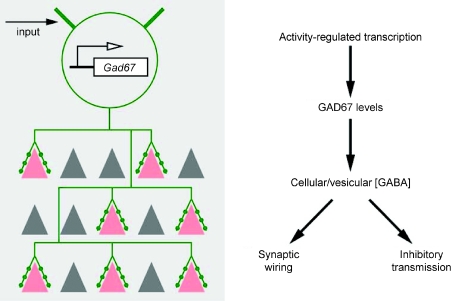
A scheme showing that the level and pattern of neuronal activity may regulate inhibitory synaptic morphogenesis and innervation patterns through GAD67-mediated GABA synthesis and signalling.

References

    1. Asada H, Kawamura Y, Maruyama K, Kume H, Ding R, Ji FY, Kanbara N, Kuzume H, Sanbo M, Yagi T, Obata K. Mice lacking the 65 kDa isoform of glutamic acid decarboxylase (GAD65) maintain normal levels of GAD67 and GABA in their brains but are susceptible to seizures. Biochem Biophys Res Commun. 1996;229:891–895. - PubMed
    1. Asada H, Kawamura Y, Maruyama K, Kume H, Ding RG, Kanbara N, Kuzume H, Sanbo M, Yagi T, Obata K. Cleft palate and decreased brain γ-aminobutyric acid in mice lacking the 67-kDa isoform of glutamic acid decarboxylase. Proc Natl Acad Sci U S A. 1997;94:6496–6499. - PMC - PubMed
    1. Bartos M, Vida I, Jonas P. Synaptic mechanisms of synchronized gamma oscillations in inhibitory interneuron networks. Nat Rev Neurosci. 2007;8:45–56. - PubMed
    1. Ben-Ari Y, Cherubini E, Corradetti R, Gaiarsa JL. Giant synaptic potentials in immature rat CA3 hippocampal neurones. J Physiol. 1989;416:303–325. - PMC - PubMed
    1. Ben-Ari Y, Gaiarsa JL, Tyzio R, Khazipov R. GABA: A pioneer transmitter that excites immature neurons and generates primitive oscillations. Physiol Rev. 2007;87:1215–1284. - PubMed

Substances

LinkOut - more resources