


Review
doi: 10.1074/jbc.R800039200.
Epub 2009 Feb 3.
Intramembrane-cleaving proteases
Affiliations
- PMID: 19189971
- PMCID: PMC2682844
- DOI: 10.1074/jbc.R800039200
Item in Clipboard
Review
Intramembrane-cleaving proteases
J Biol Chem.
.
No abstract available
Figures
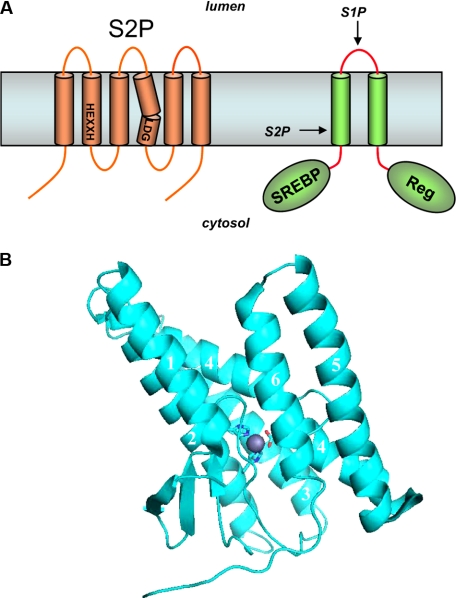
Intramembrane metalloproteases. A, S2P contains conserved
metalloprotease HEXXH and LDG motifs. SREBP is first cleaved by S1P
in the luminal loop. The regulatory domain (Reg) helps to ensure that
S1P proteolysis occurs when cholesterol levels are low. Subsequent
intramembrane proteolysis releases this transcription factor for expression of
genes essential to cholesterol and fatty acid synthesis. B, crystal
structure of an archaeal S2P in the closed conformation. Zinc (gray
sphere) is proximal to two histidines in TMD2, one aspartate in the
kinked TMD4 (side chain sticks), and one glutamate in TMD2 (not shown). In the
open conformation, TMD1 and TMD6 are considerably farther apart, suggesting
the site of lateral gating by which substrate TMD accesses the internal active
site.
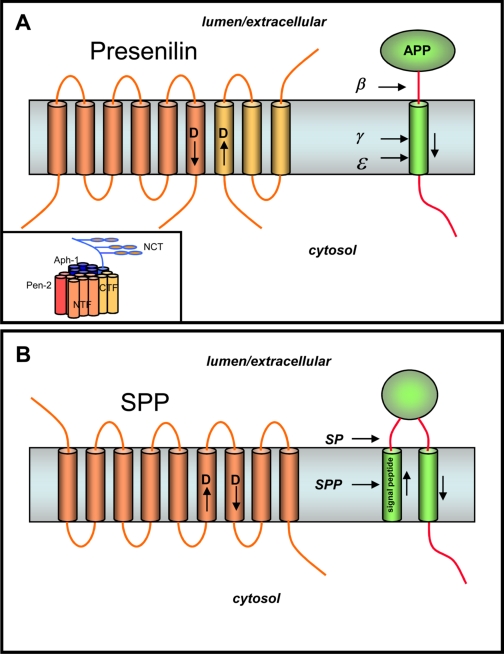
Intramembrane aspartyl proteases. A, PS, the
γ-secretase complex, and the proteolysis of APP. PS is cut into two
pieces, an NTF (dark portion) and a CTF (light portion),
that remain associated. Each fragment donates one aspartate essential for
γ-secretase activity. APP is first cleaved in the extracellular domain
by β-secretase, and the remnant is cleaved twice within the membrane by
γ-secretase to produce the Aβ peptide of Alzheimer disease
(secreted) and the intracellular domain (freed into the cytosol).
Inset, PS interacts with three other membrane proteins, nicastrin
(NCT), Aph-1, and Pen-2, to form active γ-secretase.
B, SPP. Signal peptides are removed from membrane proteins via signal
peptidase (SP), and these peptides are released from the membrane by
SPP-mediated intramembrane proteolysis. Like PS, SPP contains two aspartates
essential for protease activity, but the conserved aspartate-containing motifs
are in the opposite orientation compared with their PS counterparts.
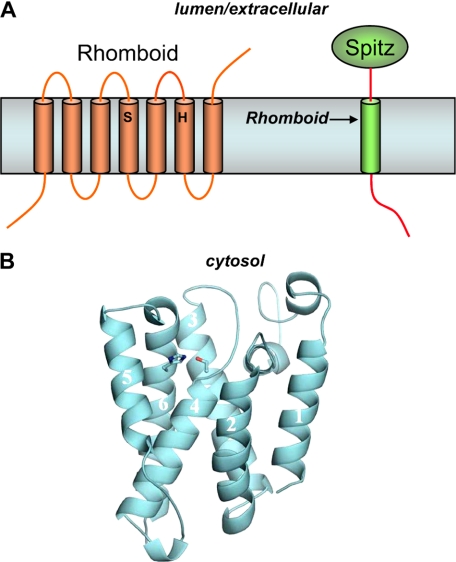
Intramembrane serine proteases. A, Rhomboid proteins
contain a conserved serine and histidine, which compose the catalytic dyad of
a serine protease. Rhomboid-1 cleaves within the transmembrane region of the
Drosophila EGF-like growth factor Spitz. B, structure of
E. coli Rhomboid GlpG. The serine in TMD4 and the histidine in TMD6
are coordinated in a manner consistent with known serine proteases and at a
depth within the membrane consistent with the site of proteolysis of Rhomboid
substrates.
References
Publication types
MeSH terms
Substances
Grants and funding
LinkOut - more resources
Full Text Sources
Other Literature Sources
