


Nicotinic receptor-evoked hippocampal norepinephrine release is highly sensitive to inhibition by isoflurane
- PMID: 19189985
- PMCID: PMC2642653
- DOI: 10.1093/bja/aen387
Nicotinic receptor-evoked hippocampal norepinephrine release is highly sensitive to inhibition by isoflurane
Abstract
Background: Inhaled anaesthetics (IAs) produce multiple dose-dependent behavioural effects including amnesia, hypnosis, and immobility in response to painful stimuli that are mediated by distinct anatomical, cellular, and molecular mechanisms. Amnesia is produced at lower anaesthetic concentrations compared with hypnosis or immobility. Nicotinic acetylcholine receptors (nAChRs) modulate hippocampal neural network correlates of memory and are highly sensitive to IAs. Activation of hippocampal nAChRs stimulates the release of norepinephrine (NE), a neurotransmitter implicated in modulating hippocampal synaptic plasticity. We tested the hypothesis that IAs disrupt hippocampal synaptic mechanisms critical to memory by determining the effects of isoflurane on NE release from hippocampal nerve terminals.
Methods: Isolated nerve terminals prepared from adult male Sprague-Dawley rat hippocampus were radiolabelled with [(3)H]NE and either [(14)C]GABA or [(14)C]glutamate and superfused at 37 degrees C. Release evoked by a 2 min pulse of 100 microM nicotine or 5 microM 4-aminopyridine was evaluated in the presence or absence of isoflurane and/or selective antagonists.
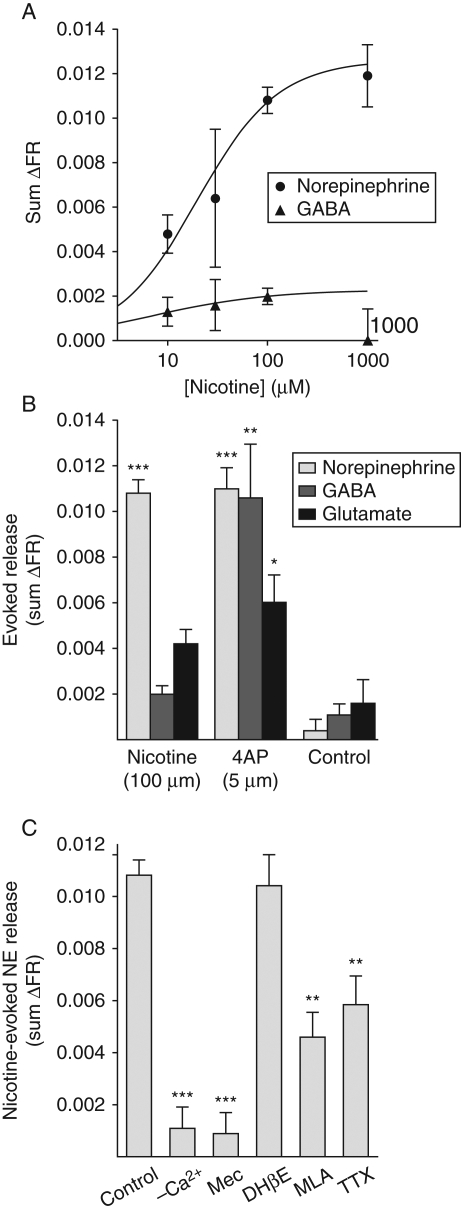
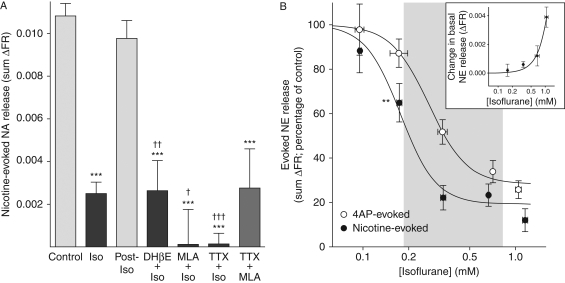
Results: Nicotine-evoked NE release from rat hippocampal nerve terminals was nAChR- and Ca(2+)-dependent, involved both alpha7 and non-alpha7 subunit-containing nAChRs, and was partially dependent on voltage-gated Na(+) channel activation based on sensitivities to various antagonists. Isoflurane inhibited nicotine-evoked NE release (IC(50)=0.18 mM) more potently than depolarization-evoked NE release (IC(50)=0.27 mM, P=0.014), consistent with distinct presynaptic mechanisms of IA action.
Conclusions: Inhibition of hippocampal nAChR-dependent NE release by subanaesthetic concentrations of isoflurane supports a role in IA-induced amnesia.
Figures
References
-
- Rudolph U, Antkowiak B. Molecular and neuronal substrates for general anaesthetics. Nat Rev Neurosci. 2004;5:709–20. - PubMed
-
- Eger EI, II, Koblin DD, Harris RA, et al. Hypothesis: inhaled anesthetics produce immobility and amnesia by different mechanisms at different sites. Anesth Analg. 1997;84:915–8. - PubMed
-
- Sonner J, Antognini JF, Dutton RC, et al. Inhaled anesthetics and immobility: mechanisms, mysteries, and minimum alveolar anesthetic concentration. Anesth Analg. 2003;97:718–40. - PubMed
-
- McGaugh JL. The amygdala modulates the consolidation of memories of emotional arousing experiences. Annu Rev Neurosci. 2004;27:1–28. - PubMed
-
- Scheiderer CL, Dobrunz LE, McMahon LL. Novel form of long-term synaptic depression in rat hippocampus induced by activation of alpha 1 adrenergic receptors. J Neurophysiol. 2004;91:1071–7. - PubMed
Publication types
MeSH terms
Substances
Grants and funding
LinkOut - more resources
Full Text Sources
Other Literature Sources
Miscellaneous
