


Comparative Study
doi: 10.1901/jaba.2008.41-539.
Effect of reinforcement probability and prize size on cocaine and heroin abstinence in prize-based contingency management
Affiliations
- PMID: 19192858
- PMCID: PMC2606595
- DOI: 10.1901/jaba.2008.41-539
Item in Clipboard
Comparative Study
Effect of reinforcement probability and prize size on cocaine and heroin abstinence in prize-based contingency management
J Appl Behav Anal.
2008 Winter.
Abstract
Although treatment outcome in prize-based contingency management has been shown to depend on reinforcement schedule, the optimal schedule is still unknown. Therefore, we conducted a retrospective analysis of data from a randomized clinical trial (Ghitza et al., 2007) to determine the effects of the probability of winning a prize (low vs. high) and the size of the prize won (small, large, or jumbo) on likelihood of abstinence until the next urine-collection day for heroin and cocaine users (N=116) in methadone maintenance. Higher probability of winning, but not the size of individual prizes, was associated with a greater percentage of cocaine-negative, but not opiate-negative, urines.
Figures
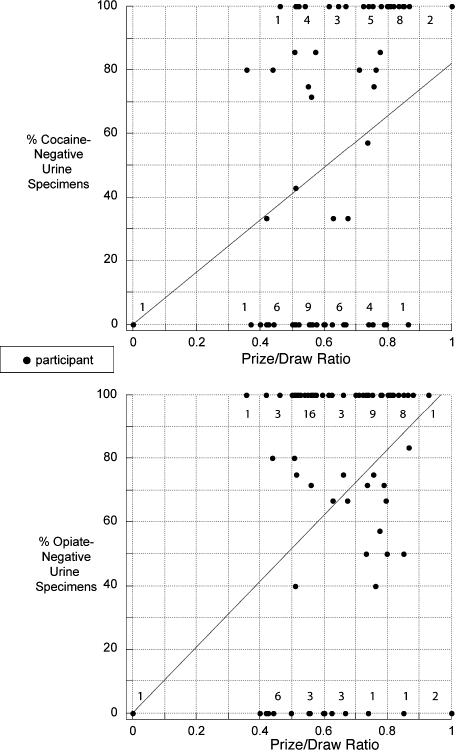
Relation between prize–draw ratio (actual prizes won divided by draws earned) and percentage of cocaine-negative (top) or opiate-negative (bottom) urines at the next urine-collection day. Each circle represents data from an individual participant in the contingent reinforcement group, averaged across all occasions in which that individual earned at least one prize draw for testing negative for cocaine or opiates. Numbers within the graph indicate the number of participants in each decile interval for 0% negative and 100% negative. The regression lines were calculated within the graphing software (Kaleidagraph) and were forced to go through the origin in order to avoid negative intercept terms, which would have been theoretically uninterpretable for these data. Forcing the intercept through the origin also produced a better fit to the data in terms of the standard errors for the regression coefficients, suggesting that this approach was appropriate (Eisenhauer, 2003).
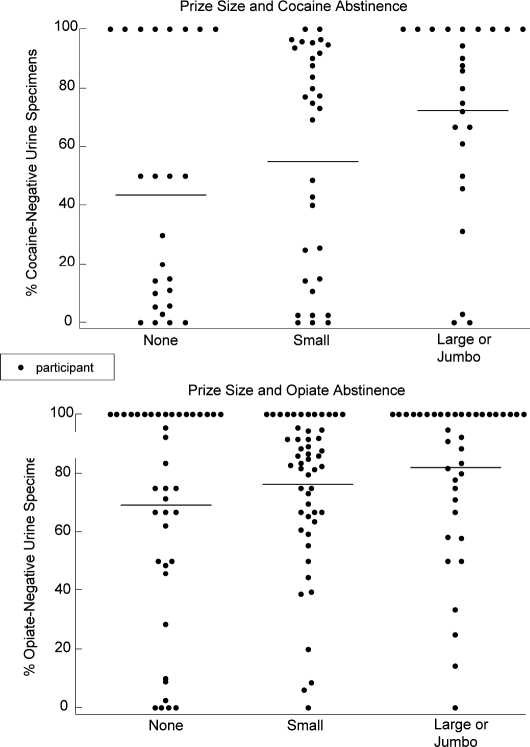
Relation between largest prize won and percentage of cocaine-negative (top) or opiate-negative (bottom) urines at the next urine-collection day. Each circle represents data from an individual participant in the contingent reinforcement group, averaged across all occasions in which that individual earned at least one prize draw for testing negative for cocaine or opiates and won none, small, or large or jumbo prizes. Jumbo and large prizes were grouped together because few jumbo prizes were earned. More participants are represented for opiates (bottom) because a larger proportion of participants tested negative for opiates at least once. Unadjusted means across participants are denoted by horizontal lines.
References
-
- Correia C.J, Benson T.A. The use of contingency management to reduce cigarette smoking among college students. Experimental and Clinical Psychopharmacology. 2006;14:171–179. - PubMed
-
- Correia C.J, Dallery J, Katz E.C, Silverman K, Bigelow G, Stitzer M.L. Single- versus dual-drug target: Effects in a brief abstinence incentive procedure. Experimental and Clinical Psychopharmacology. 2003;11:302–308. - PubMed
-
- Dallery J, Silverman K, Chutuape M.A, Bigelow G.E, Stitzer M.L. Voucher-based reinforcement of opiate plus cocaine abstinence in treatment-resistant methadone patients: Effects of reinforcer magnitude. Experimental and Clinical Psychopharmacology. 2001;9:317–325. - PubMed
-
- Eisenhauer J.G. Regression through the origin. Teaching Statistics. 2003;25:76–80.
Publication types
MeSH terms
Grants and funding
LinkOut - more resources
Full Text Sources
Medical
