


Randomized Controlled Trial
doi: 10.1901/jaba.2008.41-629.
The relative contribution of economic valence to contingency management efficacy: a pilot study
Affiliations
- PMID: 19192867
- PMCID: PMC2606608
- DOI: 10.1901/jaba.2008.41-629
Item in Clipboard
Randomized Controlled Trial
The relative contribution of economic valence to contingency management efficacy: a pilot study
J Appl Behav Anal.
2008 Winter.
Abstract
We investigated the extent to which a contingency management (CM) procedure that deducted money from a grand total available at the end of the study compared to a procedure in which money accumulated with continued abstinence from cigarette smoking. Results suggested that the procedure in which money increased contingent on abstinence resulted in a significantly greater likelihood of obtaining a clinically relevant (i.e., 48-hr) period of abstinence. In terms of attendance, participants in the condition in which monetary reinforcement accrued with consecutive instances of abstinence were significantly less likely to miss consecutive appointments than those in which money was deducted for failure to abstain.
Figures
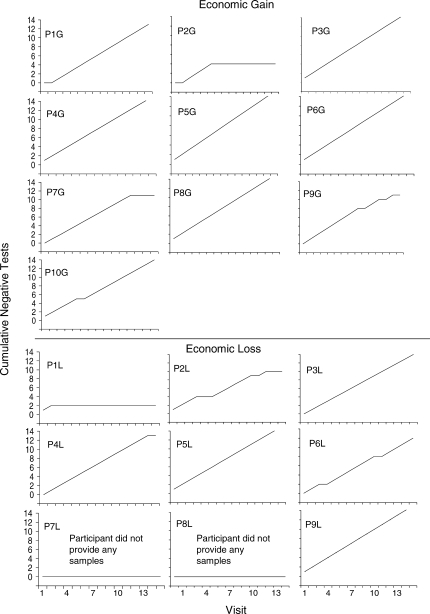
Cumulative records of abstinence (CO ≤ 8 ppm) for each participant in the gain and loss conditions over 15 trials.
References
-
- Brown C, Madden P.A, Palenchar D.R, Cooper-Patrick L. The association between depressive symptoms and cigarette smoking in an urban primary care sample. International Journal of Psychiatry and Medicine. 2000;30:15–26. - PubMed
-
- Hughes J.R, Gulliver S.B, Fenwick J.W, Valliere W.A, Cruser K, Pepper S, et al. Smoking cessation among self-quitters. Health Psychology. 1992;11:331–334. - PubMed
-
- Radloff L.S. The CES-D scale. Applied Psychological Measurement. 1977;3:385–401.
-
- Roll J.M, Higgins S.T. A within-subject comparison of three different schedules of reinforcement of drug abstinence using cigarette smoking as an exemplar. Drug and Alcohol Dependence. 2000;58:103–109. - PubMed
Publication types
MeSH terms
LinkOut - more resources
Full Text Sources
Medical
