


Cognitive functioning prior to the onset of psychosis: the role of fetal exposure to serologically determined influenza infection
- PMID: 19195645
- PMCID: PMC4058882
- DOI: 10.1016/j.biopsych.2008.12.015
Cognitive functioning prior to the onset of psychosis: the role of fetal exposure to serologically determined influenza infection
Abstract
Background: Previous studies have linked prenatal influenza exposure to increased risk of schizophrenia; however, no study has examined the neurodevelopmental sequelae of this prenatal insult before the onset of psychotic symptoms using serological evidence of infection. This study sought to examine the contribution of prenatal influenza A and B exposure to cognitive performance among children who developed psychoses in adulthood versus nonpsychiatric control children.
Methods: Subjects were 111 cases (70 with schizophrenia and 41 with affective psychoses) and 333 matched control subjects followed from gestation until age 7 through the Collaborative Perinatal Project. The Wechsler Intelligence Scale for Children (age 7) was administered and adult psychiatric morbidity was assessed by medical records review and confirmed by a validation study. Assays were conducted from archived prenatal maternal sera collected at birth, and influenza infection was determined by immunoglobulin G (IgG) antibody titers >75th percentile.
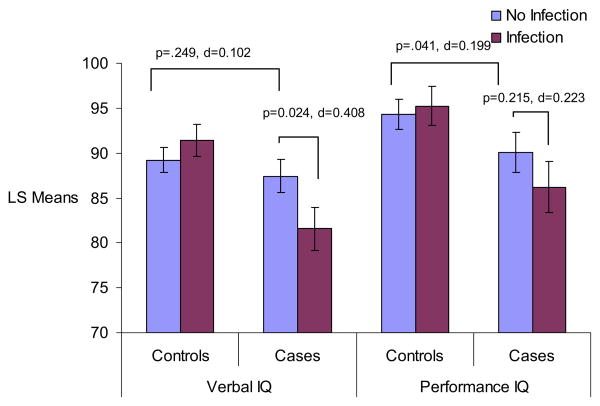
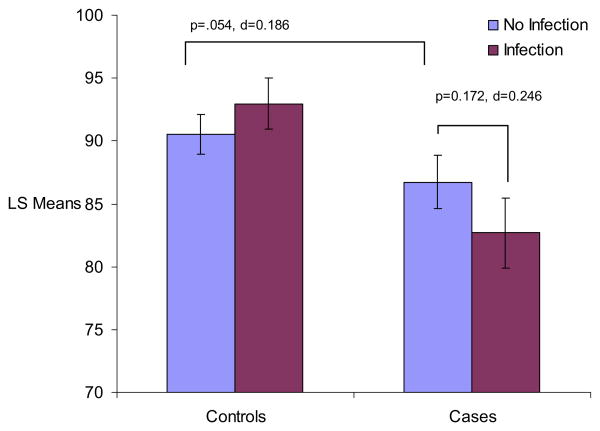
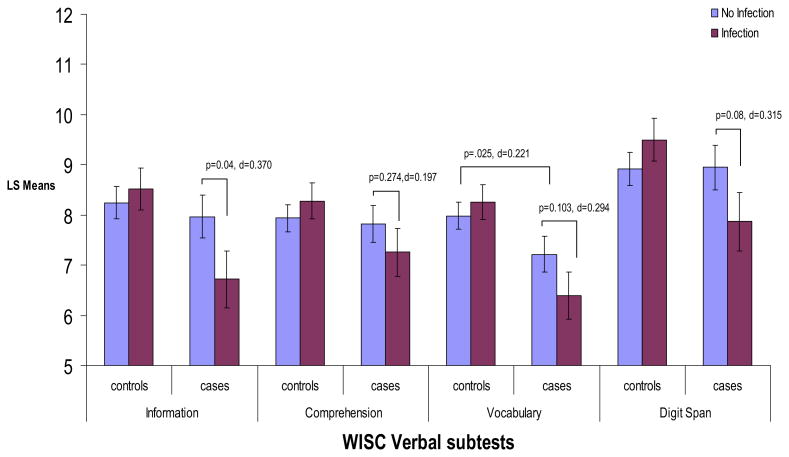
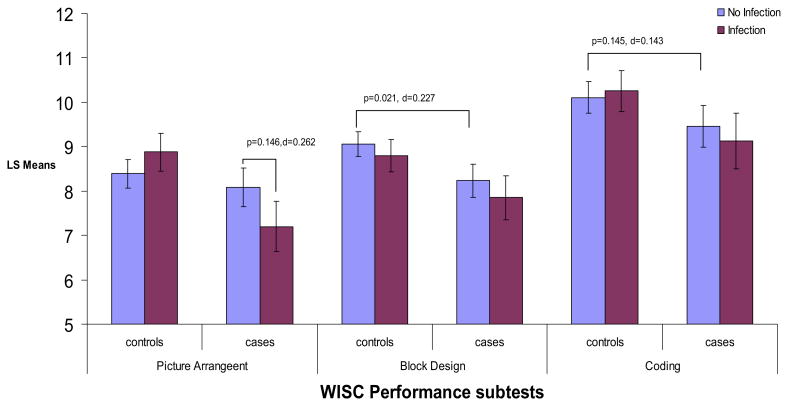
Results: Significant decreases in verbal IQ and the information subtest, as well as similar nonsignificant reductions in full scale IQ scores and vocabulary, comprehension, digit span, and picture arrangement subtests were found among cases who were prenatally exposed to influenza B versus cases who were not exposed. Fetal exposure to influenza B did not lead to any significant differences in cognitive performance among control children.
Conclusions: Cumulatively, these findings suggest that a genetic and/or an environmental factor associated with psychosis rendered the fetal brain particularly vulnerable to the effects of influenza B, leading to poorer cognitive performance even before symptom onset.
Conflict of interest statement
The authors report no biomedical financial interests or potential conflicts of interest.
Figures
References
-
- Niendam TA, Bearden CE, Rosso IM, Sanchez LE, Hadley T, Nuechterlein KH, Cannon TD. A prospective study of childhood neurocognitive functioning in schizophrenic patients and their siblings. Am J Psychiatry. 2003;160:2060–2062. - PubMed
-
- Reichenberg A, Weiser M, Caspi A, Knobler HY, Lubin G, Harvey PD, et al. Premorbid intellectual functioning and risk of schizophrenia and spectrum disorders. J Clin Exp Neuropsychol. 2006;28:193–207. - PubMed
-
- Woodberry KA, Giuliano AJ, Seidman LJ. Premorbid IQ in schizophrenia: A meta-analytic review. Am J Psychiatry. 2008;165:579–587. - PubMed
-
- Cannon TD, Bearden CE, Hollister JM, Rosso IM, Sanchez LE, Hadley T. Childhood cognitive functioning in schizophrenia patients and their unaffected siblings: A prospective cohort study. Schizophr Bull. 2000;26:379–393. - PubMed
-
- Bearden CE, Rosso IM, Hollister JM, Sanchez LE, Hadley T, Cannon TD. A prospective cohort study of childhood behavioral deviance and language abnormalities as predictors of adult schizophrenia. Schizophr Bull. 2000;26:395–410. - PubMed
Publication types
MeSH terms
Substances
Grants and funding
LinkOut - more resources
Full Text Sources
Medical
