. 2009 Feb 5:6:14.
doi: 10.1186/1743-422X-6-14.

A conserved predicted pseudoknot in the NS2A-encoding sequence of West Nile and Japanese encephalitis flaviviruses suggests NS1' may derive from ribosomal frameshifting

Affiliations

A conserved predicted pseudoknot in the NS2A-encoding sequence of West Nile and Japanese encephalitis flaviviruses suggests NS1' may derive from ribosomal frameshifting

Andrew E Firth et al. Virol J. .

Abstract

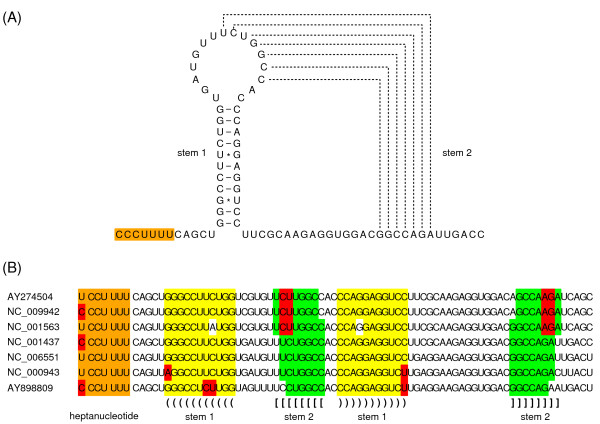
Japanese encephalitis, West Nile, Usutu and Murray Valley encephalitis viruses form a tight subgroup within the larger Flavivirus genus. These viruses utilize a single-polyprotein expression strategy, resulting in ~10 mature proteins. Plotting the conservation at synonymous sites along the polyprotein coding sequence reveals strong conservation peaks at the very 5' end of the coding sequence, and also at the 5' end of the sequence encoding the NS2A protein. Such peaks are generally indicative of functionally important non-coding sequence elements. The second peak corresponds to a predicted stable pseudoknot structure whose biological importance is supported by compensatory mutations that preserve the structure. The pseudoknot is preceded by a conserved slippery heptanucleotide (Y CCU UUU), thus forming a classical stimulatory motif for -1 ribosomal frameshifting. We hypothesize, therefore, that the functional importance of the pseudoknot is to stimulate a portion of ribosomes to shift -1 nt into a short (45 codon), conserved, overlapping open reading frame, termed foo. Since cleavage at the NS1-NS2A boundary is known to require synthesis of NS2A in cis, the resulting transframe fusion protein is predicted to be NS1-NS2A(N-term)-FOO. We hypothesize that this may explain the origin of the previously identified NS1 'extension' protein in JEV-group flaviviruses, known as NS1'.


Figures
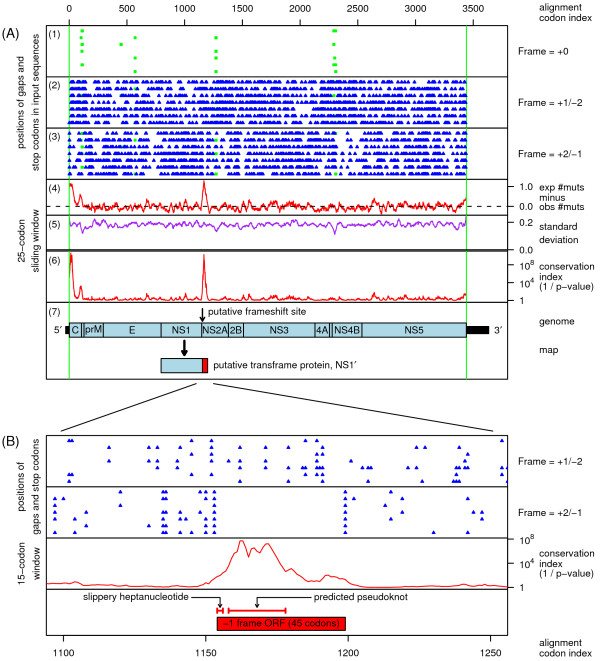
Figure 1
Figure 1
Conservation at synonymous sites in Japanese encephalitis and related viruses. Conservation at synonymous sites was calculated for an input alignment comprising the polyprotein CDSs from the seven JEV-group sequences listed in the caption to Figure 2. (A) Panels 1–3 show the positions of stop codons (blue triangles) in the three forward reading frames. The +0 frame is the polyprotein frame and is therefore devoid of stop codons. Alignment gaps are indicated in green. Panel 4 shows the difference between the expected number (assuming neutral evolution) and observed number of base substitutions at synonymous sites, summed over a phylogenetic tree, and averaged over a 25-codon sliding window. Panel 5 shows the estimated standard deviation for the statistic in panel 4 – major dips tend to correspond to alignment gaps (fewer pairwise sequence comparisons to sum over), while the rise at each end of the alignment corresponds to the shorter terminal windows over which statistics are averaged. Panel 6 is an approximation of the p-value corresponding to the statistic in panel 4, albeit subject to the assumption of normal distribution. Panel 7 shows a map of the JEV genome, indicating the position of the putative -1 ribosomal frameshift site, and the putative transframe protein which may equate to NS1'. (B) Zoom-in of the region corresponding to the conservation peak in the NS2A CDS with a 15-codon sliding window. Note the highest level of conservation corresponds precisely to the region covered by the predicted pseudoknot.
Figure 2
Figure 2
Putative stimulatory elements for ribosomal -1 frameshifting. (A) The slippery heptanucleotide and predicted 3' RNA pseudoknot structure for JEV [GenBank:NC_001437]. (B) Sequence alignment of different JEV-group sequences, showing the conserved presence of a slippery heptanucleotide (Y CCU UUU; orange) and potential to form a 3' RNA pseudoknot. Base-pairings in stem 1 are indicated with '()'s and yellow background while base-pairings in stem 2 are indicated with '[]'s and green background. Base substitutions that preserve base-pairings or the slippery heptanucleotide are highlighted in red. Viruses: Japanese encephalitis (JEV) – [GenBank:NC_001437]; West Nile (WNV; lineage I) – [GenBank:NC_009942]; West Nile (WNV; lineage II) – [GenBank:NC_001563]; Kunjin – [GenBank:AY274504]; Murray Valley encephalitis (MVEV) – [GenBank:NC_000943]; Alfuy – [GenBank:AY898809]; Usutu – [GenBank:NC_006551].
Figure 3
Figure 3
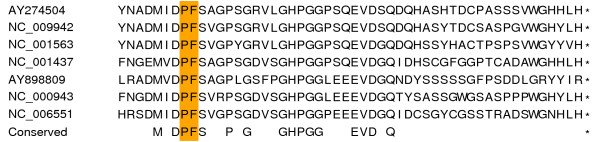
Peptide sequences for the putative transframe extension of NS1. Predicted peptide sequences for NS2AN-FOO – the putative transframe extension of NS1 – for various JEV-group viruses. The shift-site amino acids are indicated in the orange rectangle, and the foo termination codon is represented by an '*'. See caption to Figure 2 for virus names.

References

    1. Lindenbach BD, Thiel HJ, Rice CM. Flaviviridae: the viruses and their replication. In: Knipe DM, Howley PM, editor. Fields Virology. 5. Philadelphia: Lippincott-Raven Publishers; 2007. pp. 1101–1152.
    1. Brinton MA. The molecular biology of West Nile Virus: a new invader of the western hemisphere. Annu Rev Microbiol. 2002;56:371–402. doi: 10.1146/annurev.micro.56.012302.160654. - DOI - PubMed
    1. Mackenzie JS, Gubler DJ, Petersen LR. Emerging flaviviruses: the spread and resurgence of Japanese encephalitis, West Nile and dengue viruses. Nat Med. 2004;10:S98–109. doi: 10.1038/nm1144. - DOI - PubMed
    1. Simmonds P, Karakasiliotis I, Bailey D, Chaudhry Y, Evans DJ, Goodfellow IG. Bioinformatic and functional analysis of RNA secondary structure elements among different genera of human and animal caliciviruses. Nucleic Acids Res. 2008;36:2530–2546. doi: 10.1093/nar/gkn096. - DOI - PMC - PubMed
    1. Thompson JD, Higgins DG, Gibson TJ. CLUSTAL W: improving the sensitivity of progressive multiple sequence alignment through sequence weighting, position-specific gap penalties and weight matrix choice. Nucleic Acids Res. 1994;22:4673–4680. doi: 10.1093/nar/22.22.4673. - DOI - PMC - PubMed

Publication types

MeSH terms