


Review
doi: 10.1152/physiol.00035.2008.
Mutations in phosphoinositide metabolizing enzymes and human disease
Affiliations
- PMID: 19196647
- PMCID: PMC3499097
- DOI: 10.1152/physiol.00035.2008
Item in Clipboard
Review
Mutations in phosphoinositide metabolizing enzymes and human disease
Physiology (Bethesda).
2009 Feb.
Abstract
Phosphoinositides are implicated in the regulation of a wide variety of cellular functions. Their importance in cellular and organismal physiology is underscored by the growing number of human diseases linked to perturbation of kinases and phosphatases that catalyze interconversion from one phosphoinositide to another. Many such enzymes are attractive targets for therapeutic interventions. Here, we review diseases linked to inheritable or somatic mutations of these enzymes.
Figures
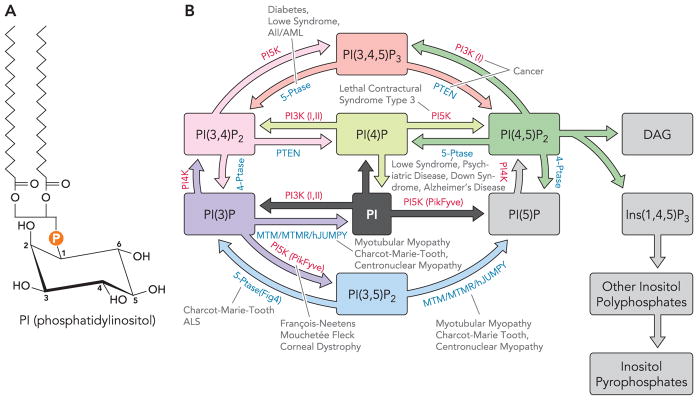
A: chemical structure of phosphatidylinositol with numbered positions of the inositol ring indicated. B: depiction of the main pathways of phosphoinositide synthesis and degradation. Diseases associated with the kinases and phosphatases that regulate this interconversion are indicated.
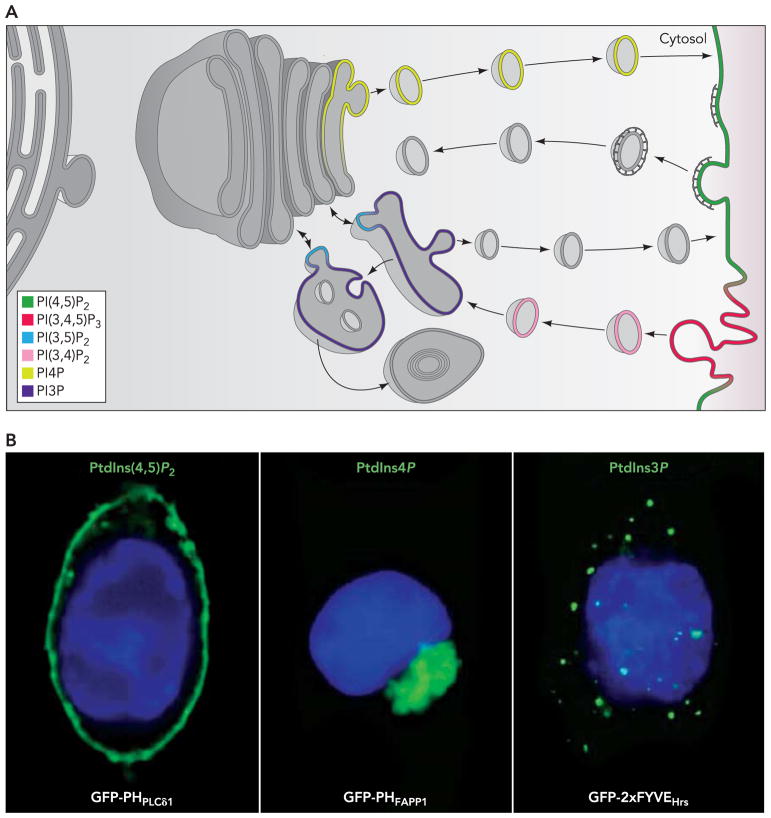
A: each phosphoinositide is thought to have its own predominant subcellular localization, as indicated (modified from a drawing by Andrea Raimondi). B: localization of PI(4,5)P2, PI4P, and PI3P, as revealed by transfected GFP fusion of protein modules that selectively bind these phosphoinositides. The localization of the fusion protein is shown in green: plasma membrane for PI(4,5)P2, the Golgi complex for PI4P, and endosomes for PI3P. (Reprinted with permission from Ref. .)
References
-
- Albanell J, Dalmases A, Rovira A, Rojo F. mTOR signalling in human cancer. Clin Transl Oncol. 2007;9:484–493. - PubMed
-
- Arai Y, Ijuin T, Takenawa T, Becker LE, Takashima S. Excessive expression of synaptojanin in brains with Down syndrome. Brain Development. 2002;24:67–72. - PubMed
-
- Attree O, Olivos IM, Okabe I, Bailey LC, Nelson DL, Lewis RA, McInnes RR, Nussbaum RL. The Lowe’s oculocerebrorenal syndrome gene encodes a protein highly homologous to inositol polyphosphate-5-phosphatase. Nature. 1992;358:239–242. - PubMed
-
- Azzedine H, Bolino A, Taieb T, Birouk N, Di Duca M, Bouhouche A, Benamou S, Mrabet A, Hammadouche T, Chkili T, Gouider R, Ravazzolo R, Brice A, Laporte J, LeGuern E. Mutations in MTMR13, a new pseudophosphatase homologue of MTMR2 and Sbf1, in two families with an autosomal recessive demyelinating form of Charcot-Marie-Tooth disease associated with early-onset glaucoma. Am J Hum Genet. 2003;72:1141–1153. - PMC - PubMed
-
- Backers K, Blero D, Paternotte N, Zhang J, Erneux C. The termination of PI3K signalling by SHIP1 and SHIP2 inositol 5-phosphatases. Adv Enzyme Regul. 2003;43:15–28. - PubMed
Publication types
MeSH terms
Substances
Grants and funding
LinkOut - more resources
Full Text Sources
Other Literature Sources
