. 2009 Feb 24;106(8):2577-82.
doi: 10.1073/pnas.0812826106. Epub 2009 Feb 5.

Drosophila hnRNP A1 homologs Hrp36/Hrp38 enhance U2-type versus U12-type splicing to regulate alternative splicing of the prospero twintron

Affiliations

Drosophila hnRNP A1 homologs Hrp36/Hrp38 enhance U2-type versus U12-type splicing to regulate alternative splicing of the prospero twintron

Sumit Borah et al. Proc Natl Acad Sci U S A. .

Abstract

During Drosophila embryogenesis, the transcription factor Prospero is critical for neuronal differentiation and axonal outgrowth. The prospero pre-mRNA undergoes alternative splicing, but is unique in that it harbors a rare twintron whereby one intron lies embedded within another. The innermost intron is excised by the major U2-type spliceosome and the outermost is excised by the minor U12-type spliceosome. Previously, an intronic purine-rich element (PRE) was identified as an enhancer of both U2- and U12-type splicing, with a greater effect on the U2-type pathway. We find that the PRE binds Drosophila homologs of heterogeneous nuclear ribonucleoprotein (hnRNP) A1, Hrp38 and Hrp36. RNAi-mediated knockdown of these proteins in S2 cells specifically decreases U2-type splicing of the twintron, which is surprising because hnRNPs usually are repressive. Conversely, tethering Hrp38 to the twintron increases U2-type splicing. Thus, developmentally regulated alternative splicing of the prospero twintron can be explained by documented changes in the abundance of these hnRNP A1-like proteins during embryogenesis.


Conflict of interest statement

The authors declare no conflict of interest.

Figures
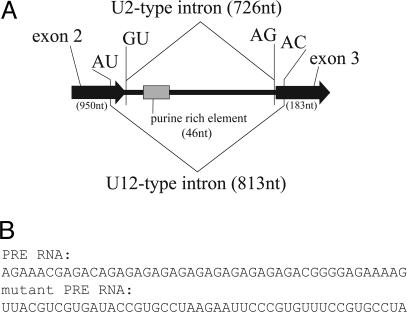
Fig. 1.
Fig. 1.
The prospero pre-mRNA is alternatively spliced. (A) Diagram (not to scale) of the twintron, which constitutes the second prospero intron. U2- and U12-type splice sites and the PRE are indicated. (B) Sequences of the PRE RNA (Upper) and a mutant PRE RNA (Lower) used for the competition experiments shown in Fig. 2A.
Fig. 2.
Fig. 2.
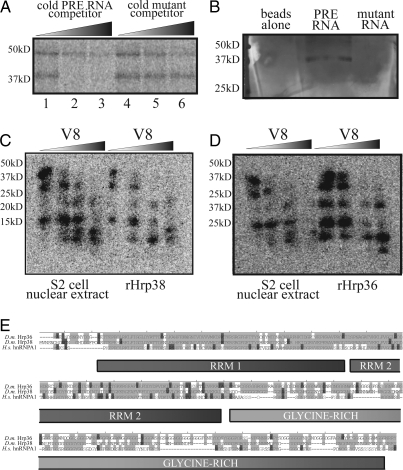
Hrp38 and Hrp36 interact with the PRE. (A) A 40-kDa protein in Drosophila Kc cell nuclear extract specifically cross-links to radiolabeled PRE RNA upon UV irradiation. Radiolabeled PRE (30 fmol) was cross-linked to proteins in nuclear extract after incubation with 300 fmol (10×; lanes 1 and 4), 3 pmol (100×; lanes 2 and 5), or 30 pmol (1,000×; lanes 3 and 6) competitor RNA. (B) A ≈40-kDa band was the most abundant selected from Drosophila S2 cell nuclear extract using immobilized wild-type PRE RNA. Mass spectrometric analysis revealed the major protein in this band to be Hrp38 and a minor protein to be Hrp36. (C) Partial proteolysis pattern of the PRE-cross-linked 40-kDa protein from extract and recombinant Hrp38. (D) Partial proteolysis pattern of recombinant Hrp36 is highly similar to that of the 40-kDa protein and Hrp38. In A–D the positions of marker proteins are indicated on the left. (E) Sequence alignment of Drosophila (D.m.) Hrp36 and Hrp38, which are ≈80% identical, and human (H.s.) hnRNP A1. Light gray indicates identical amino acids and dark gray shows similar amino acids.
Fig. 3.
Fig. 3.
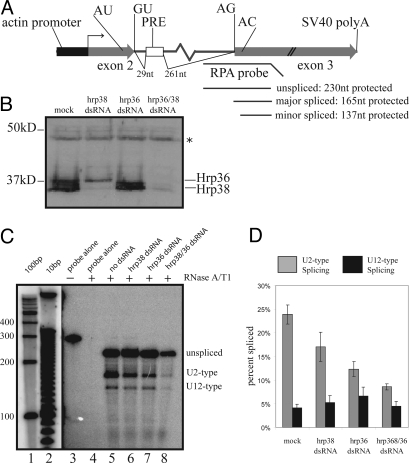
dsRNA knockdown of Hrp36 and/or Hrp38 results in lower U2-type splicing efficiency, but does not dramatically influence U12-type splicing efficiency. (A) In vivo splicing substrate used to assess twintron splicing. 5′ and 3′ splice sites of U2-type (GU/AG) and U12-type (AU/AC) introns are indicated, with regions of the antisense probe protected by unspliced precursor, major-spliced product, or minor-spliced product shown. (B) Western blot analysis of lysate from mock- or dsRNA-treated cells indicates reduction in protein expression. The antibody was rabbit polyclonal anti-Hrp38 (see Materials and Methods), which cross-reacts with Hrp36. Asterisk indicates a lysate protein that nonspecifically cross-reacts with the antiserum and therefore serves as a loading control. Hrp36 migrates slower than Hrp38 not only because of intrinsic differences in molecular mass (Hrp36 is ≈39.5kDa, and the 2 major Hrp38 isoforms are 38 and 39 kDa) but perhaps posttranslational modifications of Hrp36 as well (52). (C) RPA shows that the levels of U2-type splicing decrease upon dsRNA-mediated knockdown of Hrp38 and Hrp36 individually (lanes 6 and 7, respectively) or together (lane 8). The yield of total RNA harvested from S2 cells treated with both anti-hrp36 and anti-hrp38 dsRNA was considerably lower than that obtained from untreated or singly treated cells, resulting in lower signals of unspliced, U2-type spliced, and U12-type spliced products in the ensuing RPA (compare lanes 5–7 with lane 8). (D) Quantitation of U2- versus U12-type spliced products. Values are the average of 5 independent experiments, with SDs shown.
Fig. 4.
Fig. 4.
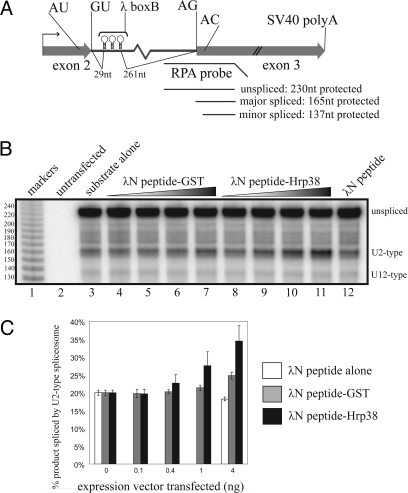
Tethering of Hrp38 to the twintron enhances U2-type splicing. (A) Splicing reporter containing 3 copies of the boxB hairpin in place of the PRE. (B) RPA of boxB twintron substrate after cotransfection with no λN fusion protein vector (lane 3) or 0, 0.1, 0.4, 1, or 4 ng of vector-encoding λN-GST fusion protein (lanes 4–7), λN-Hrp38 fusion protein (lanes 8–11) or 4 ng of λN peptide alone (lane 12). (C) Quantitation of U2- and U12-type splicing from 3 independent experiments.

References

    1. Copertino DW, Hallick RB. Group II twintron: An intron within an intron in a chloroplast cytochrome b-559 gene. EMBO J. 1991;10:433–442. - PMC - PubMed
    1. Desplan C, Theis J, O'Farrell PH. The sequence specificity of homeodomain–DNA interaction. Cell. 1988;54:1081–1090. - PMC - PubMed
    1. Chu-Lagraff Q, Wright DM, McNeil LK, Doe CQ. The prospero gene encodes a divergent homeodomain protein that controls neuronal identity in Drosophila. Development. 1991;2(Suppl):79–85. - PubMed
    1. Doe CQ, Chu-LaGraff Q, Wright DM, Scott MP. The prospero gene specifies cell fates in the Drosophila central nervous system. Cell. 1991;65:451–464. - PubMed
    1. Vaessin H, et al. prospero is expressed in neuronal precursors and encodes a nuclear protein that is involved in the control of axonal outgrowth in Drosophila. Cell. 1991;67:941–953. - PubMed

Publication types

MeSH terms

LinkOut - more resources