Comparative Study
. 2009 Aug;16(8):625-37.
doi: 10.1038/cgt.2009.6. Epub 2009 Feb 6.

INGN 007, an oncolytic adenovirus vector, replicates in Syrian hamsters but not mice: comparison of biodistribution studies

Affiliations
Comparative Study

INGN 007, an oncolytic adenovirus vector, replicates in Syrian hamsters but not mice: comparison of biodistribution studies

B Ying et al. Cancer Gene Ther. 2009 Aug.

Abstract

Preclinical biodistribution studies with INGN 007, an oncolytic adenovirus (Ad) vector, supporting an early stage clinical trial were conducted in Syrian hamsters, which are permissive for Ad replication, and mice, which are a standard model for assessing toxicity and biodistribution of replication-defective (RD) Ad vectors. Vector dissemination and pharmacokinetics following intravenous administration were examined by real-time PCR in nine tissues and blood at five time points spanning 1 year. Select organs were also examined for the presence of infectious vector/virus. INGN 007 (VRX-007), wild-type Ad5 and AdCMVpA (an RD vector) were compared in the hamster model, whereas only INGN 007 was examined in mice. DNA of all vectors was widely disseminated early after injection, but decayed rapidly in most organs. In the hamster model, DNA of INGN 007 and Ad5 was more abundant than that of the RD vector AdCMVpA at early times after injection, but similar levels were seen later. An increased level of INGN 007 and Ad5 DNA but not AdCMVpA DNA in certain organs early after injection, and the presence of infectious INGN 007 and Ad5 in lung and liver samples at early times after injection, strongly suggests that replication of INGN 007 and Ad5 occurred in several Syrian hamster organs. There was no evidence of INGN 007 replication in mice. In addition to providing important information about INGN 007, the results underscore the utility of the Syrian hamster as a permissive immunocompetent model for Ad5 pathogenesis and oncolytic Ad vectors.


Figures

Figure 1
Figure 1
Genomic structure of INGN 007, Ad5 and AdCMVpA and the QPCR assays to detect viral DNA. (a) Schematic of vectors used in this study. The genomes of wild-type Ad5, INGN 007 and AdCMVpA are depicted. The early transcription units 1 (E1), 2 (E2), 3 (E3) and 4 (E4) are shown as arrows. Exons 1, 2 and 3 of the tripartite leader as well as the late transcription units L1, L2, L3, L4, ADP and L5 are shown above the Ad5 genome. The E3 region of INGN 007 is deleted and replaced by the ADP gene. AdCMVpA, which was derived from dl309, lacks all of E1 and a portion of the E3 transcription unit. AdCMVpA does not contain a transgene. (b) Schematic of the differences between the E3 region of each of the genomes. The amplicon of the INGN 007 QPCR assay is shown above the INGN 007 genome. The amplicon of the Ad5/AdCMVpA QPCR assay is shown below the Ad5 genome. Performance characteristics of the INGN 007 (c) and Ad5/AdCMVpA (d) assays were derived from three independent experiments.
Figure 2
Figure 2
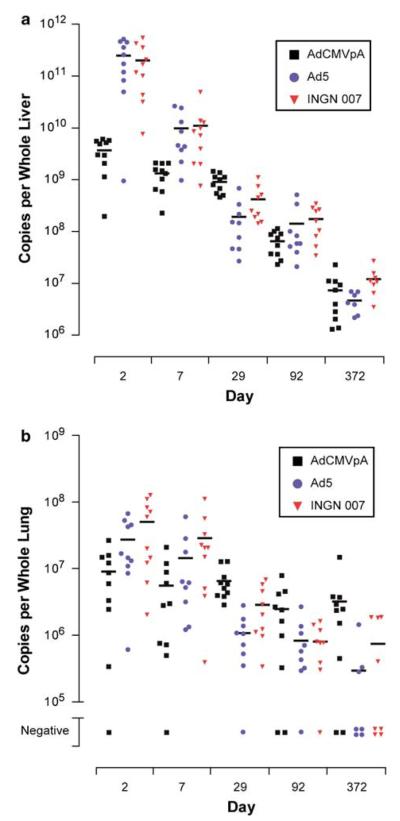
Genome copies in Syrian hamster liver and lung samples. The number of genome copies of AdCMVpA, Ad5 and INGN 007 in whole Syrian hamster liver (a) and lungs (b) was calculated. The horizontal bar represents the mean copy number. Tissue samples that were negative for viral genomic DNA were considered as zero for the purposes of calculating the mean copy number.
Figure 3
Figure 3
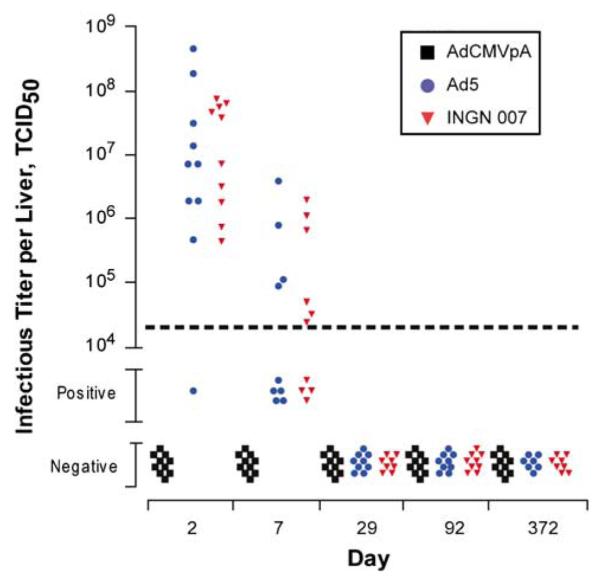
Infectious titer of INGN 007, Ad5 and AdCMVpA in Syrian hamster liver samples. A portion of each liver sample was homogenized and then subjected to a TCID50 assay on HEK-293 cells to determine the amount of infectious vector/virus present. The lower limit of sensitivity of the assay with liver homogenates is shown by the horizontal dashed line. Samples that contained detectable infectious vector/virus but whose titer could not be calculated are shown as being positive. Samples where vector/virus was not detectable are shown as being negative.
Figure 4
Figure 4
Immunohistochemistry of liver samples for adenovirus (Ad) fiber protein. Liver samples from the companion toxicology study were prepared for immunohistochemical staining and then stained using an antifiber antibody. Representative fields from the mock-injected (a), AdCMVpA-injected (b) and INGN 007-injected (c, d) Syrian hamsters are shown. (d) A magnified portion of the field shown in c. The black bar represents 100 μm (a, b and c) or 10 μm (d).
Figure 5
Figure 5
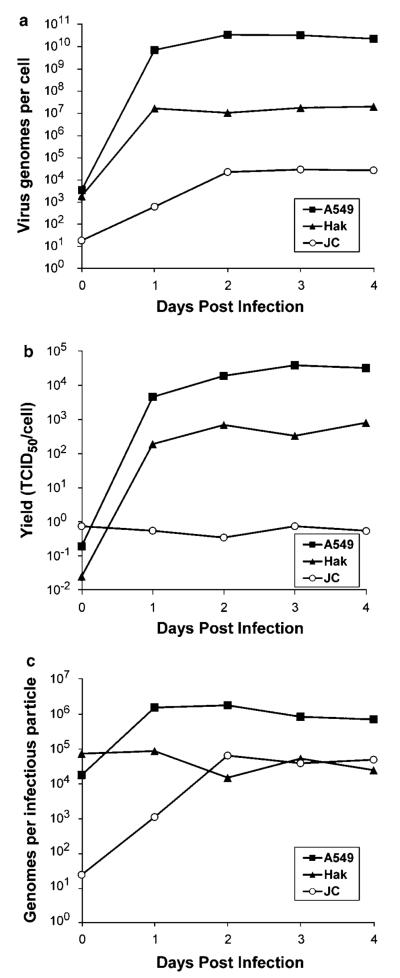
Ratio of Ad5 genomic DNA copies to infectious virus in different cell lines. Human A549, Syrian hamster HaK and mouse JC cells infected at a multiplicity of infection (MOI) of 100 PFU per cell were harvested on the indicated days. Each lysate was subjected to the TCID50 assay (a) and the Ad5/AdCMVpA QPCR assay (b). The Ad5 copy number was divided by the TCID50 titer and plotted vs days post infection (c).

References

    1. Everts B, van der Poel H. Replication-selective oncolytic viruses in the treatment of cancer. Cancer Gene Ther. 2005;12:141–161. - PubMed
    1. Bischoff JR, Kirn DH, Williams A, Heise C, Horn S, Muna M, et al. An adenovirus mutant that replicates selectively in p53-deficient human tumor cells. Science. 1996;274:373–376. - PubMed
    1. Lichtenstein DL, Wold WSM. Experimental infections of humans with wild-type adenoviruses and with replication-competent adenovirus vectors: replication, safety, and transmission. Cancer Gene Ther. 2004;11:819–829. - PubMed
    1. Wold WSM, Cladaras C, Magie SC, Yacoub N. Mapping a new gene that encodes an 11 600-molecular-weight protein in the E3 transcription unit of adenovirus 2. J Virol. 1984;52:307–313. - PMC - PubMed
    1. Tollefson AE, Ryerse JS, Scaria A, Hermiston TW, Wold WSM. The E3-11.6 kDa adenovirus death protein (ADP) is required for efficient cell death: characterization of cells infected with adp mutants. Virology. 1996;220:152–162. - PubMed

Publication types