. 2009 Mar;10(3):271-7.
doi: 10.1038/embor.2008.255. Epub 2009 Feb 6.

The M-type receptor PLA2R regulates senescence through the p53 pathway

Affiliations

The M-type receptor PLA2R regulates senescence through the p53 pathway

Arnaud Augert et al. EMBO Rep. 2009 Mar.

Abstract

Senescence is a stable proliferative arrest induced by various stresses such as telomere erosion, oncogenic or oxidative stress. Compelling evidence suggests that it acts as a barrier against tumour development. Describing new mechanisms that favour an escape from senescence can thus reveal new insights into tumorigenesis. To identify new genes controlling the senescence programme, we performed a loss-of-function genetic screen in primary human fibroblasts. We report that knockdown of the M-type receptor PLA2R (phospholipase A2 receptor) prevents the onset of replicative senescence and diminishes stress-induced senescence. Interestingly, expression of PLA2R increases during replicative senescence, and its ectopic expression results in premature senescence. We show that PLA2R regulates senescence in a reactive oxygen species-DNA damage-p53-dependent manner. Taken together, our study identifies PLA2R as a potential new tumour suppressor gene crucial in the induction of cellular senescence through the activation of the p53 pathway.


Conflict of interest statement

The authors declare that they have no conflict of interest.

Figures

Figure 1
Figure 1
The downregulation of PLA2R induces a bypass of replicative- and stress-induced senescence. (A) After infection of WI38 cells by control (Ctrl) or shPLA2R-encoding vectors and selection, RNAs were prepared. PLA2R mRNA levels were analysed in control cells and in various shPLA2R-infected cells by using QRT–PCR. (B) Colony formation assay. Control, shPLA2R-, shPLA2R-6- or shPLA2R-9-expressing WI38 cells were seeded at low densities. After 2 weeks, the cells were fixed and stained with crystal violet. (C) Growth curve analysis. WI38 cells were seeded at the same density, split every week and counted. The population doublings were calculated at each passage. (D) Control and shPLA2R WI38 cells were analysed for their SA-β-gal activity and the percentage of positive cells in each condition was calculated. (E) A colony formation assay of control versus shPLA2R-infected cells was performed in various primary human cells. The cells were seeded at low densities and stained 2 weeks later with crystal violet. (F) Control, shPLA2R or shp53 WI38 cells were plated at low densities, pulsed every 2 days with H2O2 (50 μM during 30 min) and stained 2 weeks later with crystal violet. (G) Control, shPLA2R or shp53 cells were treated with H2O2 as described above, until control cells entered a senescence-like morphology after which the cells were subjected to SA-β-gal analysis. For both experiments, untreated controls were also used in parallel. HMEC, human mammary epithelial cells; mRNA, messenger RNA; PLA2R, phospholipase A2 receptor; QRT–PCR, quantitative reverse transcription–PCR; SA-β-gal, senescence-associated β-galactosidase; sh, short hairpin.
Figure 2
Figure 2
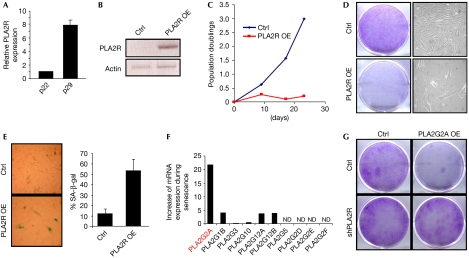
The ectopic expression of PLA2R triggers premature senescence. (A) RNAs from WI38 HDFs at p22 (proliferating) and p29 (senescing) were prepared. After retro-transcription, Q PCR against PLA2R mRNA and GAPDH mRNA were performed. The relative levels of mRNA PLA2R are shown. (B) After infection, selection and RNA preparation, ectopic expression of PLA2R was verified by RT–PCR in WI38 cells. (C) Growth curve analysis of control versus PLA2R-overexpressing WI38 cells. (D) A colony formation assay was performed to illustrate the growth difference of control and PLA2R-overexpressing WI38 cells. (E) Control and PLA2R-overexpressing WI38 cells were seeded and SA-β-gal activity was analysed. The number of positive cells was counted and the percentage was calculated for both conditions. (F) RNAs were prepared as in (A) and the expression of the indicated sPLA2 was analysed at p22 and p29. The results are presented as a fold increase during senescence (ND stands for not detected). (G) WI38 cells were first infected with a control or an shPLA2R-encoding vector, and G418 was selected. The cells were subjected to a second round of infection with a control or a PLA2G2A-encoding vector and puromycin was selected. The cells were then seeded at low densities and stained 2 weeks later with crystal violet. Ctrl, control; GAPDH, glyceraldehyde-3-phosphate dehydrogenase; HDF, human fibroblasts; mRNA, messenger RNA; OE, overexpression; PLA2R, phospholipase A2 receptor; QRT–PCR, quantitative reverse transcription–PCR; SA-β-gal, senescence-associated β-galactosidase.
Figure 3
Figure 3
PLA2R induces senescence through the production of reactive oxygen species. (A) Young WI38 cells were infected with control (Ctrl) or PLA2R-expressing vectors. After 2 weeks, the cells were loaded with H2DCFDA and the fluorescence was analysed by microscopy and flow cytometry. Pictures and relative mean fluorescence are shown (upper panel). WI38 cells approaching senescence were infected with a control vector or a shPLA2R construct, and when control cells entered senescence, the cells were loaded with H2DCFDA and the fluorescence was analysed as above (lower panel). (B) After infection, 2.5 mM N-acetyl-cysteine (NAC) was added or not from day 1 after infection and renewed every 2 days. The cells were stained with crystal violet 2 weeks later or pictures were taken after 10 days. (C) WI38 cells were analysed for their SA-β-gal activity, and the percentage of positive cells in each condition was calculated. OE, overexpression; PLA2R, phospholipase A2 receptor; ROS, reactive oxygen species; SA-β-gal, senescence-associated β-galactosidase; sh, short hairpin.
Figure 4
Figure 4
PLA2R regulates senescence through the p53 pathway. (A,B) Old control (Ctrl) and shPLA2R-infected WI38 cells or young control and PLA2R-infected WI38 cells were subjected to γH2AX immunofluorescence, and the percentage of γH2AX-positive cells was determined. (C) WI38 cells were cultured until control cells entered senescence. Both control and shPLA2R-infected cells were lysed and western blot analysis was performed. (D) When the growth arrest induced by the overexpression of PLA2R was visualized, control and PLA2R-infected WI38 cells were lysed and western blot analysis was performed. (E) WI38 cells were first infected with E6- or E7-encoding vectors or both. Cells were then infected with control or PLA2R-encoding vectors. After selection, cells were seeded at low densities and the ability to form colonies was visualized by crystal violet staining. NAC, N-acetyl-cysteine; OE, overexpression; PLA2R, phospholipase A2 receptor; sh, short hairpin.

References

    1. Acosta JC et al. (2008) Chemokine signaling via the CXCR2 receptor reinforces senescence. Cell 133: 1006–1018 - PubMed
    1. Berns K et al. (2004) A large-scale RNAi screen in human cells identifies new components of the p53 pathway. Nature 428: 431–437 - PubMed
    1. Braig M, Lee S, Loddenkemper C, Rudolph C, Peters AH, Schlegelberger B, Stein H, Dorken B, Jenuwein T, Schmitt CA (2005) Oncogene-induced senescence as an initial barrier in lymphoma development. Nature 436: 660–665 - PubMed
    1. Campisi J, d'Adda di Fagagna F (2007) Cellular senescence: when bad things happen to good cells. Nat Rev Mol Cell Biol 8: 729–740 - PubMed
    1. Catalano A, Rodilossi S, Caprari P, Coppola V, Procopio A (2005) 5-Lipoxygenase regulates senescence-like growth arrest by promoting ROS-dependent p53 activation. EMBO J 24: 170–179 - PMC - PubMed

Publication types

MeSH terms

Substances