. 2009 Feb;5(2):e1000365.
doi: 10.1371/journal.pgen.1000365. Epub 2009 Feb 6.

Genome-wide association studies in an isolated founder population from the Pacific Island of Kosrae

Affiliations

Genome-wide association studies in an isolated founder population from the Pacific Island of Kosrae

Jennifer K Lowe et al. PLoS Genet. 2009 Feb.

Abstract

It has been argued that the limited genetic diversity and reduced allelic heterogeneity observed in isolated founder populations facilitates discovery of loci contributing to both Mendelian and complex disease. A strong founder effect, severe isolation, and substantial inbreeding have dramatically reduced genetic diversity in natives from the island of Kosrae, Federated States of Micronesia, who exhibit a high prevalence of obesity and other metabolic disorders. We hypothesized that genetic drift and possibly natural selection on Kosrae might have increased the frequency of previously rare genetic variants with relatively large effects, making these alleles readily detectable in genome-wide association analysis. However, mapping in large, inbred cohorts introduces analytic challenges, as extensive relatedness between subjects violates the assumptions of independence upon which traditional association test statistics are based. We performed genome-wide association analysis for 15 quantitative traits in 2,906 members of the Kosrae population, using novel approaches to manage the extreme relatedness in the sample. As positive controls, we observe association to known loci for plasma cholesterol, triglycerides, and C-reactive protein and to a compelling candidate loci for thyroid stimulating hormone and fasting plasma glucose. We show that our study is well powered to detect common alleles explaining >/=5% phenotypic variance. However, no such large effects were observed with genome-wide significance, arguing that even in such a severely inbred population, common alleles typically have modest effects. Finally, we show that a majority of common variants discovered in Caucasians have indistinguishable effect sizes on Kosrae, despite the major differences in population genetics and environment.


Conflict of interest statement

The authors have declared that no competing interests exist.

Figures
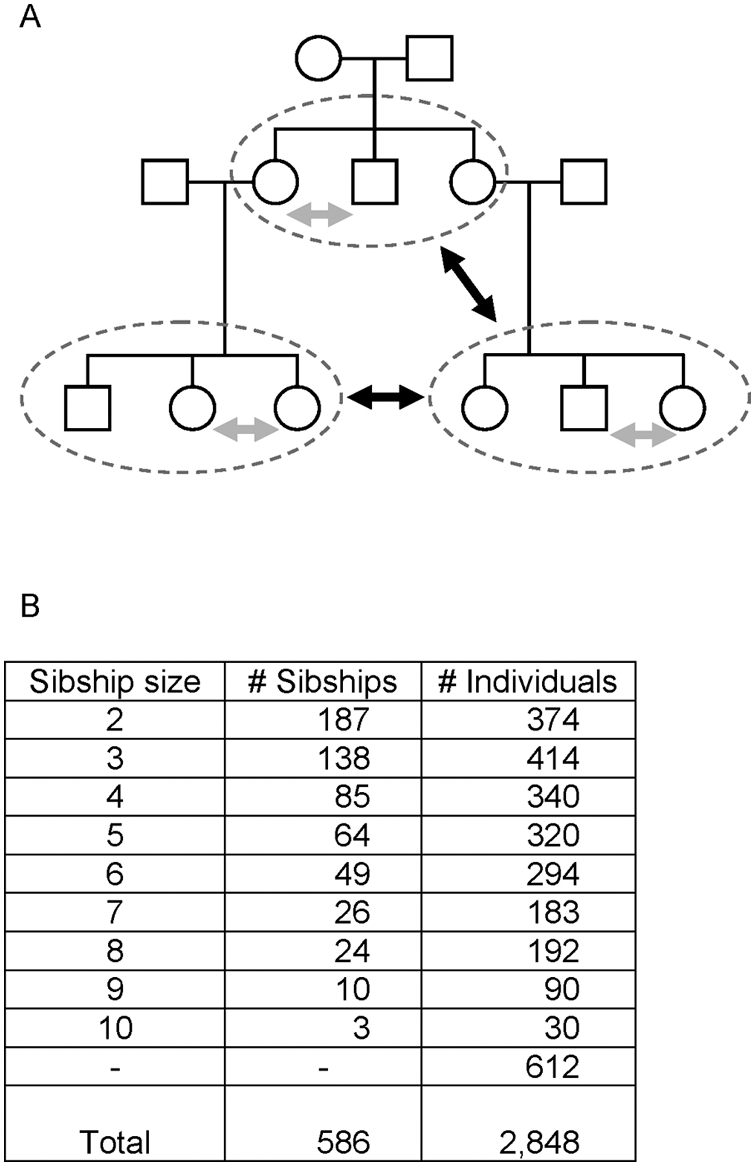
Figure 1
Figure 1. Breaking the extended Kosrae pedigree.
A) The extended Kosrae pedigree is broken into sibships without parents. Parent-child or cousin relationships may exist between different sibships. Tests of association are performed within sibships (gray arrows) and between sibships (black arrows). Individuals without siblings (sibships of size 1) are filtered based on genome-wide IBD sharing to produce a maximal set of individuals with pairwise relationships equivalent to first cousins or less. Panel B shows the number of sibships of each size for n = 2,848 Kosraen individuals genotyped with the Affymetrix 500 k assay.
Figure 2
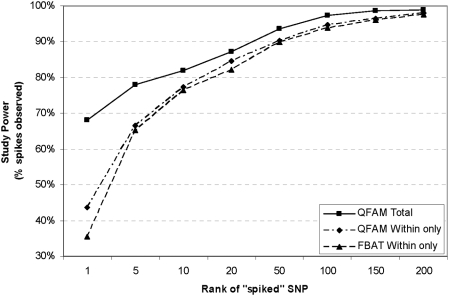
Figure 2. Inclusion of a between-family test of association increases study power using rank as a metric.
A known effect comprising 1% of phenotypic variance explained was “spiked” into a dataset of 770 randomly selected SNPs with MAF≥0.01. Study power was evaluated for within-only (FBAT and PLINK/QFAM-Within) and within- and between-family (PLINK/QFAM-Total) tests of association. Across the 770 spiked datasets generated, study power is measured as the fraction of datasets in which the “spiked” SNP exceeds a particular rank. Ranking first out of 770 SNPs in each dataset approximates a rank of ≤440 in the context of a full genome-wide scan of ∼340,000 markers.
Figure 3
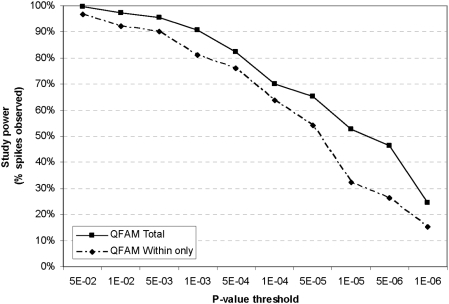
Figure 3. Inclusion of a between-family test of association increases study power using p-value as a metric.
A known effect comprising 2% of phenotypic variance explained was “spiked” into a dataset of 770 randomly selected SNPs with MAF≥0.01. Study power was evaluated for within-only (PLINK/QFAM-Within) and within- and between-family (PLINK/QFAM-Total) tests of association. After calibrating the score distribution to the null using genomic control, study power is measured as the fraction of datasets in which the “spiked” SNP exceeds a particular p-value threshold.
Figure 4
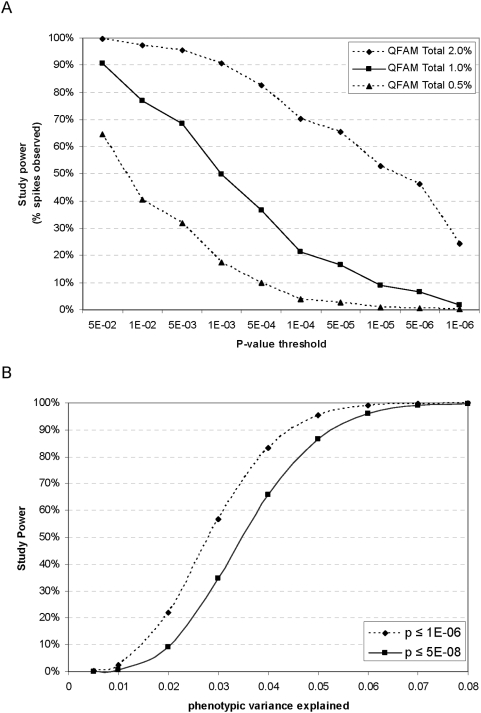
Figure 4. Study power over varying effect sizes.
A known effect explaining 0.5%, 1% or 2% of phenotypic variance was “spiked” into a dataset of 770 randomly selected SNPs with MAF≥0.01. Study power was evaluated using a combined score from within- and between-family tests of association (QFAM-Total) with genomic control. A) Of 770 spiked datasets generated, power is measured as fraction of datasets in which the “spiked” SNP exceeds a particular p-value threshold. These data were used to estimate an effective sample size for Kosrae, from which power estimates for effects explaining up to 8% of phenotypic variance were generated (panel B).
Figure 5
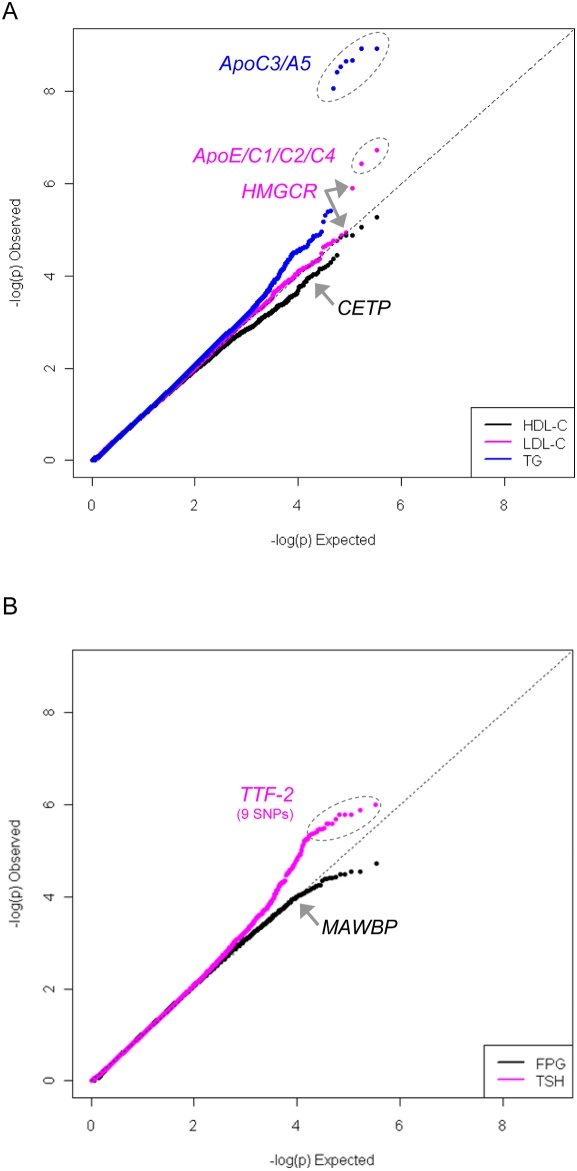
Figure 5. Quantile-quantile plots showing genome-wide association results for five selected quantitative traits.
The extended Kosrae pedigree was broken into sibships. Association for each quantitative trait was evaluated using PLINK/QFAM-Total. Scores were adjusted for inflation due to excess relatedness using genomic control. Panel A highlights SNPs with known association to HDL-C, LDL-C and triglycerides. Panel B shows an excess of association for thyroid stimulating hormone (TSH), while association scores for fasting plasma glucose (FPG) follow the null distribution.

References

    1. Arcos-Burgos M, Muenke M. Genetics of population isolates. Clin Genet. 2002;61:233–247. - PubMed
    1. Heutink P, Oostra BA. Gene finding in genetically isolated populations. Hum Mol Genet. 2002;11:2507–2515. - PubMed
    1. Shifman S, Darvasi A. The value of isolated populations. Nat Genet. 2001;28:309–310. - PubMed
    1. Bonnen PE, Pe'er I, Plenge RM, Salit J, Lowe JK, et al. Evaluating potential for whole-genome studies in Kosrae, an isolated population in Micronesia. Nat Genet. 2006;38:214–217. - PubMed
    1. Jakobsson M, Scholz SW, Scheet P, Gibbs JR, VanLiere JM, et al. Genotype, haplotype and copy-number variation in worldwide human populations. Nature. 2008;451:998–1003. - PubMed

Publication types