


A closer look at amphetamine-induced reverse transport and trafficking of the dopamine and norepinephrine transporters
- PMID: 19199083
- PMCID: PMC2729543
- DOI: 10.1007/s12035-009-8053-4
A closer look at amphetamine-induced reverse transport and trafficking of the dopamine and norepinephrine transporters
Abstract
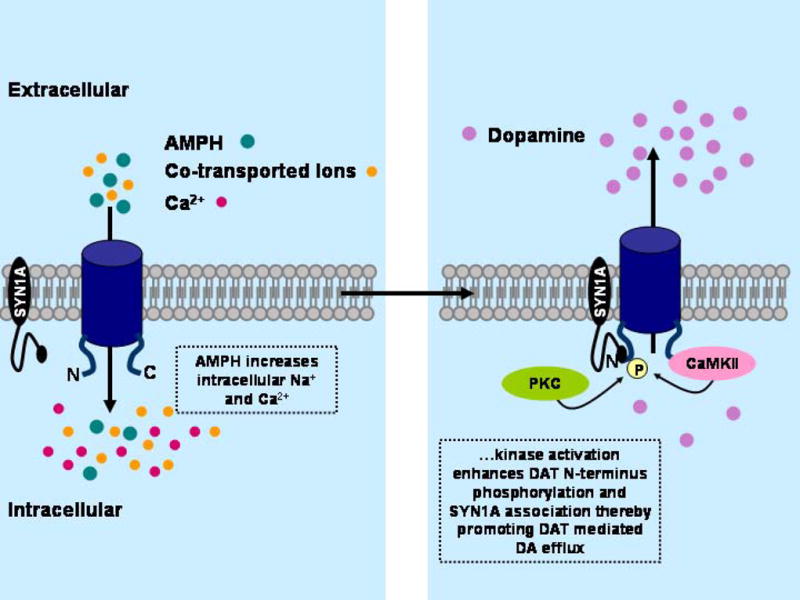
Amphetamine (AMPH) and its derivatives are regularly used in the treatment of a wide array of disorders such as attention-deficit hyperactivity disorder (ADHD), obesity, traumatic brain injury, and narcolepsy (Prog Neurobiol 75:406-433, 2005; J Am Med Assoc 105:2051-2054, 1935; J Am Acad Child Adolesc Psychiatry 41:514-521, 2002; Neuron 43:261-269, 2004; Annu Rev Pharmacol Toxicol 47:681-698, 2007; Drugs Aging 21:67-79, 2004). Despite the important medicinal role for AMPH, it is more widely known for its psychostimulant and addictive properties as a drug of abuse. The primary molecular targets of AMPH are both the vesicular monoamine transporters (VMATs) and plasma membrane monoamine-dopamine (DA), norepinephrine (NE), and serotonin (5-HT)-transporters. The rewarding and addicting properties of AMPH rely on its ability to act as a substrate for these transporters and ultimately increase extracellular levels of monoamines. AMPH achieves this elevation in extracellular levels of neurotransmitter by inducing synaptic vesicle depletion, which increases intracellular monoamine levels, and also by promoting reverse transport (efflux) through plasma membrane monoamine transporters (J Biol Chem 237:2311-2317, 1962; Med Exp Int J Exp Med 6:47-53, 1962; Neuron 19:1271-1283, 1997; J Physiol 144:314-336, 1958; J Neurosci 18:1979-1986, 1998; Science 237:1219-1223, 1987; J Neurosc 15:4102-4108, 1995). This review will focus on two important aspects of AMPH-induced regulation of the plasma membrane monoamine transporters-transporter mediated monoamine efflux and transporter trafficking.
Figures
References
-
- Sulzer D, Sonders MS, Poulsen NW, Galli A. Mechanisms of neurotransmitter release by amphetamines: a review. Prog Neurobiol. 2005;75:406–33. - PubMed
-
- Prinzmetal M, Bloomberg W. Use of benzedrine for the treatment of narcolepsy. J Am Med Assoc. 1935;105:2051–2054.
-
- Olfson M, Marcus SC, Weissman MM, Jensen PS. National trends in the use of psychotropic medications by children. J Am Acad Child Adolesc Psychiatry. 2002;41:514–21. - PubMed
-
- Knutson B, et al. Amphetamine modulates human incentive processing. Neuron. 2004;43:261–9. - PubMed
-
- Fleckenstein AE, Volz TJ, Riddle EL, Gibb JW, Hanson GR. New insights into the mechanism of action of amphetamines. Annu Rev Pharmacol Toxicol. 2007;47:681–98. - PubMed
Publication types
MeSH terms
Substances
Grants and funding
LinkOut - more resources
Full Text Sources
