


Olfactory dysfunction in pure autonomic failure: Implications for the pathogenesis of Lewy body diseases
- PMID: 19201246
- PMCID: PMC4164391
- DOI: 10.1016/j.parkreldis.2008.12.009
Olfactory dysfunction in pure autonomic failure: Implications for the pathogenesis of Lewy body diseases
Abstract
Background: Pure autonomic failure (PAF) and Parkinson disease (PD) both are Lewy body diseases, and both entail substantia nigra dopaminergic, locus ceruleus noradrenergic, and cardiac sympathetic denervation. Multiple system atrophy (MSA) is a non-Lewy body disease in which alpha-synuclein accumulates in glial cells, with central catecholamine deficiency but preserved cardiac sympathetic innervation in most patients. PD is associated with more severe and consistent olfactory dysfunction than in MSA; whether PAF entails olfactory dysfunction has been unknown. In this study we assessed olfactory function in PAF in comparison with the two other synucleinopathies and whether olfactory dysfunction correlates with neuroimaging evidence of cardiac noradrenergic or nigrostriatal dopaminergic denervation.
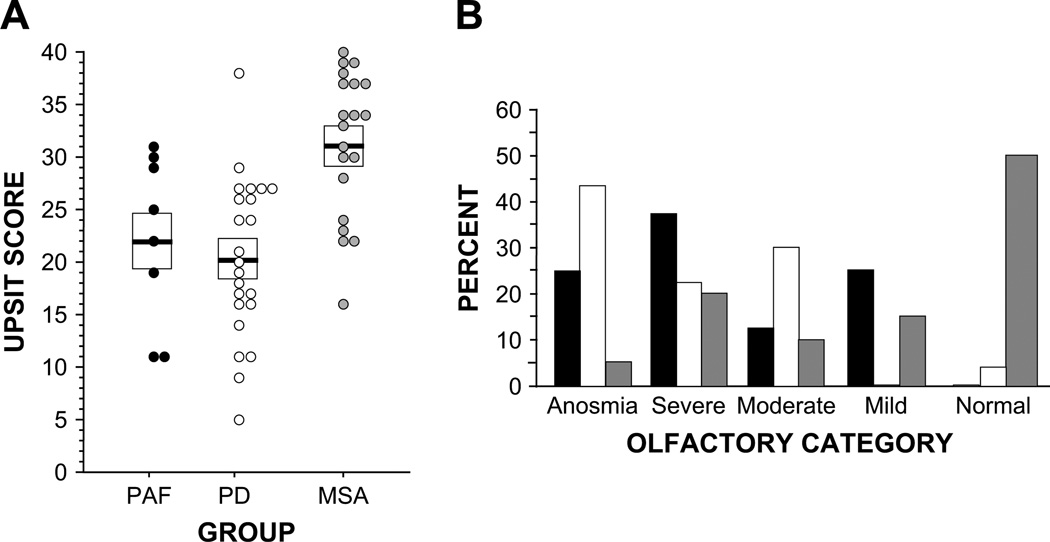
Method: The University of Pennsylvania Smell Identification Test (UPSIT) was administered to 8 patients with PAF, 23 with PD, and 20 with MSA. 6-[(18)F]Fluorodopamine positron emission tomographic (PET) scanning was used to indicate cardiac noradrenergic innervation and the putamen:occipital cortex (PUT:OCC) and substantia nigra (SN):OCC ratios of 6-[(18)F]fluorodopa-derived radioactivity to indicate nigrostriatal dopaminergic innervation.
Results: The PAF group had a low mean UPSIT score (22+/-3), similar to that in PD (20+/-2) and lower than in MSA (31+/-2, p=0.004). Individual UPSIT scores correlated positively with cardiac 6-[(18)F]fluorodopamine-derived radioactivity (r=0.63 in the septum, p<0.0001; r=0.64 in the free wall, p<0.0001) but not with PUT:OCC or SN:OCC ratios of 6-[(18)F]fluorodopa-derived radioactivity.
Discussion: In synucleinopathies, olfactory dysfunction is related to Lewy body pathology and cardiac sympathetic denervation, independently of parkinsonism or striatal dopamine deficiency.
Figures

References
-
- Durrieu G, Senard JM, Rascol O, Tran MA, Lataste X, Rascol A, et al. Blood pressure and plasma catecholamines in never-treated Parkinsonian patients: effect of a selective D1 agonist (CY 208–243) Neurology. 1990;40:707–709. - PubMed
-
- Brooks DJ, Salmon EP, Mathias CJ, Quinn N, Leenders KL, Bannister R, et al. The relationship between locomotor disability, autonomic dysfunction, and the integrity of the striatal dopaminergic system in patients with multiple system atrophy, pure autonomic failure, and Parkinson’s disease, studied with PET. Brain. 1990;113:1539–1552. - PubMed
-
- Hoshi H, Kuwabara H, Leger G, Cumming P, Guttman M, Gjedde A. 6-[18F]fluoro-L-dopa metabolism in living human brain: a comparison of six analytical methods. J Cereb Blood Flow Metab. 1993;13:57–69. - PubMed
-
- Hague K, Lento P, Morgello S, Caro S, Kaufmann H. The distribution of Lewy bodies in pure autonomic failure: autopsy findings and review of the literature. Acta Neuropathol (Berl) 1997;94:192–196. - PubMed
-
- Wakabayashi K, Takahashi H. Neuropathology of autonomic nervous system in Parkinson’s disease. Eur Neurol. 1997;38(Suppl 2):2–7. - PubMed
Publication types
MeSH terms
Substances
Grants and funding
LinkOut - more resources
Full Text Sources
Medical
