


Whole-genome-based phylogeny and divergence of the genus Brucella
- PMID: 19201792
- PMCID: PMC2668414
- DOI: 10.1128/JB.01581-08
Whole-genome-based phylogeny and divergence of the genus Brucella
Abstract
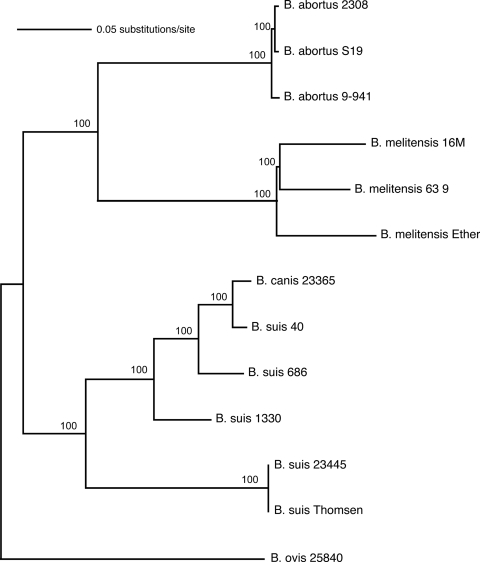
Brucellae are worldwide bacterial pathogens of livestock and wildlife, but phylogenetic reconstructions have been challenging due to limited genetic diversity. We assessed the taxonomic and evolutionary relationships of five Brucella species-Brucella abortus, B. melitensis, B. suis, B. canis, and B. ovis-using whole-genome comparisons. We developed a phylogeny using single nucleotide polymorphisms (SNPs) from 13 genomes and rooted the tree using the closely related soil bacterium and opportunistic human pathogen, Ochrobactrum anthropi. Whole-genome sequencing and a SNP-based approach provided the requisite level of genetic detail to resolve species in the highly conserved brucellae. Comparisons among the Brucella genomes revealed 20,154 orthologous SNPs that were shared in all genomes. Rooting with Ochrobactrum anthropi reveals that the B. ovis lineage is basal to the rest of the Brucella lineage. We found that B. suis is a highly divergent clade with extensive intraspecific genetic diversity. Furthermore, B. suis was determined to be paraphyletic in our analyses, only forming a monophyletic clade when the B. canis genome was included. Using a molecular clock with these data suggests that most Brucella species diverged from their common B. ovis ancestor in the past 86,000 to 296,000 years, which precedes the domestication of their livestock hosts. Detailed knowledge of the Brucella phylogeny will lead to an improved understanding of the ecology, evolutionary history, and host relationships for this genus and can be used for determining appropriate genotyping approaches for rapid detection and diagnostic assays for molecular epidemiological and clinical studies.
Figures
References
-
- Achtman, M., G. Morelli, P. Zhu, T. Wirth, I. Diehl, B. Kusecek, A. J. Vogler, D. M. Wagner, C. J. Allender, W. R. Easterday, V. Chenal-Francisque, P. Worsham, N. R. Thomson, J. Parkhill, L. E. Lindler, E. Carniel, and P. Keim. 2004. Microevolution and history of the plague bacillus, Yersinia pestis. Proc. Natl. Acad. Sci. USA 10117837-17842. - PMC - PubMed
-
- Alland, D., T. S. Whittam, M. B. Murray, M. D. Cave, M. H. Hazbon, K. Dix, M. Kokoris, A. Duesterhoeft, J. A. Eisen, C. M. Fraser, and R. D. Fleischmann. 2003. Modeling bacterial evolution with comparative-genome-based marker systems: application to Mycobacterium tuberculosis evolution and pathogenesis. J. Bacteriol. 1853392-3399. - PMC - PubMed
-
- Brumfield, R. T., P. Beerli, D. A. Nickerson, and S. V. Edwards. 2003. The utility of single nucleotide polymorphisms in inferences of population history. Trends Ecol. Evol. 18249-256.
Publication types
MeSH terms
Substances
LinkOut - more resources
Full Text Sources
Molecular Biology Databases
Miscellaneous
